Intro
Travelling around Japan is an absolute pleasure, and one of the main reasons is the country’s world-class public transport system. Japan’s transport infrastructure is widely considered among the best in the world, making it easy, comfortable, and efficient to explore everything from major cities like Tokyo and Osaka to remote countryside towns and islands.
The country’s public transport, in particular, is second to none. From its fast, safe, and famously punctual trains to its modern, clean, and reliable city metros and subways, travelling around Japan is remarkably stress-free. Even buses and ferries serving rural destinations and smaller islands are typically efficient, well-maintained, and easy to use. It is simply a joy to get around in Japan.
Alongside its excellent public transportation, Japan also offers a wide range of other travel options, including domestic flights, car rentals, taxis, cycling routes, and regional ferry services. Whether you’re planning to travel between cities on the Shinkansen bullet train, navigate urban neighbourhoods by subway, or explore quieter regions at your own pace, there’s a transport option to suit almost every kind of trip and budget.
In this quick-start guide, we’ll take a closer look at how to get around Japan, including trains, metros, buses, flights, taxis, ferries, and more.

Types of Transport
When it comes to transport, Japan has it all. The country excels at making travel quick, relaxing, and stress-free. Japan takes great pride in its exceptional public transport and also offers a wealth of private options, covering almost every mode of travel and preference. Travel in Japan is incredibly well-organised, efficient, reliable, and comprehensive. If there’s somewhere you want to go in Japan, chances are there’s already a smooth and convenient way to get there.
For most visitors, trains and public transport are the easiest and most efficient way to travel around Japan, especially between major cities such as Tokyo, Kyoto, Osaka, and Hiroshima. However, domestic flights, ferries, taxis, rental cars, and bicycles also have their place depending on where you’re travelling and the kind of trip you’re planning.
Here are the main transport types you’ll encounter in Japan.
Railways
We had to start with trains! From high-speed shinkansen ‘bullet trains’ to quaint local services winding through rural towns and coastal scenery, Japan’s rail network is arguably the best in the world and is generally considered the easiest way to get around the country.
The rail network is extensive, connecting Japan’s four main islands and acting as a gateway to almost any area of the country you’d like to explore, from Hokkaido in the north to Kyushu in the south. As well as being comprehensive, it’s also fast, safe, clean, efficient, and enjoyable to use. Japan has many different types of trains, including the shinkansen, limited express, express, rapid, and local services, but they all share these qualities in common.
Japan’s railways are primarily operated by the JR (Japan Railways) Group. The JR Group consists of six regional passenger rail companies: JR Hokkaido, JR Central, JR East, JR West, JR Shikoku, and JR Kyushu. Together, these companies connect the country’s main islands and operate most long-distance intercity rail services, including the shinkansen network. There are also many smaller private railway companies operating regional and city services, particularly in major urban areas such as Tokyo, Osaka, and Nagoya.

The Shinkansen is Japan’s high-speed bullet train network and one of the fastest, easiest ways to travel between major cities. It connects many of Japan’s key destinations, including Tokyo, Nagoya, Kyoto, Osaka, Hiroshima, Hakata, and Kagoshima, while the Hokkaido Shinkansen currently runs as far north as Shin-Hakodate-Hokuto, with an extension to Sapporo planned for the future.
These incredible high-speed trains are operated by JR Group companies and have separate ticket gates and platforms at many major stations. On Japanese trains, you’ll find ordinary seats and Green Car seats, which are the equivalent of first class. There’s also reserved and non-reserved seating, depending on the train and ticket type.
The Japan Rail Pass provides unlimited travel on most of the national JR network, including many Shinkansen bullet train services and selected transport to and from the country’s airports. Whether you’re planning to explore the whole country or travel from Tokyo to Kyoto or Osaka and back again, a JR Pass can offer better value than purchasing individual tickets, although this depends on your itinerary and which trains you plan to use.
The JR Pass is only available to eligible international visitors and is valid for 7, 14, or 21 consecutive days once activated. It covers JR trains, many JR buses, and selected JR ferry services across Japan. It also includes useful extras, such as travel on the Tokyo Monorail between Haneda Airport and central Tokyo, selected JR airport services, JR local buses in some areas, and the JR-operated ferry to Miyajima in Hiroshima.
One of the main benefits of the JR Pass, alongside unlimited travel on covered JR trains and Shinkansen services, is that seat reservations are included at no extra cost. Having a pass also means you can hop on and off covered JR trains as needed without buying a separate ticket each time, which gives you a huge amount of extra flexibility as a traveller. You can also upgrade to a Green Class JR Pass for unlimited travel in Green Car seats on eligible services.

Japan Rail Passes can be bought in advance and exchanged or activated once you arrive in Japan. If you buy through an authorised agent, you’ll usually receive an Exchange Order, which must be exchanged in Japan within three months of issue. Regional JR passes are also available if you’re only visiting one area of Japan, such as Kansai, Kyushu, Hokkaido, or the Tokyo–Nagano–Niigata area.
Finally, you can also purchase individual tickets for single and return journeys from self-service ticket machines, online reservation services, or ticket counters at stations. If you’re only planning on taking the train once or twice during your stay, individual tickets may be better value than a JR Pass. However, if your itinerary includes several long-distance journeys, it’s always worth comparing the total cost of individual tickets against the price of a pass before you travel.
Metros and Subways
Japan’s major cities each have dedicated metro and subway systems, and they are generally the best way to get around Japanese cities. They’re fast, regular, efficient, clean, and especially useful in places such as Tokyo, Osaka, Kyoto, Nagoya, Fukuoka, and Sapporo.
They can also be a very affordable option when paired with an IC card. These are prepaid contactless smartcards, similar to London’s Oyster card, which can be used across much of Japan’s public transport network, including metros, subways, local trains, buses, and even some ferries. IC cards can also be used at many convenience stores, vending machines, station lockers, and some taxis.

IC cards are one of the easiest ways to get around Japanese cities thanks to the speed, cleanliness, and frequency of the country’s public transport. As such, you’ll definitely want to use a prepaid travel card such as ICOCA, PASMO, or Suica where available. Tourist-friendly options such as Welcome Suica may also be available for short-term visitors. Mobile versions of Suica and PASMO can be especially convenient if your phone supports them.
IC cards like these can be topped up as needed and work by tapping them on the card reader as you pass through the ticket gates. It’s also worth noting that metro and subway systems do not run 24/7 in Japan. In Tokyo, for example, trains generally run from around 5am until around midnight, although exact times vary by line and station, so be sure to check the last train if you’re out late at night.
Buses
Japan’s buses, like all of the country’s public transport, are clean, efficient, and reliable. The two main types to be aware of are local buses and highway buses. Local buses cover the entire country and can be a particularly helpful way of reaching more off-the-beaten-path destinations that may not have direct train access, including smaller towns, mountain regions, countryside attractions, and rural villages.

While travelling on local buses in major cities, you’ll usually be able to pay using an IC card like those mentioned in the section above about metros and subways. However, in more rural areas, payment systems can vary slightly depending on the region and bus company. On many local buses, you’ll board through the centre or rear door and take a numbered ticket when you get on. Before you get off at the front of the bus, you’ll need to pay the fare using the machine next to the driver. Some rural buses may still only accept cash, so it’s important to carry Japanese yen with you while travelling in Japan, especially outside the major cities.
Highway buses travel between cities as well as to and from major landmarks, airports, and tourist attractions. While typically slower than taking the train or Shinkansen, buses can also be an excellent budget option if you’re not in a hurry, especially for long-distance and overnight journeys between cities such as Tokyo, Osaka, Kyoto, Nagoya, and Hiroshima.
Many overnight buses are designed for comfort and usually include reclining seats, onboard toilets, charging ports, blankets, curtains for privacy, and luggage storage. Travelling overnight can also help save the cost of a hotel stay. Premium coaches with extra legroom and more luxurious seating are available at a higher price, making long journeys significantly more comfortable.
Japan’s major highway bus operators include companies such as Willer Express and Japan Bus Lines. Reservations for long-distance buses can usually be made online in advance, which is recommended during busy travel periods and holiday seasons.
Ferries
As you might expect from an archipelago consisting of more than 14,000 islands, there are some destinations in Japan that require a ferry or boat crossing. Japan’s four main islands — Hokkaido, Honshu, Shikoku, and Kyushu — are linked by bridges and tunnels, but ferries and car ferries remain extremely useful for reaching smaller islands and some of the subtropical islands in the south, including Okinawa and the remote islands of Kagoshima Prefecture.

For example, long-distance ferries operate between Kagoshima and Okinawa, while shorter ferry routes connect popular destinations such as Miyajima near Hiroshima, Naoshima in the Seto Inland Sea, and islands across Okinawa Prefecture. In many cases, ferries are not just a scenic option, but an essential part of travelling around Japan.
Ferries can also be an enjoyable, slower-paced way to explore Japan’s stunning coastlines from the vantage point of the sea. Some long-distance routes offer overnight cabins, restaurants, public baths, and observation decks, turning the journey itself into part of the travel experience. There are also sightseeing ferries, short crossings to landmarks and attractions, boat rides across Japan’s lakes and bays, and cruise ships operating from coastal cities such as Tokyo, Yokohama, and Kobe.
While ferries are typically slower than trains or domestic flights, they can be a relaxing and memorable way to experience a different side of Japan, especially in coastal and island regions.
Flights
Domestic flights are one of the fastest ways to cover long distances in Japan, especially when travelling to destinations such as Hokkaido or Okinawa. Japan has around 100 airports across the country, including major international airports such as Narita Airport and Haneda Airport in Tokyo, Kansai International Airport near Osaka, and Chubu Centrair International Airport near Nagoya.
Many airports are directly connected to city centres by efficient public transport, including express train services such as the Narita Express into Tokyo and the Haruka Express linking Kansai Airport with Osaka and Kyoto. The JR Pass includes travel on some of these airport rail services, including the Narita Express and the Haruka.

Within Japan, the two main full-service airlines are Japan Airlines (JAL) and All Nippon Airways (ANA). Both offer special domestic discount fares for eligible international visitors, which can make flying surprisingly affordable for longer journeys.
Alongside these, there are a number of low-cost carriers, including Peach Aviation, Jetstar Japan, and Spring Japan, as well as regional airlines connecting smaller local airports across the country.
For destinations that are very far apart, such as Tokyo to Sapporo or Okinawa, flying can often save a significant amount of travel time compared to trains or buses. However, for routes such as Tokyo to Kyoto or Osaka, the Shinkansen is usually more convenient once airport transfers and security procedures are taken into account.
As with flights anywhere in the world, it’s generally best to book domestic flights as far in advance as possible for the best prices. It’s also worth being aware of peak travel periods in Japan, such as New Year, Golden Week (late April to early May), and Obon (mid-August), when flights and airports can become extremely busy.
Taxi
Like all transport in Japan, the country’s taxis are clean, safe, and reliable. While not the cheapest option on this list, they do have their uses in certain situations. For example, if you miss the last metro or subway back to your accommodation late at night, are travelling with large luggage, or are trying to reach a hotel, restaurant, or address that’s difficult to find on foot.
Japanese taxi drivers are known for their professionalism, and taxis are generally easy to spot thanks to their illuminated roof signs and automatic rear doors, which open and close automatically for passengers.

It’s worth noting that while many taxis in major cities now accept credit cards, IC cards, and contactless payments, some smaller operators may still prefer cash. As such, it’s always advisable to carry some Japanese yen while travelling around Japan.
Alongside traditional taxis, ride-hailing and taxi-hailing services are also available in many parts of Japan through apps such as GO (formerly JapanTaxi), Uber, DiDi, and S.RIDE. In most cases, Uber in Japan connects users with licensed local taxi companies rather than private drivers.
Car
While Japan’s public transport is hard to beat, renting a car does have its benefits. It can be particularly appealing if you’re travelling with young children, elderly relatives, or lots of luggage. A rental car can also give you the flexibility to explore more remote, off-the-beaten-path destinations at your own pace, particularly in rural areas such as Hokkaido, the Japanese Alps, Kyushu, and parts of Okinawa.
Japan’s roads are very well maintained, and Japanese motorists are generally known for their respectful and sensible driving. Although public transport covers the vast majority of the country, some countryside attractions, mountain areas, and coastal regions are easier to access by car.
If you want to rent a car and drive in Japan, you’ll usually need an International Driving Permit (IDP) before you travel. This is a legal requirement for many visitors and must typically be obtained in your home country before arrival in Japan. Requirements can vary slightly depending on your nationality, so it’s always worth checking the latest official guidance before your trip.

Motorists drive on the left in Japan, which is the same as the UK but the opposite of the US and much of mainland Europe, so it’s important to keep this in mind before setting off. Japan’s four main islands are connected by an extensive expressway network stretching more than 10,000km, with many road signs written in both Japanese and English.
Be mindful of speed limits and toll roads, as many expressways require payment. If you’re hiring a car, you may be able to rent an ETC (Electronic Toll Collection) card from the rental company, allowing you to pass through toll gates more easily. Some rental companies also offer expressway passes designed specifically for overseas visitors.
Bikes
Cycling in Japan is a popular activity and a fantastic way to explore both cities and rural areas. In Japan, one of the most common styles of bicycle is the mamachari, or ‘mom’s bicycle’, a practical everyday bike typically featuring a basket, upright seating position, kickstand, and sometimes a child seat. You’ll see them everywhere, from quiet residential streets to busy city neighbourhoods.
Many other types of bikes are available too, including electric bikes, road bikes, and mountain bikes for outdoor adventures and longer-distance cycling.
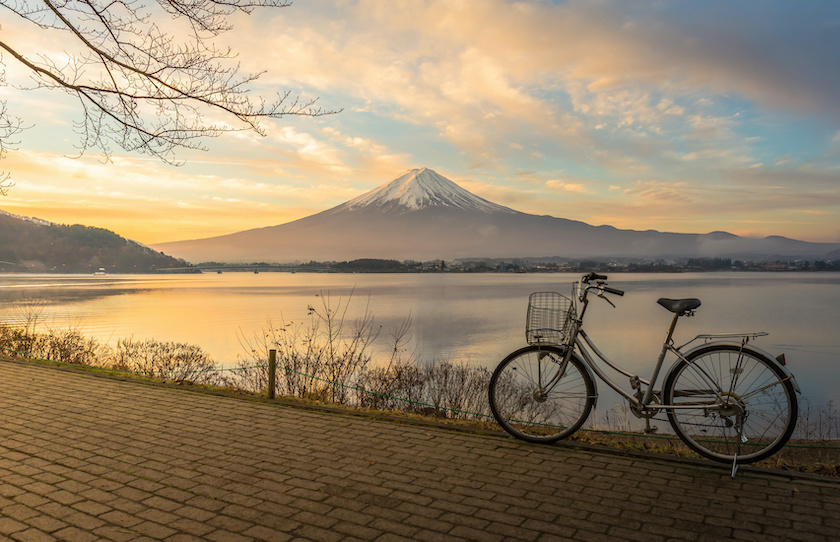
Japan is a bike-friendly country with designated cycle lanes, bicycle parking areas, and rental shops across much of the country, especially near train stations and shopping districts. Bikes can be used for short city journeys as well as for exploring more rural landscapes, coastlines, and countryside routes at a slower pace.
The country is also home to several famous cycling routes, including the Shimanami Kaido, an approximately 70km route connecting Honshu and Shikoku via a series of bridges and islands across the Seto Inland Sea. The route is known for its spectacular coastal scenery, excellent cycling infrastructure, and convenient bike rental facilities along the way.
Cities such as Kyoto are also popular for cycling thanks to their relatively flat streets and easy-to-navigate layouts. Exploring temples, local cafés, residential neighbourhoods, and riverside paths by bike can be one of the most enjoyable ways to experience the city.
While cycling is mainly used for shorter journeys and leisure activities, it’s also a beautiful way to experience Japan’s national parks, countryside, coastlines, and smaller towns first-hand. For longer distances, Japan’s rail network and public transport system make it easy to combine cycling with train travel as part of the experience.
Other
You’ll also find a number of alternative and lesser-known forms of transport in Japan. These include the previously mentioned Tokyo Monorail, which connects Haneda Airport with central Tokyo and is covered by the JR Pass, as well as monorail systems in cities such as Osaka and Chiba.
Japan is also home to scenic ropeways and cable cars, particularly in mountainous and volcanic regions. Examples include the Hakone Ropeway, which offers dramatic views of volcanic landscapes and, on clear days, Mount Fuji.
Trams, also known as streetcars, still operate in several Japanese cities and can be a charming, nostalgic way to get around. Hiroshima has Japan’s largest tram network, while cities such as Nagasaki, Kagoshima, and Hakodate also continue to operate historic tram systems.
You’ll even find unique transport experiences in certain parts of the country, from sightseeing boats and river cruises to retro local railways and mountain funiculars climbing steep hillsides. Japan’s transport network is not only efficient — it’s also part of the travel experience itself.

Luggage Services in Japan
If you’re planning to travel to more than one destination during your stay in Japan, it’s well worth considering the country’s luggage storage and forwarding services. Japan’s excellent public transport makes it easy to travel from city to city and explore more remote destinations off the beaten path, but navigating busy train stations with large suitcases can quickly become tiring, especially during peak travel times.
For that reason, we always recommend travelling as light as possible. If it’s impossible to avoid bringing large or oversized luggage with you, then Japan’s luggage forwarding services can be a real game-changer. Commonly known as Takkyubin or Takuhaibin, these reliable and efficient services can send your suitcases directly to your next hotel or destination within Japan, often with next-day delivery depending on the route and drop-off time.
This allows you to travel footloose and baggage-free while exploring cities, taking the Shinkansen, or visiting places with lots of stairs, smaller trains, or limited luggage space. Major providers such as Yamato Transport and Sagawa Express are widely available across Japan, including at airports, hotels, convenience stores, and train stations.
It’s also worth noting that oversized luggage rules now apply on certain Shinkansen routes, particularly on the Tokaido, Sanyo, and Kyushu Shinkansen lines. Travellers carrying very large suitcases may need to reserve designated oversized baggage seats in advance, making luggage forwarding services even more useful for longer trips.
Alongside forwarding services, Japan also has excellent luggage storage options. Coin lockers are available at many train stations, while apps such as Ecbo Cloak can help you find and reserve luggage storage spaces at shops, cafés, and hotels in major cities.
Useful Links
Planning a trip to Japan is much easier when everything you need is in one place. Alongside this transport guide, JapanDen brings together practical travel advice, destination inspiration, hotel options, Pocket WiFi guidance, and a traveller community to help you plan with more confidence.
For the perfect place to stay, visit our Hotels page and choose from more than 2,800 hotels and 1,800 traditional ryokans.
Want to use Google Translate, follow live train updates on Google Maps, post photos, or keep in touch with home while travelling? A Pocket WiFi device, such as those from Ninja WiFi, can make this much easier, especially if you’re travelling with others and want to share one connection. Our Pocket WiFi guide has everything you need to know.
And finally, if you’re planning to explore Japan by rail, be sure to visit JRPass.com. From nationwide and regional rail passes to Shinkansen tickets, travel guides, and essential trip planning information, it’s designed to help international travellers experience Japan’s world-class rail network with confidence.