Bicycles in Japan: Get Around Japan by Bike (Ultimate guide)

Ride smart, roam freely
If you've been Googling bicycles in Japan, here's the reality: Japan is essentially a love letter to "last-mile" cycling. People ride to the station, the store, the café, and the park as if it were the most natural accessory in the world. And what about the travelers? Bike riding can change "we'll just walk there" right into "we just found our favorite backstreet shrine, three indie bakeries, and a riverside path with zero stress."
This guide covers what to expect from cycling culture, the most common bike types you'll see, how to rent a bike in Japan, realistic cost ranges (renting and buying), and the practical stuff: how to park a bicycle in Japan, whether you can ride on the sidewalk in Japan, and the big one, can I take a bicycle on the train in Japan (spoiler: yes, but it needs a "fashion accessory," aka a bike bag).
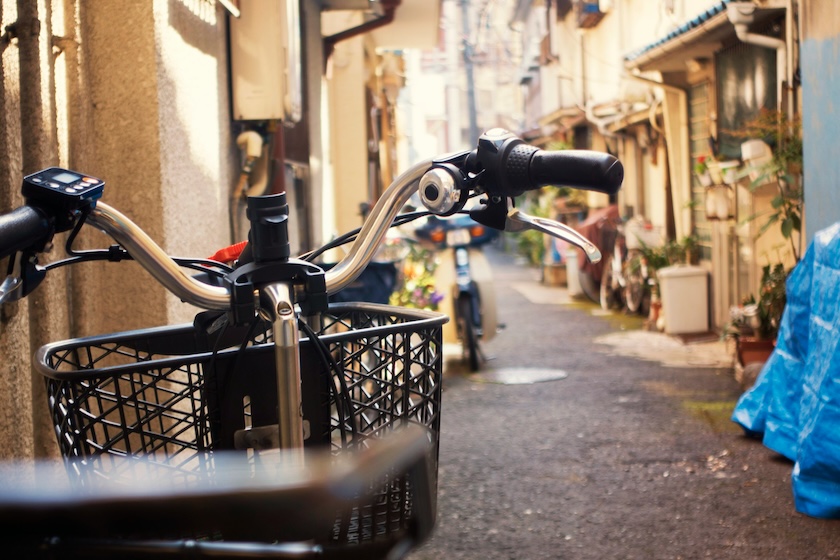
In Japan, cycling is everyday transport, not a sport. People use bikes for short trips, to the station, the shop, or work, often in normal clothes and at a relaxed pace. As a traveler, you’ll feel surprisingly normal on a bicycle very quickly. In places like Tokyo, Kyoto, and Osaka, bikes are everywhere, which means two things:
You'll feel normal riding a bicycle quickly.
You'll need to be more aware of where you ride and park.
Cycling in rural locations may be idyllic because of quiet roads, river trails, rice fields, and a "why don't I live here?" vibe. In large cities, it's more "cute chaos": tiny streets, a lot of pedestrians, and strict parking regulations.
Bicycles are also treated as vehicles in Japan (more on rules below), so imagine yourself as a small, stylish car.
Why it matters in Japan: Due to the widespread use of motorcycles, Japan has explicit (and well enforced) regulations on parking and riding locations. Large cities like Tokyo, Kyoto, and Osaka have limited space, plenty of pedestrians, and stringent parking regulations. Cycling in rural places is serene and picturesque, with riverbank trails and calm roads.
When use a bike while traveling in Japan:
Leaving your hotel and deciding whether to ride on the road or walk the bike
Parking near train stations, shops, or temples
Navigating busy sidewalks in tourist areas
Combining cycling with trains or buses
Exploring neighborhoods where cars, bikes, and pedestrians all coexist
Once you understand that cycling in Japan is about blending in, not standing out, everything gets easier. You stop overthinking, start flowing with the city, and suddenly Japan feels smaller, smoother, and far more personal.
City |
Shop |
Location |
Tokyo |
Yanesen area (near Nippori/Sendagi) |
|
Tokyo |
Near Tawaramachi Station (Taito) |
|
Tokyo |
Tama River area (Tokyo) |
|
Kyoto |
Central Kyoto (tourist-friendly rentals) |
|
Kyoto |
Kyoto city rental shop |
|
Kyoto |
Kyoto (e-bike/eco-focused options) |
|
Osaka |
Grand Front Osaka (Umeda area) |
|
Osaka |
Multiple ports across Osaka |
|
Osaka |
Osaka shop (sports/touring bikes) |
|
Hiroshima |
Ports across Hiroshima city |
|
Hiroshima |
Cycle terminals (Onomichi area) |
|
Hiroshima |
Sport bike rentals via GIANT stores |
|
Sapporo |
Ports across Sapporo (seasonal) |
|
Sapporo |
Sapporo (road bike-focused) |
|
Fukuoka |
Ports incl. Canal City Hakata area |
|
Fukuoka |
Shikanoshima (coastal rides) |
|
Nara |
Asuka area (historic countryside routes) |
|
Nara |
Near Horyu-ji area (Nara Pref.) |
If you're staying for several weeks or months, buying a bicycle can sometimes be more economical than renting one long term.
New bicycles
Basic city bikes (mamachari): typically ¥20,000–¥40,000 (approximately $125–$250 USD or £90–£185 GBP), depending on the retailer and features.
Entry-level cross bikes and hybrids: often ¥40,000–¥80,000+
Electric-assist bicycles: commonly ¥80,000–¥180,000+
Used bicycles
Budget second-hand bikes: often ¥5,000–¥15,000
Better-quality used bikes: commonly ¥15,000–¥25,000+, depending on age, condition, and brand
Electric-assist and sports bikes cost significantly more, so they are usually best suited to longer stays or frequent riders.
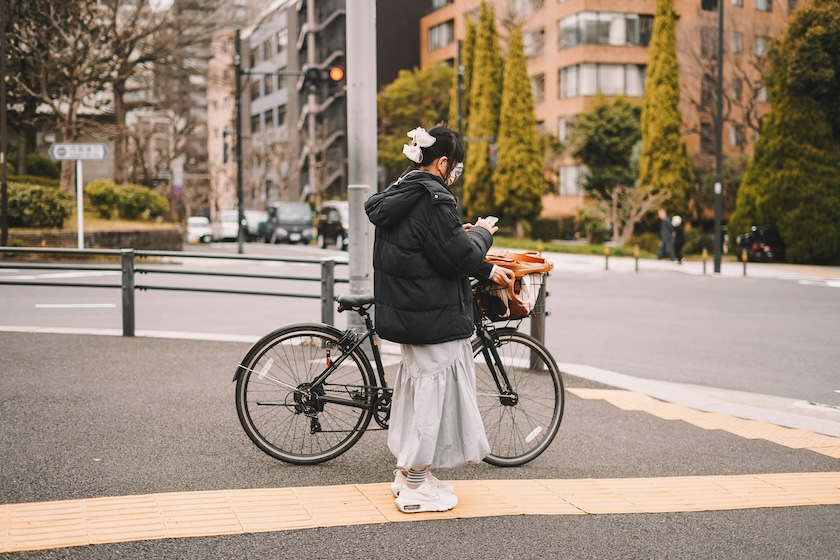
Renting is often the easiest option for visitors.
You can typically find bicycles:
Near major train stations
Around popular tourist districts
At local bicycle rental shops
Through bike-share systems in many major cities
Many cities now have app-based bike sharing, allowing you to unlock and return bikes at different locations throughout the city.
Requirements vary by provider, but you may need:
A passport or photo ID for traditional rental shops
A smartphone for app-based rentals
A payment card for registration and rental fees
For bike-share systems, one of the most widely used services is LUUP, which operates in Tokyo, Osaka, Kyoto, Yokohama, Utsunomiya, Kobe, Nagoya, Hiroshima, Sendai, Fukuoka, Kitakyushu and Hamamatsu. After downloading the app, you'll create an account, add a payment method, reserve a bicycle, and unlock it using your phone.
Before setting off, take a minute to check:
Adjust the seat height for comfortable pedaling
Test the brakes
Confirm the front and rear lights work
Check that the lock is included and functioning
Verify the return location and rental rules
Make sure the basket is secure if you plan to carry bags
For electric bicycles, check the battery charge level
A quick inspection can save a surprising amount of trouble later in the day.
Cycling in Japan is easy, safe, and enjoyable, but it comes with a few local rules that first-time visitors often don't expect. Understanding how bikes fit into daily life will help you avoid fines, confusion, and awkward moments.
One of the biggest surprises for travelers is that bicycles cannot simply be left anywhere.
What happens:
You stop for coffee or sightseeing.
You leave the bike outside for "just a few minutes."
What can go wrong:
The bike is removed and taken to a municipal impound lot.
You may need to pay a fee to retrieve it.
What works:
Use clearly marked bicycle parking areas.
Lock the bike properly.
Follow local signs, even for short stops.
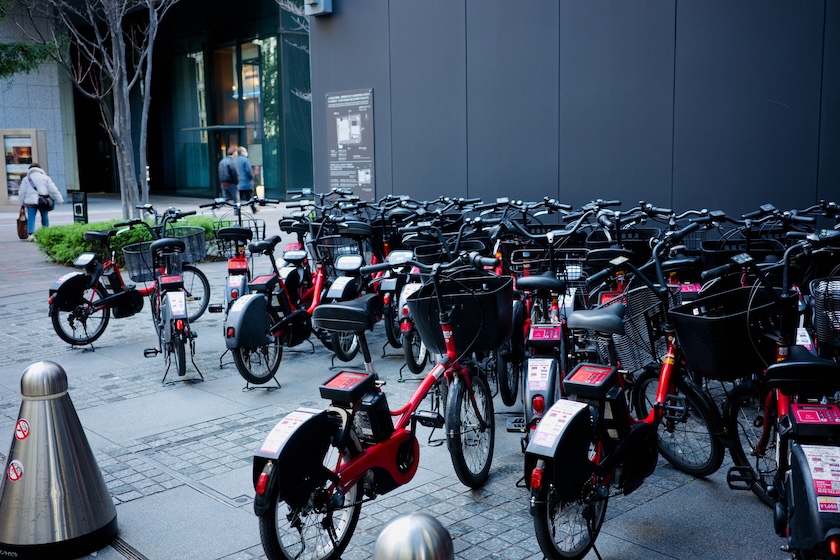
Cities like Tokyo, Osaka, and Kyoto have large numbers of cyclists, pedestrians, and vehicles sharing limited space.
What works best:
Ride predictably.
Slow down around pedestrians.
Follow traffic signals.
Stay aware of your surroundings.
The goal is to move with the flow rather than through it.
Bicycles are a fantastic way to reach sightseeing spots, but parking rules still apply.
What works:
Look for designated bicycle parking.
Lock your bike before exploring.
Allow a few extra minutes to walk from the parking area.
Yes, but not as a normal uncovered bicycle. On most trains in Japan, including JR lines, private railways, and many subway systems, bicycles must be folded or partially dismantled and fully packed inside a dedicated bicycle bag, often called a rinkō bag.
For most visitors, this means you should not plan to roll a rental bike straight onto a train. If you are using a city bike-share or hotel rental, return it before boarding and rent another bike at your next destination.
If you are travelling with your own bicycle, the usual rule is:
Standard bicycles must be dismantled and placed in a dedicated bike bag.
Folding bicycles must be folded and placed inside a proper carrying bag.
No parts of the bike should stick out of the bag.
Size and weight limits may apply, often around 250 cm total dimensions and 30 kg.
Staff may refuse bikes that are unsafe, too bulky, or likely to inconvenience other passengers.
Some special sightseeing or cycling trains allow bikes onboard without packing, but these are exceptions and usually operate only on specific routes or dates. For most city travel, the easiest option is to cycle within one area, return the rental bike, then take the train normally.
Japan is generally bicycle-friendly, but the experience changes depending on where and when you ride. Below are the best Cities for Cycling:
Great for neighborhood exploration, riverside routes, and local discovery.
Challenges:
Strict parking enforcement
Busy streets
Complex road layouts
One of Japan's most popular cycling destinations.
Why cyclists love it:
Flat terrain
Compact city center
Easy access to temples and gardens
Practical, bike-friendly, and relatively easy to navigate.
Many travelers find these the most enjoyable places to cycle.
Benefits:
Less traffic
Easier parking
Scenic routes
Slower pace
Comfortable temperatures and cherry blossoms make this one of the best cycling seasons.
Cool weather and colorful foliage create excellent riding conditions.
Possible, but hot and humid.
Comfortable in many major cities but weather conditions vary significantly across Japan.
Cycling works particularly well for:
First-time visitors
Slow travelers
Solo travelers
Couples
Budget-conscious travelers
Travelers who enjoy exploring neighborhoods beyond major attractions
It may be less suitable for:
Travelers with mobility challenges
Families with very young children
Visitors planning extremely short trips focused only on major sights
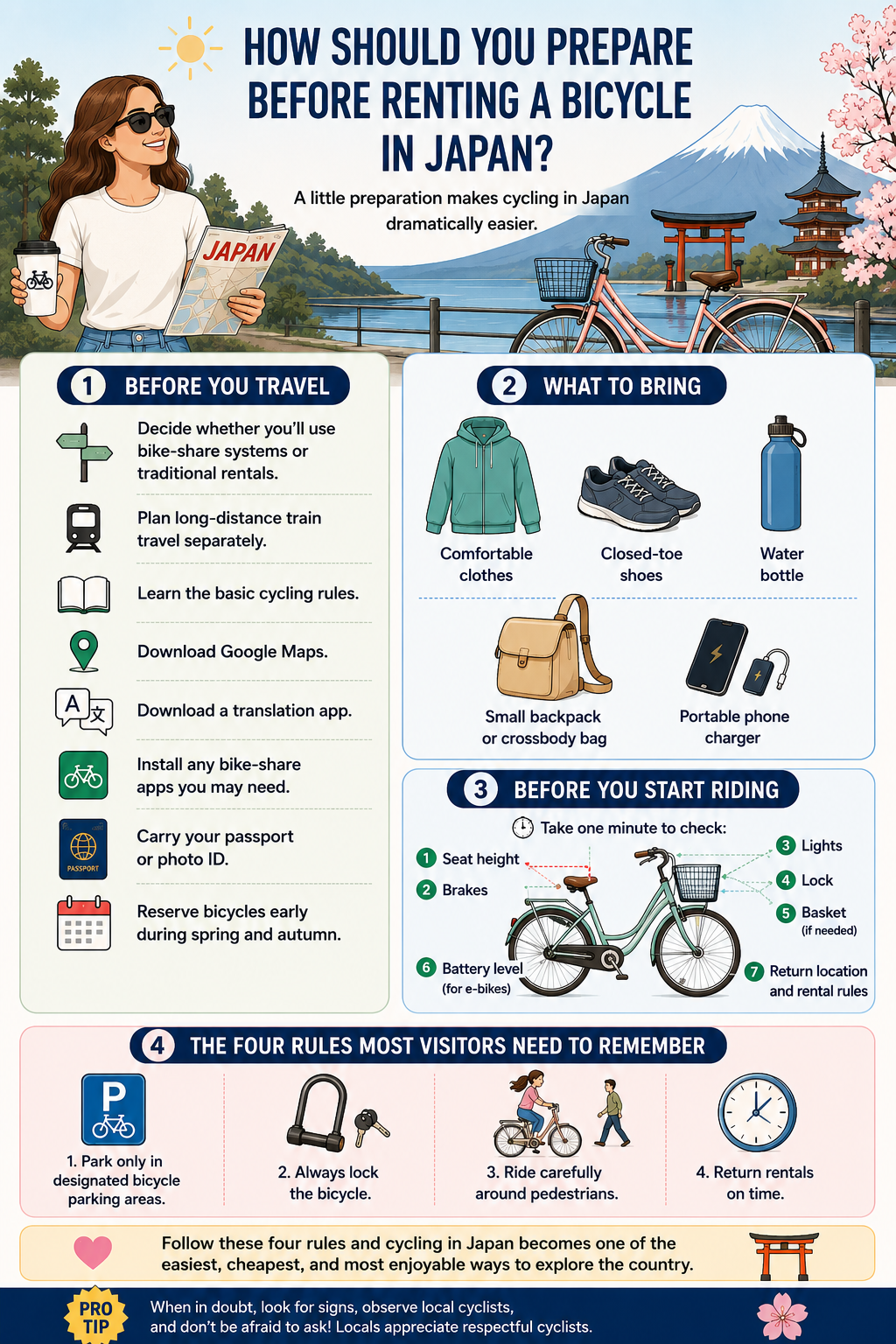
A little preparation makes cycling in Japan dramatically easier.
Decide whether you'll use bike-share systems or traditional rentals.
Plan long-distance train travel separately.
Learn the basic cycling rules.
Download Google Maps.
Download a translation app.
Install any bike-share apps you may need.
Carry your passport or photo ID.
Reserve bicycles early during spring and autumn.
Comfortable clothes
Closed-toe shoes
Water bottle
Small backpack or crossbody bag
Portable phone charger
Take one minute to check:
Seat height
Brakes
Lights
Lock
Basket (if needed)
Battery level (for e-bikes)
Return location and rental rules
Park only in designated bicycle parking areas.
Always lock the bicycle.
Ride carefully around pedestrians.
Return rentals on time.
Follow those four rules and cycling in Japan becomes one of the easiest, cheapest, and most enjoyable ways to explore the country.
This is the “cheat sheet” section you will likely screenshot.
Ride calmly and predictably
Keep left on the road when cycling
Slow down and yield to pedestrians
Use designated bicycle parking
Lock your bike every time
Turn lights on after dark
Follow traffic signals
Don’t park “just for a minute” anywhere
Don’t ride fast on sidewalks
Don’t ignore signs or markings
Don’t use your phone while cycling
Don’t block walkways or shop entrances
Don’t drink and ride
Mistakes happen, Japan is forgiving if you’re polite.
Say a quick “sumimasen” (sorry/excuse me)
Ask staff or locals for help
Follow signs, apps, or information desks to correct course
Cycling in Japan works best when it’s part of a well-planned trip, not something you figure out at the last minute.
Start by booking accommodation via JapanDen in bike-friendly neighborhoods or near major stations, so cycling feels convenient rather than forced.
For moving between cities, sort out your long-distance travel first with a JR Pass or the right Regional Pass, then use bicycles mostly for local exploration once you arrive.
To make navigation effortless, book Pocket Wi-Fi (or add a SIM at pass checkout) so you can use maps, bike-share apps, and translations without stress. If you’re arriving after a long flight or want an easy first day, a Meet & Greet can help you settle in smoothly before you start exploring on two wheels.
And soon, you’ll be able to take this even further with JapanDen Tours, where cycling fits naturally into curated local experiences.
Plan the big pieces first. Add cycling where it makes sense. Japan flows better that way.
Q: Is cycling a good way to get around Japan?
A: Yes. Cycling is one of the best ways to explore neighborhoods, parks, riversides, and smaller towns. It allows you to see places that many visitors miss while avoiding crowded trains for short journeys.
Q: Do I really need to learn Japan's cycling rules?
A: Yes, especially in larger cities such as Tokyo, Osaka, and Kyoto. Most visitors have no problems, but understanding basic rules about parking, road use, and pedestrian priority will make your ride much smoother.
Q: Can tourists rent bicycles in Japan?
A: Absolutely. Many cities offer traditional bike rentals, hotel rentals, and bike-share systems. Most require a passport or photo ID, while app-based services usually require a smartphone and payment card.
Q: Can you ride a bicycle on the sidewalk in Japan?
A: In principle, bicycles are considered vehicles and should use the road. However, some sidewalks are specifically designated for shared bicycle and pedestrian use. Whenever you ride on a sidewalk, pedestrians always have priority.
Q: How do I park a bicycle in Japan safely?
A: Use designated bicycle parking areas whenever possible. Parking in prohibited locations, even for a short time, can result in your bicycle being removed and taken to a storage facility.
Q: What happens if my bicycle is impounded?
A: If a bicycle is removed for illegal parking, you will usually need to visit the designated impound facility, show identification, and pay a retrieval fee before collecting it.
Q: Can I take a bicycle on trains in Japan?
A: Usually yes, but only if it is folded or partially dismantled and completely enclosed in a bicycle bag known as a rinkō bag. Standard rental bicycles are generally not allowed on trains in normal riding condition.
Q: Are helmets required when cycling in Japan?
A: Japan strongly encourages cyclists to wear helmets, and many locals do. While adult helmet use is not universally mandatory nationwide, wearing one is highly recommended for safety.
Q: Is cycling in Tokyo safe?
A: Generally yes. Tokyo has a large cycling culture and many people use bicycles for daily transportation. The key is riding predictably, following signs, respecting pedestrians, and staying aware of traffic.
Q: Should I use a bike-share system or a traditional rental bike?
A: It depends on your plans. Bike-share systems are ideal for short trips around a city, while traditional rentals are usually better for full-day sightseeing, countryside rides, or longer routes.
Why should I book with JapanDen?
How do I book a hotel or ryokan through JapanDen?
What types of accommodations do you offer in Japan?
How can JapanDen help with planning my trip?
As well as booking accommodation, JapanDen is a place to learn more about Japan and how you can make the most of your time in this special country. From in-depth region guides to stories from Japan, we’ll be regularly publishing carefully curated insights from Japanese culture, with recommendations for the best activities and attractions and the latest news. Looking forward, we’ll also be adding special community features so you can share ideas and inspiration with like-minded people. Please come back and visit us regularly as we continue to add new content. We want JapanDen to be your home away from home too.
Do you offer guided tours in Japan, and how can I book one?
As part of the JRPass.com group, we offer a dedicated Meet and Greet service with expert personal assistance on your arrival in Japan booked via JRPass.com, alongside nationwide and regional rail passes for travel. As JapanDen grows, we will be offering more services and activities to provide a complete Japan travel experience.
Can I purchase Japan Rail Passes through your website?
JapanDen is part of the JRPass.com group, book your passes and tickets directly on JRPass.com