Japan’s football culture rewards travellers who go looking for it. The J.League is one of the best-run, most accessible top-flight leagues in the world for visiting fans, affordable tickets, excellent stadium food, passionate but welcoming crowds, and grounds that range from cavernous former World Cup venues to stadiums so small you could fit the entire crowd into a single Tokyo subway carriage.
This bucket list covers seven stadiums and experiences across Japan, from the 63,700-seat home of Asia’s most popular club to a tiny pitch on the lower slopes of Mount Fuji.
1. Saitama Stadium 2002: The Wembley of Japan
Urawa Red Diamonds | Midori-ku, Saitama City | Capacity: 63,700 (62,300 for J.League games)
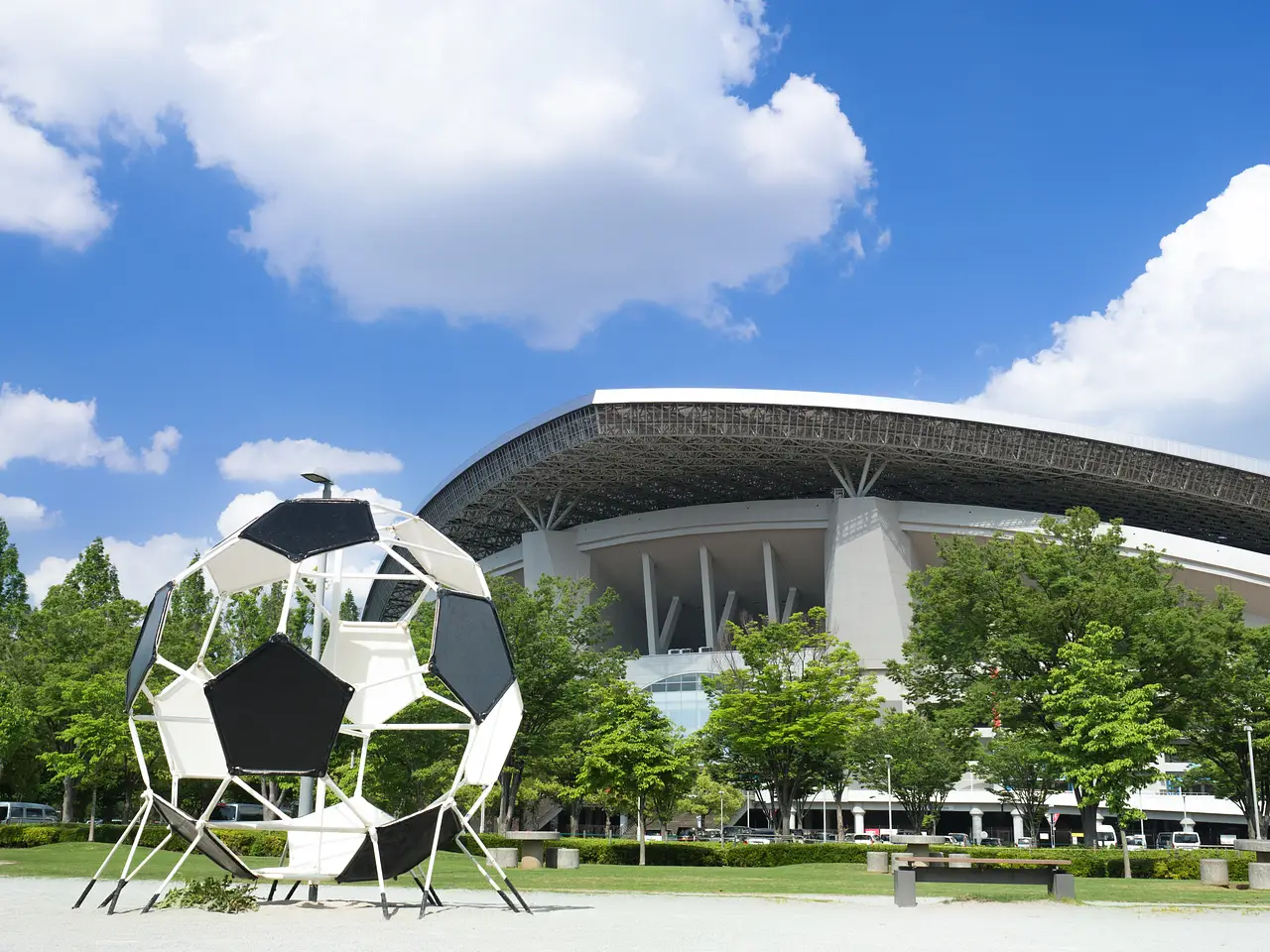
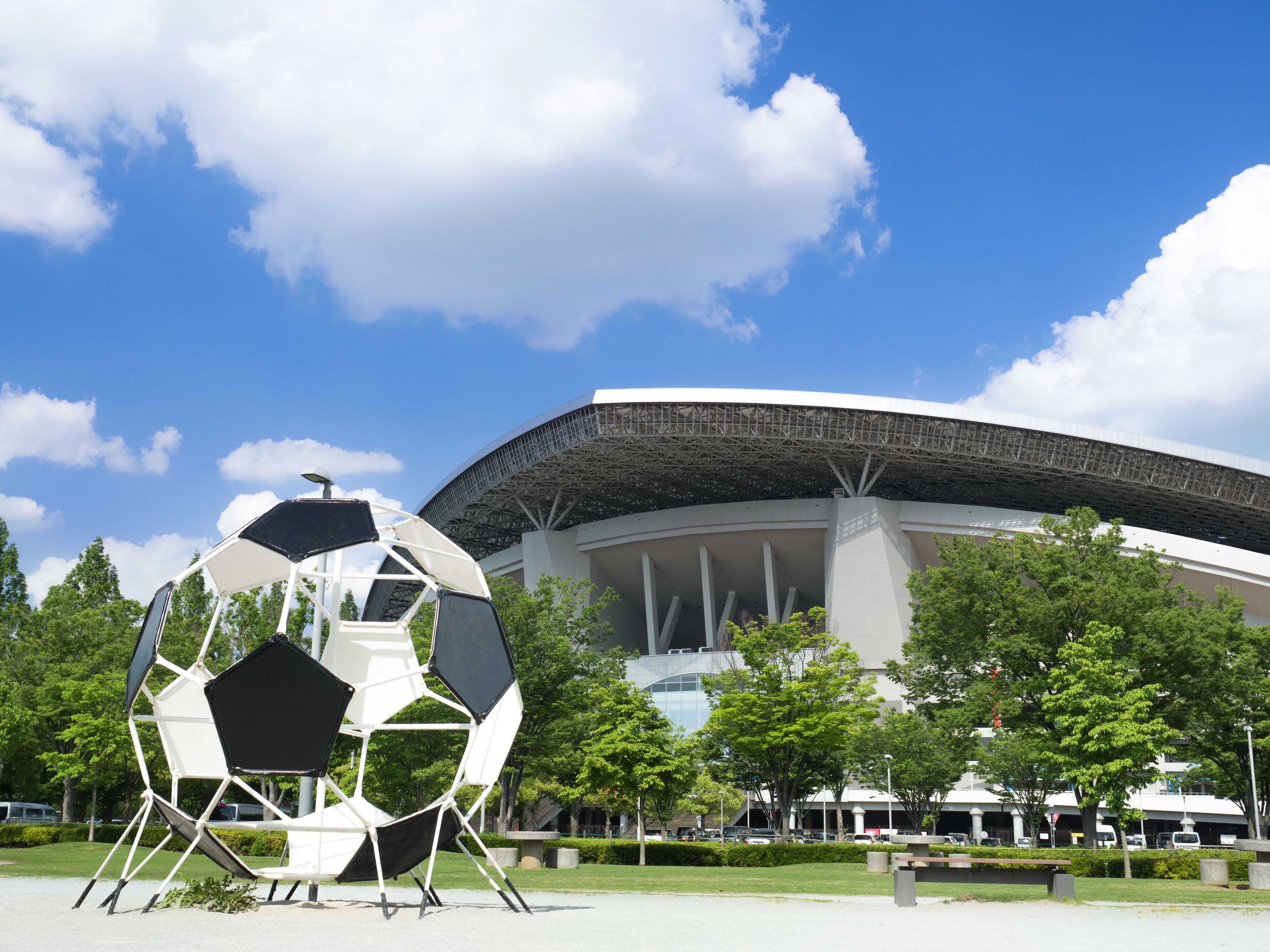
Saitama Stadium 2002, known to fans simply as “Saisuta”, is the largest football-specific stadium in Japan and one of the largest in Asia. It opened on October 1, 2001, purpose-built for the 2002 FIFA World Cup, and its inaugural match two weeks later, Urawa Reds vs Yokohama F. Marinos on October 13, 2001, drew a crowd of 60,553, breaking J.League attendance records before the stadium had even hosted a World Cup game.
During the 2002 World Cup, Saisuta hosted four matches: three group-stage games (including Japan’s opening match against Belgium, a 2-2 draw) and the semi-final between Brazil and Turkey, in which Ronaldo scored the only goal of the game on his way to winning the tournament with Brazil. The stadium later hosted football at the 2020 Tokyo Olympics, including the men’s final.
Since 2001, Saisuta has been the home of Urawa Red Diamonds, founded in 1950 as Mitsubishi Motors FC, owned by Mitsubishi Heavy Industries, and widely regarded as the best-supported club in the J.League. “The Wembley of Japan” is not an exaggeration as nicknames go: with no athletics track separating fans from the pitch and a design that channels noise back onto the field, a full Urawa crowd is, by reputation, one of the loudest experiences in Asian club football.
Urawa Reds have won the J1 League title only once, in 2006, but their cup record is formidable: four Emperor’s Cups, two J.League Cups, and three AFC Champions League titles (2007, 2017, and 2022) — a continental record matched by very few clubs in Asia.
Capacity |
63,700 (62,300 for J.League fixtures) |
Opened |
October 1, 2001 |
Record attendance |
63,551 — Japan vs Oman, June 3, 2012 |
2002 World Cup matches hosted |
4, including Japan vs Belgium and the Brazil vs Turkey semi-final |
How to get there |
Saitama Rapid Railway Line to Urawa-Misono Station, then ~20-minute walk (or shuttle bus on matchdays) |
From Tokyo |
Approximately 50 minutes from Tokyo Station |
Honours |
J1 League (1x, 2006), Emperor’s Cup (4x), AFC Champions League (3x — 2007, 2017, 2022) |
2. Kashima Soccer Stadium
Kashima Antlers | Kashima City, Ibaraki | Capacity: 40,728 | Currently “Mercari Stadium”
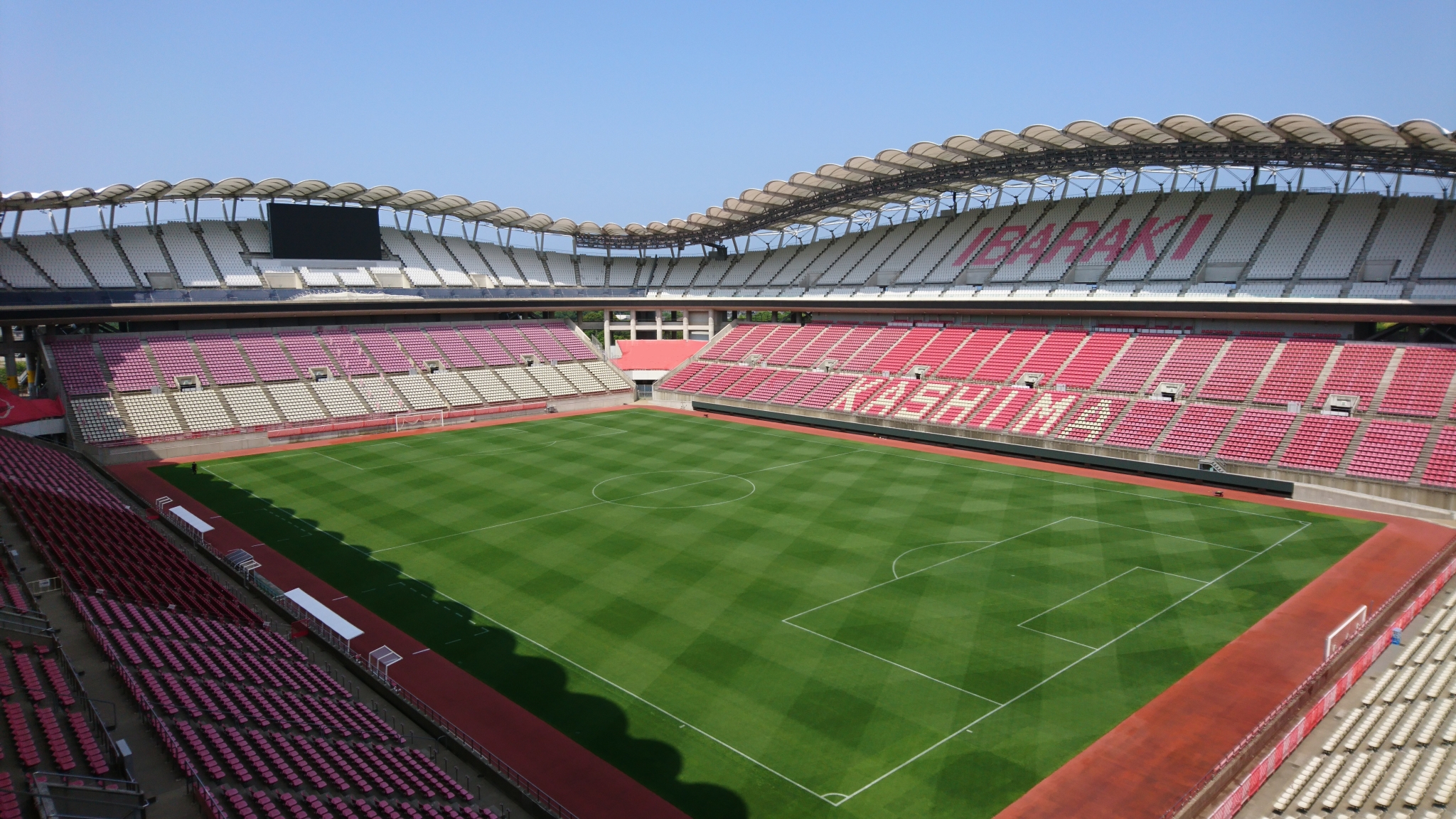
Kashima Stadium opened in May 1993 as Japan’s first purpose-built, full-scale soccer-specific stadium, a milestone that matters because Kashima itself is considered the home of modern era football in Japan. The Antlers, founded in 1947 as Sumitomo Metal FC, have been based here since the J.League’s very first season, and the connection between club and town runs deeper than almost anywhere else in Japanese football.
The original 1992 stadium held around 15,000 spectators. It was substantially expanded ahead of the 2002 World Cup, reopening in 2001 with a capacity of just over 40,000, all-independent seating with backrests, double-tiered stands, and an evergreen natural grass pitch maintained by a dedicated turf management system. The stadium hosted three matches during the 2002 World Cup and football at the 2020 Tokyo Olympics, as well as the FIFA Club World Cup in 2016.
In 2025, e-commerce company Mercari, the Antlers’ owner since 2019, acquired the stadium’s naming rights, and it is now commonly referred to as Mercari Stadium, although its official registered name remains Kashima Soccer Stadium. On site, the Kashima Soccer Museum showcases the club’s trophy collection, and the Antlers have plenty to show: as of the end of the 2025 season, they are J1 League champions for a record 9th time, more than any other club in Japan.
Brazilian legend Zico, who scored the very first goal at the rebuilt stadium in a 1993 friendly against Fluminense, played for and later coached the club, and remains closely associated with Kashima’s identity to this day.
Getting There: Half the Experience
Kashima is one of the more remote J.League grounds, sandwiched between Lake Kitaura and the Pacific coast in Ibaraki Prefecture. The journey from Tokyo takes around 2 hours 30 minutes by train, with the Kashima Line serving a station literally named “Kashima Soccer Stadium”, a station that, notably, is only served on matchdays. Faster direct highway bus services also run from Tokyo Station’s Yaesu exit. The journey itself, watching the dense Greater Tokyo sprawl give way to open Ibaraki farmland, is part of what makes a trip to Kashima feel like an occasion rather than a commute.
Capacity |
40,728 |
Opened |
1993 (original 15,000-capacity ground); expanded and reopened 2001 for the World Cup |
2002 World Cup matches hosted |
3 |
Other major events |
FIFA Club World Cup 2016, football at the 2020 Tokyo Olympics |
Current naming |
Mercari Stadium (sponsorship name, since 2025); official name remains Kashima Soccer Stadium |
How to get there |
JR Kashima Line to ‘Kashima Soccer Stadium’ Station (matchday-only service), or highway bus from Tokyo Station Yaesu exit |
Journey time from Tokyo |
~2.5 hours by train |
Honours |
J1 League (9x — record), among Japan’s most decorated clubs |
On site |
Kashima Soccer Museum |
3. Any J.League Match: The Real Bucket List Item
60 clubs across J1, J2, and J3 | Affordable, accessible, and genuinely welcoming
If this list has one essential entry, it is this one: go to any J.League match, at any club, in any division. The specific stadium matters far less than simply being there.
The J.League now operates across three divisions, J1, J2, and J3, with 60 clubs in total, spread from Hokkaido to Kyushu. What makes this such a strong recommendation for visiting fans is the combination of factors that, individually, exist in other leagues, but rarely all together: tickets are affordable and easy to buy (often available on the day), stadiums are clean, safe, and easy to navigate, the standard of football is genuinely high, and the atmosphere is intensely passionate without the edge that can make away days in some European leagues feel unwelcoming to outsiders.
Then there is the food. J.League stadium concessions are, by any honest international comparison, extraordinary, regional specialities, proper meals rather than reheated snacks, and queues that move quickly. A J.League matchday is as much a food experience as a football one.
For a first-timer, almost any J1 fixture on a weekend works well. If your itinerary includes Tokyo, FC Tokyo and Tokyo Verdy both play at Ajinomoto Stadium; if you’re in Yokohama, Yokohama F. Marinos play at Nissan Stadium (the 2002 World Cup final venue); if you’re anywhere near Kobe, Vissel Kobe’s Noevir Stadium is excellent and historically home to Andrés Iniesta. The point is less which match, and more that you go.

4. Urawa Reds vs Kashima Antlers: Japan’s Great Non-Derby Rivalry
One of the J.League’s ‘Original 10’ fixtures
Urawa Red Diamonds and Kashima Antlers are both members of the J.League’s “Original 10”, the ten founding clubs of the league’s inaugural 1993 season. The two clubs are based roughly 65 kilometres apart, on opposite sides of the Greater Tokyo and Ibaraki region, with no shared city, prefecture border, or historical local connection. What they share instead is three decades of competing for the same trophies, especially through the 2000s, when both clubs were consistently among the J.League’s strongest sides.
The head-to-head record between the two clubs, going back to 1985 (predating the J.League itself, when both existed as company teams), is remarkably close, effectively even across well over 90 meetings in all competitions. In recent seasons the rivalry has, if anything, intensified: the two sides drew seven consecutive meetings between 2022 and the first half of the 2025 season, the longest such streak between the same two teams in J1 League history. As the official Urawa Reds site itself puts it, the rivalry is “comparable to, or even greater than, that of a derby,” despite the absence of any geographical rivalry.
For a visiting fan, a Urawa vs Kashima fixture, whether at Saitama Stadium or Kashima Soccer Stadium, offers something a genuine “derby” often doesn’t: two of the J.League’s most historically significant clubs, both with serious continental pedigree (Urawa’s three AFC Champions League titles, Kashima’s record nine J1 titles), playing a fixture that has carried real weight for over thirty years.
Clubs |
Urawa Red Diamonds (Saitama) and Kashima Antlers (Ibaraki) |
Distance apart |
~65 km — no geographical or historical local rivalry |
Status |
Both ‘Original 10’ founding J.League clubs (1993) |
Head-to-head (all competitions, since 1985) |
Effectively even — 91+ meetings |
Recent record |
7 consecutive draws between 2022 and 2025 — longest streak in J1 history |
Official framing |
Urawa Reds’ own site: ‘no geographical relationship... not a typical derby... comparable to, or even greater than, that of a derby’ |
Where to watch |
Saitama Stadium 2002 or Kashima Soccer Stadium, depending on the season’s fixture list |
5. Sanga Stadium by Kyocera: Mountains on Every Side
Kyoto Sanga F.C. | Kameoka, Kyoto Prefecture | Capacity: 21,600 | Opened 2020
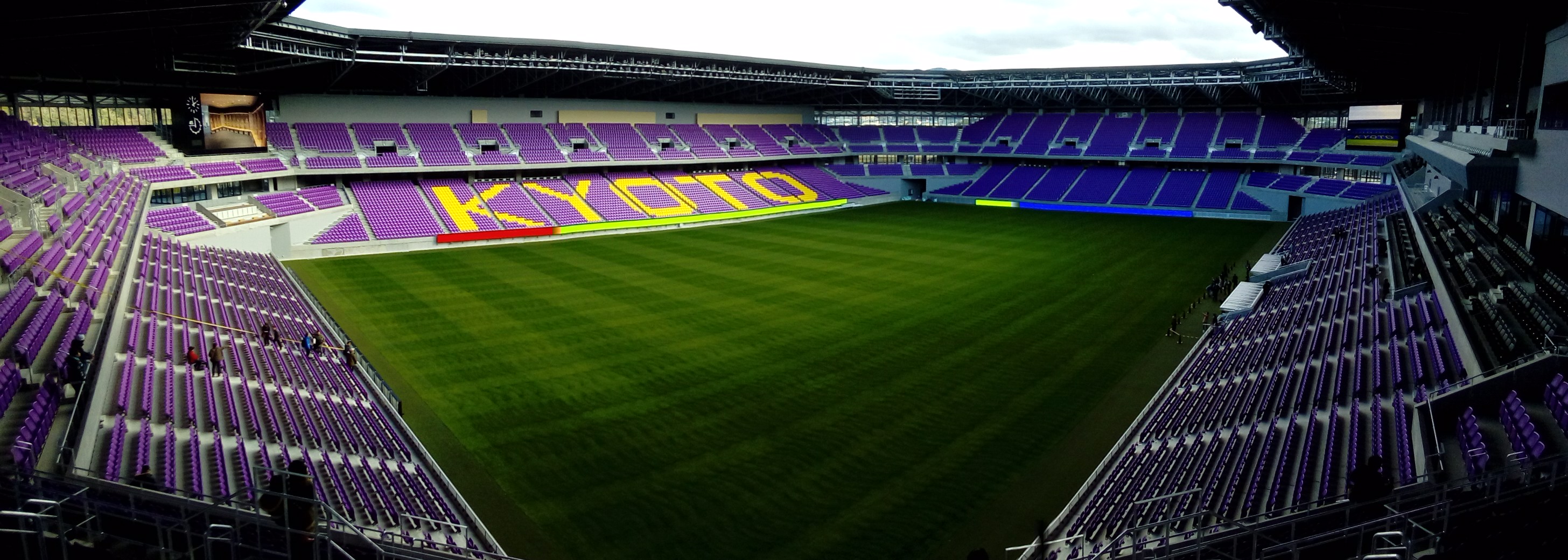
Sanga Stadium by Kyocera, officially Kyoto Stadium, Kyoto Prefecture’s first purpose-built football stadium,opened on January 11, 2020, replacing the aging Nishikyogoku Stadium, a 1940s athletics ground long considered one of the J.League’s least-loved venues. The contrast could hardly be greater. Kyoto Sanga’s new home sits in Kameoka, a small city in a mountain basin about 30 minutes by train from Kyoto Station, and the stadium’s design makes the most of that setting deliberately.
The stadium was designed by Nikken Sekkei, one of Japan’s largest architecture firms, at a cost of approximately ¥16.7 billion, with naming rights sold to Kyocera, the Kyoto-based ceramics and electronics giant, for ¥2 billion over 20 years. Structurally, it’s notable for how close fans sit to the pitch: the stands are elevated only 1.2 metres above the field, with a roof that extends 2 metres over the front row specifically to keep spectators dry without compromising sightlines. The result is an intimate, steep-sided bowl that feels considerably smaller than its 21,600 capacity suggests.
What makes Sanga Stadium worth the trip, though, is what surrounds it. Kameoka sits in a basin ringed by mountains, and the open, two-tiered concourse design, with screens and walkways running the full circumference, means that walking around the stadium at any point during a match offers changing views of the surrounding hills. The stadium sits directly beside JR Kameoka Station (a 3-minute walk from the north exit), and the Hozu River, famous for its scenic boat-ride gorge, runs nearby, adding to the sense that this stadium belongs to its landscape rather than simply occupying it.
Capacity |
21,600 |
Opened |
January 11, 2020 |
Architect |
Nikken Sekkei |
Construction cost |
~¥16.7 billion |
Naming rights |
Kyocera, ¥2 billion / 20 years (2019) |
How to get there |
JR Sagano Line from Kyoto Station to Kameoka Station (~20–30 min) — stadium is a 3-minute walk from the station |
Distinctive feature |
Stands just 1.2m above pitch level; full-circumference concourse with mountain views of the Kameoka basin |
6. Yanmar Hanasaka Stadium (formerly Yodoko Sakura Stadium)
Cerezo Osaka | Nagai Park, Osaka | Capacity: 24,481
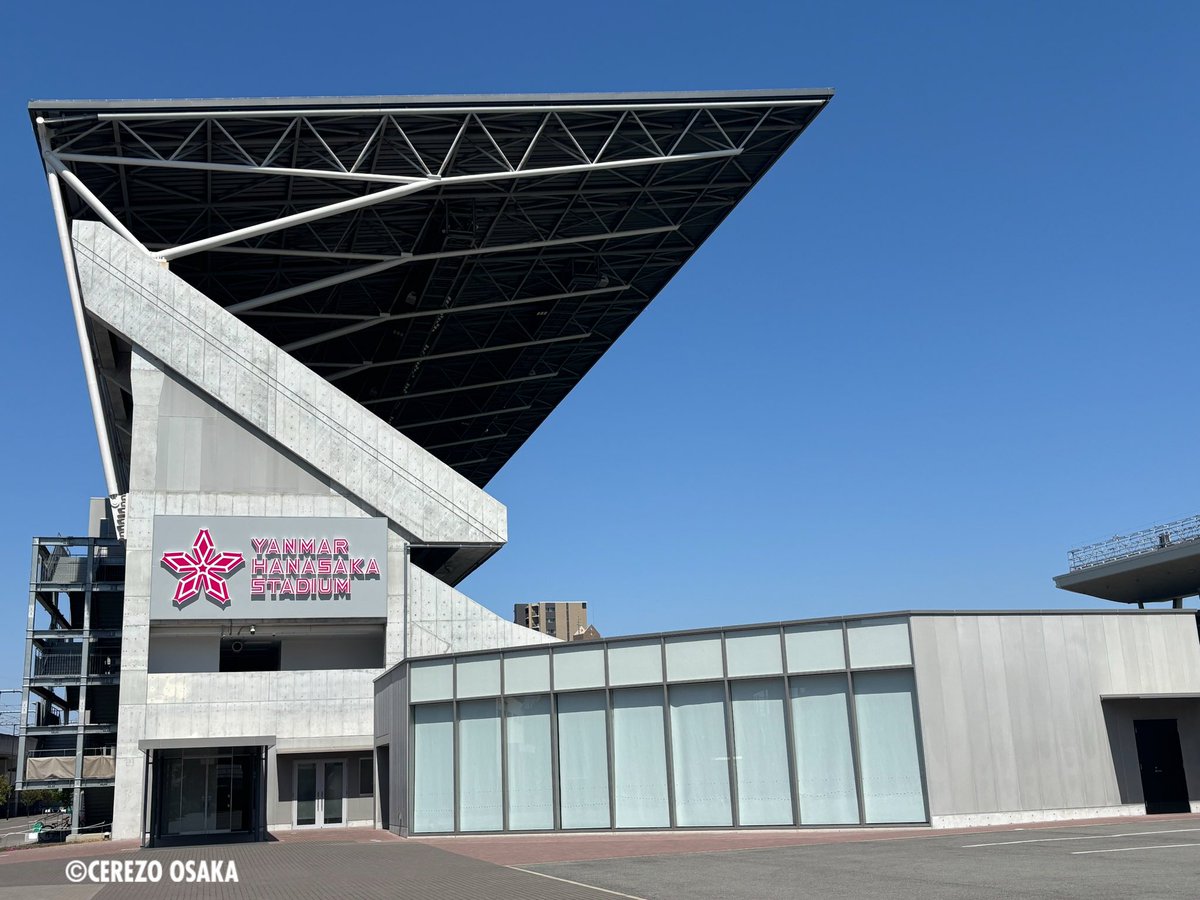
A naming note up front, because it matters for anyone trying to find this place: the stadium widely known in recent years as Yodoko Sakura Stadium was renamed Yanmar Hanasaka Stadium as of 2025, after the club’s long-standing partner Yanmar (the agricultural and marine engine manufacturer that originally founded the club in 1957 as Yanmar Diesel SC). Before that, from 2010 to 2018, it was known as Kincho Stadium. If you’re booking tickets or directions, search for the current name, but most fans, and most of the football world, still know it by its 2020–2025 identity, Yodoko Sakura Stadium.
The ground itself first opened in 1987 within the large Nagai Park sports complex in southern Osaka, the same complex that contains the much larger Nagai Stadium (47,000+ capacity), which hosted three matches during the 2002 World Cup, including Japan’s 2-0 win over Tunisia. Cerezo Osaka, whose name means “cherry tree” in Spanish (a reference to Osaka’s symbol, the cherry blossom), became the stadium’s primary tenants in 2010, moved out in 2018, and returned in 2021 following a major renovation that brought the ground to its current 24,481 capacity, funded substantially through supporter donations and club fundraising, a relatively unusual model for a publicly owned Japanese stadium.
Cerezo’s honours list includes the 2017 Emperor’s Cup and J.League Cup double, and the club has fielded notable players including Shinji Kagawa and, for two seasons, Diego Forlán. The stadium is a five-minute walk from both Nagai Station (Osaka Metro Midosuji Line) and Tsurugaoka Station (JR Hanwa Line), placing it firmly within easy reach of central Osaka.
On the “sunset views” reputation: the stadium’s open upper concourse and west-facing orientation within Nagai Park give evening kickoffs a genuinely striking backdrop as the Osaka skyline catches the late light, one of the more underrated visual experiences among J.League grounds, and a strong reason to prioritise an evening fixture here if your schedule allows.
Capacity |
24,481 |
Originally opened |
1987 |
Major renovation |
2019–2021, reopened 2021 |
Naming history |
Kincho Stadium (2010–2018) → Yodoko Sakura Stadium (2020–2025) → Yanmar Hanasaka Stadium (2025–present) |
How to get there |
5-min walk from Nagai Station (Osaka Metro Midosuji Line) or Tsurugaoka Station (JR Hanwa Line) |
Honours (Cerezo Osaka) |
Emperor’s Cup and J.League Cup, both 2017 |
Good to know |
Sits within Nagai Park, alongside the much larger Nagai Stadium (2002 World Cup venue) |
The Bucket List at a Glance
1. Saitama Stadium 2002 |
Urawa, Saitama | 63,700 capacity | ‘Wembley of Japan’, 2002 World Cup semi-final venue |
2. Kashima Soccer Stadium |
Kashima, Ibaraki | 40,728 capacity | Birthplace of Japanese football, J.League’s most decorated club |
3. Any J.League match |
Anywhere | 60 clubs, J1–J3 | Affordable, welcoming, exceptional stadium food |
4. Urawa vs Kashima |
Saitama Stadium or Kashima Stadium | One of the J.League’s defining rivalries — not a geographical derby |
5. Sanga Stadium by Kyocera |
Kameoka, Kyoto | 21,600 capacity | Mountain views from a full-circumference concourse |
6. Yanmar Hanasaka Stadium |
Nagai Park, Osaka | 24,481 capacity | Sunset views over the Osaka skyline |
Pro Tips for J.League Matchdays
Buy tickets online in advance where possible. Most clubs sell through J.League Ticket or club-specific platforms; some offer English-language interfaces. For high-demand fixtures (Urawa, Kashima, any Osaka or Tokyo derby), book ahead — for smaller fixtures, walk-up tickets are usually available.
Arrive early and explore the concourse. Stadium food in the J.League is a genuine highlight. Arriving an hour before kickoff gives time to explore food stalls, club shops, and — at stadiums like Sanga and Yanmar Hanasaka — the views themselves.
Check which stand is the supporters’ end. The atmosphere is concentrated behind the goals, particularly the home end. Sitting in the main stand gives a calmer, more panoramic experience; sitting behind the goal gives the full atmosphere.
Plan transport for remote grounds. Kashima and Sanga Stadium in particular require more planning than central Tokyo or Osaka venues. Check the last train times back from Kashima especially — it’s a long way back to Tokyo if you miss it.
Use the JR network to combine fixtures with sightseeing. Saitama, Kameoka (Sanga), and Osaka (Cerezo) are all reachable by JR from Tokyo, Kyoto, or Osaka respectively — making it possible to combine a match with a wider Kansai or Kanto itinerary on the same JR Pass.
Planning Your Football Trip to Japan
Build around the J.League calendar: The J.League season runs roughly from February to December, with a winter break. Check the fixture list for your travel dates well in advance — and note that the 2026–27 season structure has shifted to an autumn-to-spring calendar in line with international trends, so confirm dates against the current official schedule.
Use the JR Pass for stadium-hopping: Saitama, Kameoka (Kyoto), and Osaka are all accessible by JR from major hubs, making a multi-stadium itinerary straightforward on a single pass. Kashima requires a longer JR journey but remains accessible.
Stay connected: Ticket platforms, stadium access maps, and last-train times are all easier to manage with a Pocket Wi-Fi, especially for more remote grounds like Kashima and Sanga Stadium.
Combine with World Cup viewing: If your trip overlaps with the 2026 World Cup, many of the pubs and venues covered in JapanDen’s Tokyo and Osaka World Cup viewing guide are a short trip from several stadiums on this list — a J.League match by day, a World Cup match by night.
Final Thought
What makes this list work as a bucket list, rather than just a list of stadiums, is the range. Saitama Stadium and Kashima Soccer Stadium represent Japanese football at its biggest and most historically significant: World Cup venues, continental champions, a fixture that has mattered for over thirty years. Sanga Stadium and Yanmar Hanasaka Stadium show how thoughtfully modern Japanese stadium design integrates with landscape and city. And Tokinosumika Ground, with its handful of seats and a view of hills rather than Fuji itself, is a reminder that football in Japan exists at every scale, from continental finals to a pitch beside an onsen resort.
And what ties this whole list together is how easy it is to move between these places on a single JR Pass. Saitama, Kameoka (home to Sanga Stadium), and Nagai Park in Osaka are all directly reachable by JR from Tokyo, Kyoto, or Osaka respectively, and even Kashima, is accessible by JR Kashima Line from central Tokyo. That means a fan with a week or two in Japan could realistically string together three or four of these stadiums, a J.League match in whichever city they're passing through, and the wider sightseeing each region offers, all on the same pass that gets them there. Football in Japan rewards exactly this kind of itinerary, stadiums spread far enough apart to feel like real destinations, but close enough together, by rail, that getting to all of them is part of the trip rather than an obstacle to it.
FAQs
Is the Urawa Reds vs Kashima Antlers match really called the ‘Tateyama Derby’?
No verified source supports this name. The official Urawa Reds website explicitly describes the rivalry as having ‘no geographical relationship’ and states it is ‘not a typical derby match’ — while also acknowledging the rivalry is comparable to or greater than a derby in intensity. The fixture is best understood as a historic non-geographical rivalry between two of the J.League’s founding clubs, rather than a named geographical derby.
What is Yodoko Sakura Stadium called now?
As of 2025, the stadium is named Yanmar Hanasaka Stadium, reflecting a new naming-rights arrangement with Yanmar, the company that originally founded Cerezo Osaka in 1957. It was known as Yodoko Sakura Stadium from 2020 to 2025, and as Kincho Stadium from 2010 to 2018. The underlying venue — within Nagai Park, capacity 24,481 — is unchanged.
Can I see Mount Fuji from Tokinosumika Ground?
Not from the seats facing the pitch — Mount Fuji sits behind the stands at this stadium. What you do get from the stands is a view across the pitch toward the hilly landscape around Gotemba. The wider Tokinosumika Sports Center complex, including its onsen and other facilities, is set in an area with excellent Mount Fuji views generally, just not framed directly by the football pitch itself.
Is Kashima Soccer Stadium still called that, or is it Mercari Stadium now?
Both names are correct and in use. Mercari, the e-commerce company that has owned Kashima Antlers since 2019, acquired the stadium’s naming rights in 2025 and the venue is now commonly referred to as Mercari Stadium for matches and events. However, its official registered name remains Kashima Soccer Stadium (also commonly called Kashima Football Stadium).
Which stadium on this list is easiest to combine with sightseeing?
Sanga Stadium by Kyocera is arguably the strongest combination: it’s 20–30 minutes from Kyoto Station by JR, sits beside the Hozu River (famous for its scenic gorge boat trips), and the stadium’s mountain-basin setting is itself a reason to visit. Yanmar Hanasaka Stadium (Osaka) is also easy to combine with central Osaka sightseeing, being a 5-minute walk from a major metro and JR station.