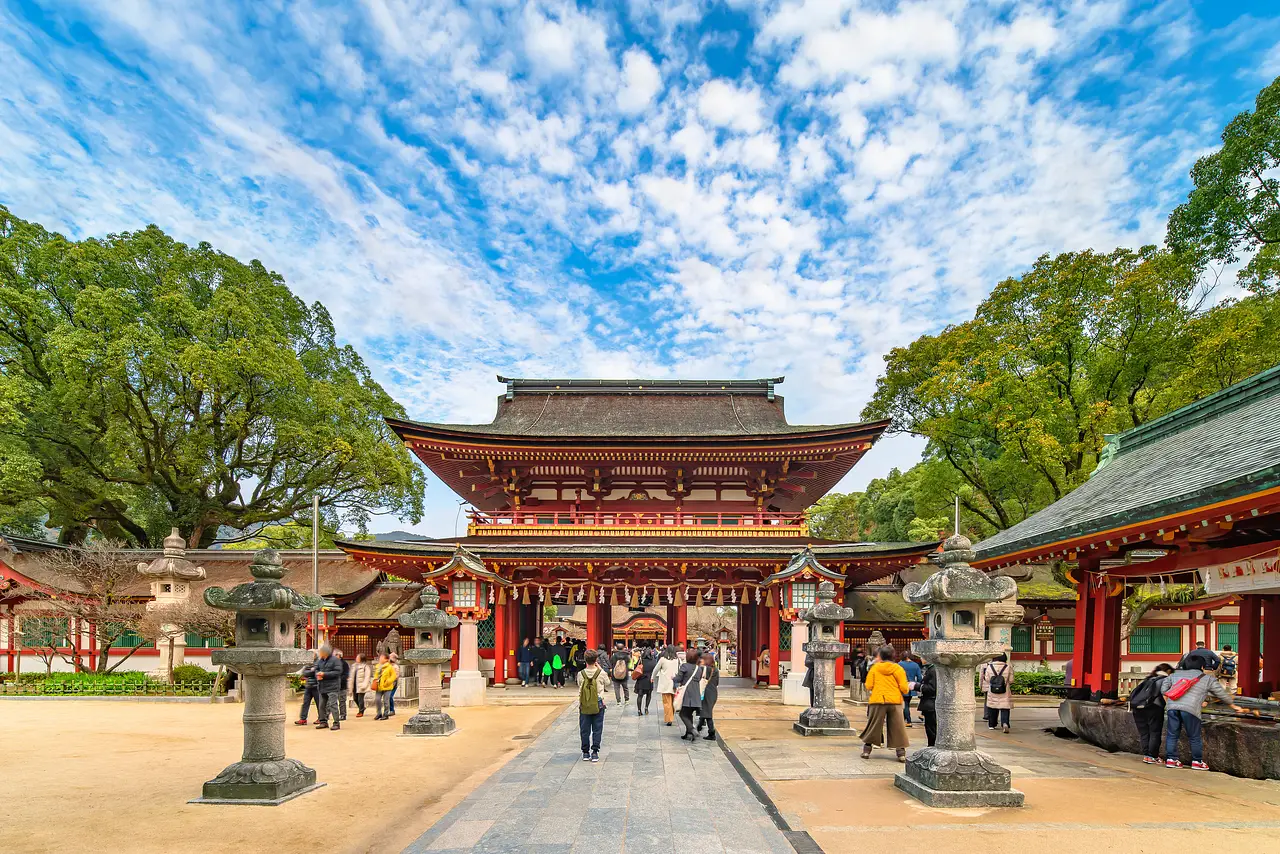
If you are planning a trip to Fukuoka and Dazaifu is not on your itinerary, this guide is asking you to reconsider.
Most visitors to Fukuoka spend their time in Hakata and Tenjin, the food, the shopping, the yatai stalls along the river. All of which is worth doing. But 30 minutes to the south, in a compact city of camphor trees and stone bridges and plum blossoms, is one of the most historically layered and genuinely atmospheric day trips in all of Kyushu, and most people walk right past it.
Dazaifu was Japan’s western capital for over five centuries. Before Tokyo existed, before Kyoto consolidated power, this city governed the Kyushu region, managed Japan’s diplomatic relations with China and Korea, and served as the country’s gateway to the rest of Asia. Intellectuals, monks, diplomats, and poets passed through here. Some of Japan’s greatest scholars were exiled here. And one of them, a 9th-century statesman and poet named Sugawara no Michizane, became a god here.
You can walk the entire core of Dazaifu in an afternoon. The shrine, the temple, the museum, the Starbucks designed by one of Japan’s greatest living architects, the grilled rice cakes you will definitely eat more than one of. The history is everywhere, the atmosphere is extraordinary, and the journey from Fukuoka costs less than ¥500.
Dazaifu: Key Details
Type |
Historic city / Day trip / Shrine and temple experience |
Location |
Dazaifu City, Fukuoka Prefecture, Kyushu, Japan (~16 km southeast of Fukuoka City) |
Nearest Station |
Nishitetsu Dazaifu Station (Nishitetsu Dazaifu Line) |
Getting There |
Nishitetsu Line from Nishitetsu Fukuoka (Tenjin) Station → Nishitetsu Futsukaichi (transfer) → Dazaifu. Total: ~25–40 min, ~¥480. Private line — NOT covered by JR Pass. |
Main Attractions |
Dazaifu Tenmangu Shrine, Kyushu National Museum, Komyozenji Temple, Dazaifu Government Office Ruins, Omotesando approach street |
Admission |
Shrine grounds: Free. Dazaifu Tenmangu museums: from ¥100–¥500. Kyushu National Museum permanent collection: ¥700 (adults). Komyozenji: exterior only currently accessible. |
Opening Hours (Shrine) |
Apr–May: 6:30–19:00 | Jun–Aug: 6:30–19:30 | Sep–Nov: 6:30–19:00 | Dec–Mar: 6:30–18:30 |
Best For |
History and culture lovers, first-time Japan visitors, students, families, photographers, Fukuoka day-trippers |
Official Website |
dazaifutenmangu.or.jp/en |
Why Dazaifu Matters: The Western Capital of Ancient Japan
To understand Dazaifu, you need to understand where it sat in ancient Japan’s geography of power. For most of the Nara and Heian periods, from roughly the 7th century through the 12th, this city was the administrative capital of Kyushu and Japan’s single most important point of contact with the Asian continent.
Dazaifu’s rise began in 663 AD, when Japan suffered a military defeat on the Korean Peninsula. Fearing invasion, the imperial court ordered the construction of a series of fortifications along Hakata Bay, the chief port for ships arriving from China and Korea. In the early 8th century, the city of Dazaifu was built in a fortified mountain basin to the south, modelled on the grid system of Tang-dynasty Chang’an, then one of the largest and most sophisticated cities on earth. A 1.2-kilometre defensive embankment, 13 metres wide, was constructed nearby.
Under the Taiho Code of 701, Dazaifu was charged with the administration of all Kyushu provinces, plus diplomatic and defence responsibilities for the western frontier. It had imperial administrative offices, a school for training government officials, Buddhist temples founded in honour of imperial family members, and a lavish guesthouse, the Korokan, where foreign diplomats were received. It was, in effect, a second capital: the nishi no miyako, the Capital of the West.
Distinguished Buddhist monks including Ganjin, Kōbō Daishi (Kukai), and Saichō stayed in Dazaifu. Intellectuals from the Tang Dynasty were entertained here. Poems from the Man’yoshu anthology, Japan’s oldest collection of poetry, were composed here, including a celebrated plum-blossom party at the residence of the Governor-General that introduced plum blossoms as a subject of Japanese poetry. The plum arrived from China, became beloved in Dazaifu, and through one man’s story became inseparable from this place for over a thousand years.
What to Expect at Dazaifu
Dazaifu Tenmangu Shrine
The centre of Dazaifu as most visitors experience it is Dazaifu Tenmangu, one of the most important Shinto shrines in Japan. It is the head shrine of more than 12,000 Tenmangu shrines across the country, and it draws over 10 million visitors a year, one of the highest visitor counts of any shrine in Japan.
The shrine is dedicated to Sugawara no Michizane (845–903 AD), a scholar, poet, and statesman of exceptional talent. Born into a family of scholars, Michizane was composing classical Chinese poetry by the age of 11 and rose rapidly through the imperial court to become Minister of the Right, one of the two highest-ranking political positions in the Heian government. His ability and influence brought him into rivalry with the powerful Fujiwara clan, who arranged his exile from the capital to Dazaifu in 901 AD. He died there two years later, in 903, at the age of 59, stripped of his wealth and status, far from everything he loved.
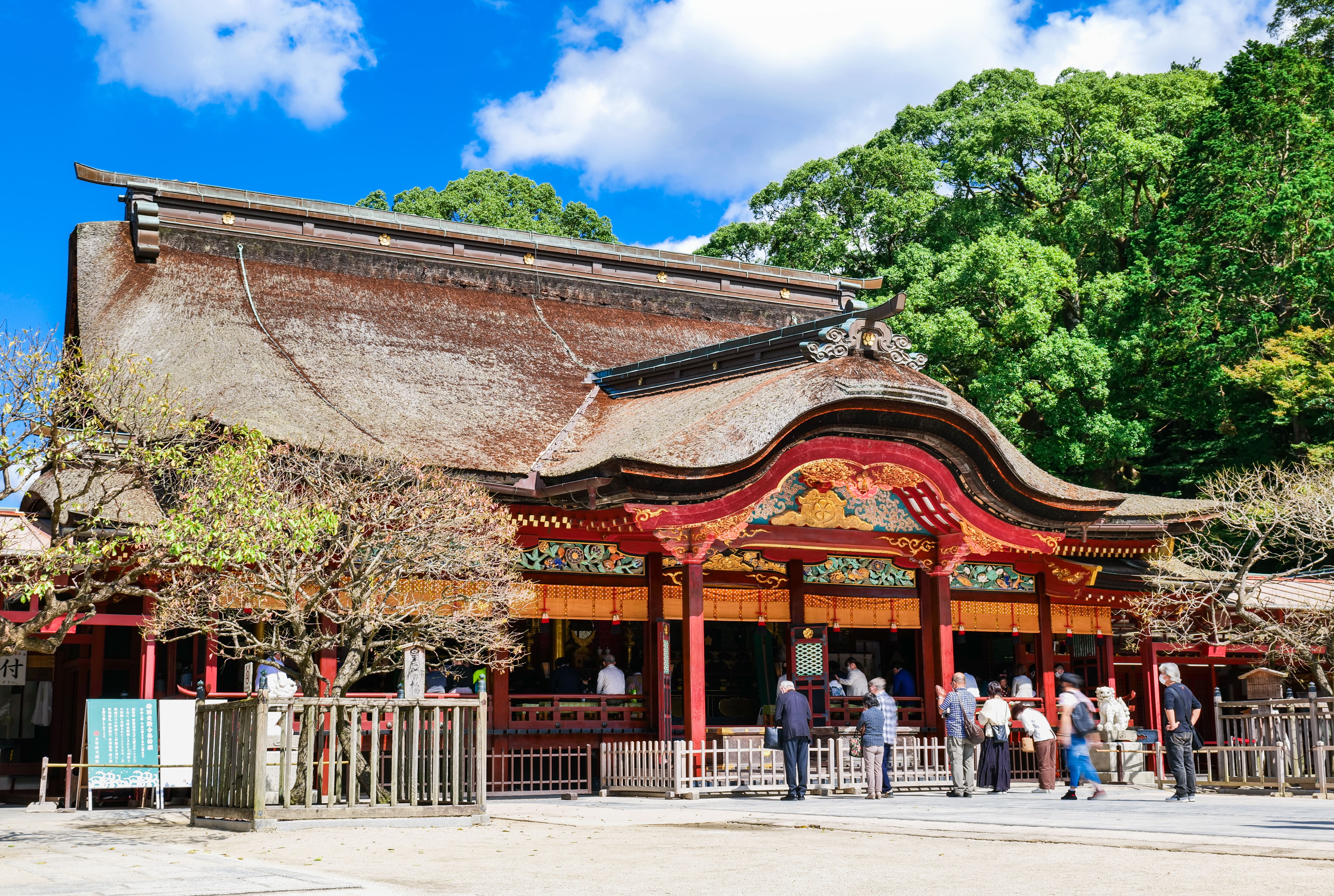
After his death, a series of natural disasters, storms, drought, and the deaths of several Fujiwara officials, were interpreted by the imperial court as the vengeful spirit of Michizane exacting punishment on those who had wronged him. He was posthumously pardoned, his titles were restored, and he was deified as Tenman-Tenjin, the kami of scholarship, culture, and the arts. The shrine was built at his burial site; the earliest iteration dates to 913 AD, a decade after his death. The current main hall (honden), designated an Important Cultural Property of Japan, was rebuilt in 1591 in the Momoyama architectural style.
The approach to the shrine, the Omotesando, or honourable front way, runs from Dazaifu Station through a street of shops and teahouses to the three distinctive arched bridges over the shrine ponds. Students from across Japan come here before exams, tying ema prayer plaques to the racks and buying academic achievement amulets (gakugyō jōju). The atmosphere on the approach combines the solemn and the festive, the ancient and the commercial, in a way that is entirely particular to Dazaifu.
Within the shrine grounds, look for the eleven bronze ox statues dedicated to Michizane, touching their heads is said to bring wisdom. One of Japan’s oldest stone torii gates, dating to the 14th century, stands near the entrance. The grounds contain 6,000 plum trees of 197 varieties, all donated to the shrine.
The Tobiume: The Flying Plum Tree
To the right of the main hall is the detail that makes Dazaifu extraordinary: the Tobiume, the “flying plum tree.”
When Michizane was exiled to Dazaifu in 901, he composed a farewell poem to his beloved plum tree in the garden of his Kyoto home. The poem reads, in translation:
“When the east wind blows, send your fragrance, oh plum blossoms, even without your master, do not forget the spring.”
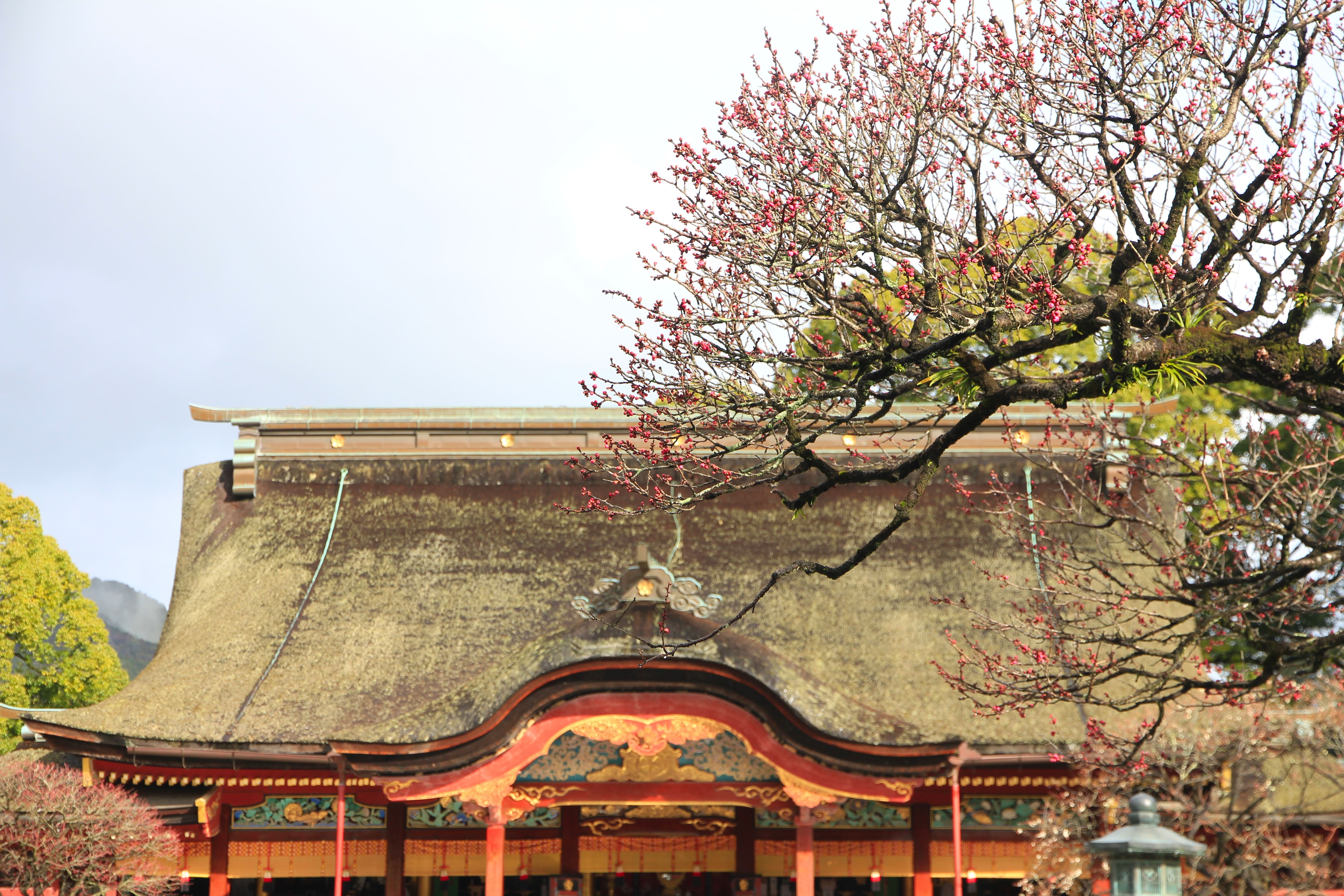
According to legend, the tree was so devoted to its master that it uprooted itself and flew overnight across Japan to be with him in Dazaifu. The tree that stands to the right of the honden today is believed to be that tree, and it behaves accordingly. Every late January to early February, the Tobiume blooms first, before every other tree in the shrine grounds, as if arriving ahead of the season in a hurry to be there.
There is something about this story that lands differently when you are standing in front of the tree itself. The plum tree that flew for love. It is 1,100 years old, and it still blooms first.
The Omotesando Approach and Umegae Mochi
The Omotesando shopping street that leads from Dazaifu Station to the shrine is one of the most enjoyable approach walks in Kyushu. It is lined with teahouses, souvenir shops, craft stores, and food stalls, and it runs roughly 250 metres between the station and the first of the arched bridges.
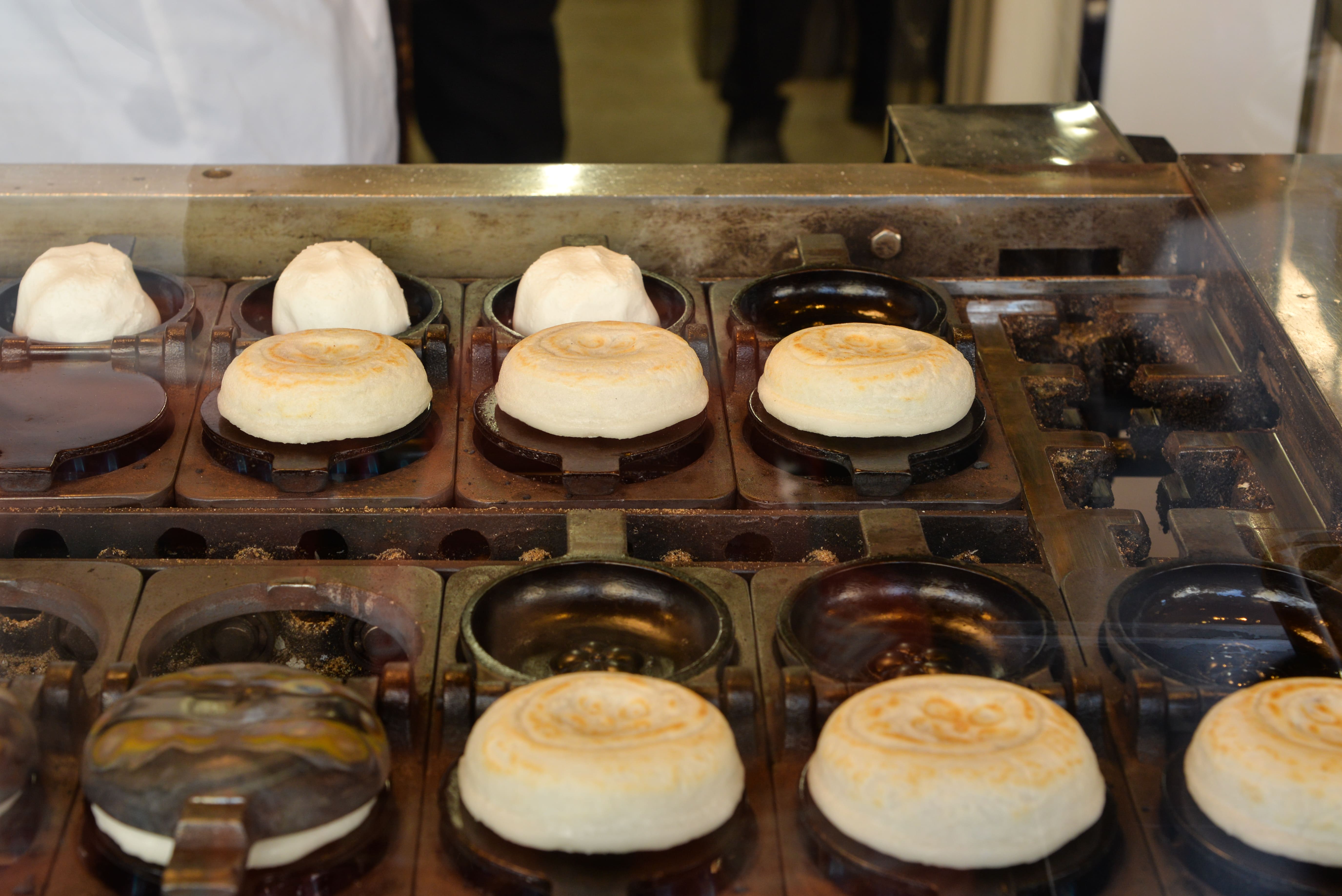
The essential food here is umegae mochi, a small grilled rice cake filled with sweet red bean paste, stamped on the surface with a plum blossom, sold warm directly from the grill. The name comes from the ume (plum) and the branch (gae) associated with Michizane’s legend. Every shop along the Omotesando has their own version. They cost approximately ¥130–¥150 per piece. They are best eaten immediately, directly from the paper wrapper, while still hot. You will eat more than one.
Also on the Omotesando: a Starbucks that is worth stopping at even if you don’t drink coffee. Opened in 2011, the store was designed by Kengo Kuma one of Japan’s most celebrated architects, also responsible for the Tokyo Olympic Stadium. The interior is constructed from over 2,000 cedar wood sticks, ranging from 1.3 to 4 metres in length and 6 centimetres in cross-section, woven diagonally in an interlocking latticework that covers the walls and ceiling across a site 7.5 metres wide and 40 metres deep. The technique is based on the Chidori, a traditional Japanese interlocking wooden toy. The total combined length of the cedar pieces is approximately 4 kilometres. Kuma described the intention as making customers feel they are “drinking coffee in a forest.” Walk in, look up, take your time.
Kyushu National Museum
At the far end of the shrine grounds, connected by a long covered escalator through the forest, is the Kyushu National Museum, the newest national museum in Japan, opened in 2005 and the only national museum outside Tokyo, Kyoto, and Nara. The building itself is a statement: a vast, mountain-shaped glass structure whose mirrored facade reflects the surrounding forested hillside, making the building appear to dissolve into the landscape from certain angles.
The museum’s permanent collection focuses on the cultural exchange between Japan and the rest of Asia, a fitting theme for a city that was, for centuries, Japan’s primary point of contact with the continent. Exhibits trace the movement of people, objects, and ideas between Japan, China, Korea, and Southeast Asia from the prehistoric period through to the Edo era. The permanent collection admission is ¥700 for adults; special exhibitions carry separate pricing. The museum is open Tuesday to Sunday, 9:30 AM to 5:00 PM (entry until 4:30 PM). Closed Mondays.
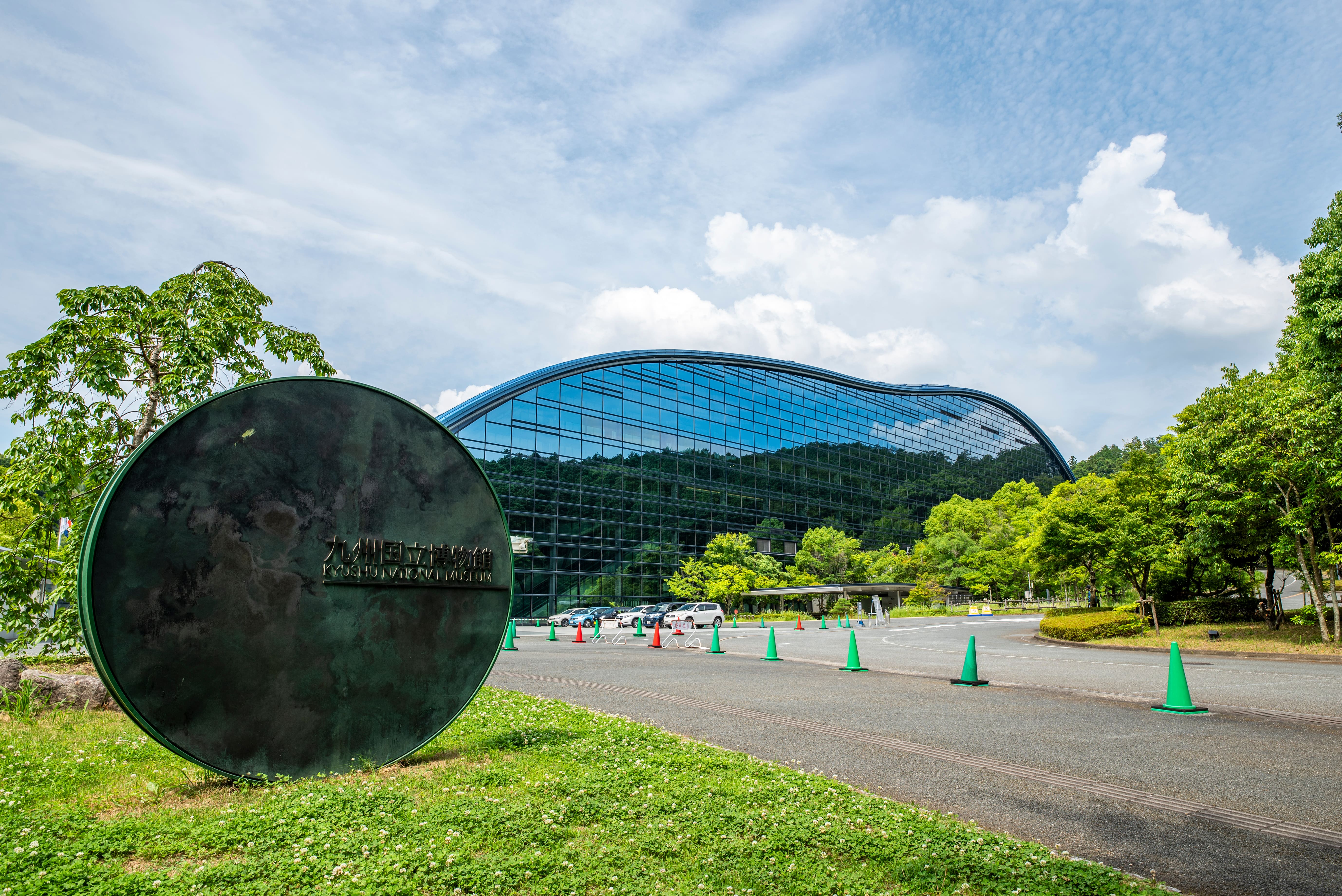.jpeg "Kyushu National Museum")
Komyozenji Temple
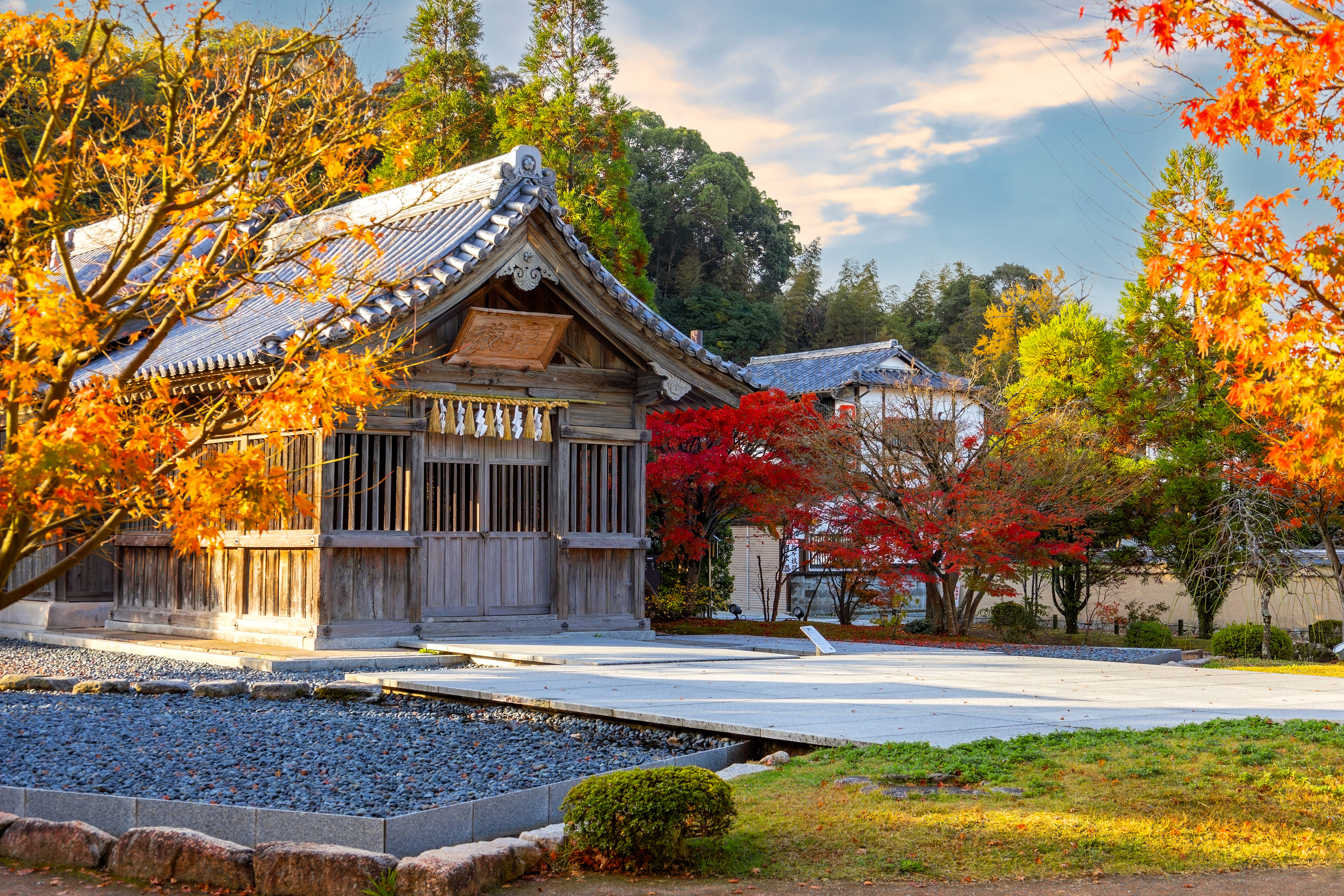
A short walk from the shrine approach is Komyozenji, a Zen temple founded in the early Kamakura period. Its main draw is a karesansui dry landscape garden designed in 1957 by Mirei Shigemori, the most important Japanese garden designer of the 20th century, responsible for over 200 gardens across the country. The garden was designated a Fukuoka Prefectural Scenic Spot in 2014. It features patterns of raked white sand, carefully placed standing stones, and maple trees whose autumn foliage creates a celebrated visual contrast with the grey-white gravel.
Note: as of 2026, interior viewing of the Komyozenji garden is suspended. The exterior and surrounding area remain accessible. Check the current status before including it as a primary visit, the situation may have changed by the time you read this.
Dazaifu Government Office Ruins
For visitors who want to go deeper into the city’s ancient history, the ruins of the Dazaifu Government Office, also called the Tofuro Ruins, sit about 15 minutes’ walk from the shrine, preserved as a public park. What remains are the foundation stones and cornerstones of the main administrative buildings that once constituted the political centre of Kyushu. The scale of the original complex was significant: after Heijo Palace (Nara) and Heian Palace (Kyoto), Dazaifu was the third-largest administrative site in ancient Japan. The adjacent Dazaifu Exhibition Hall contains scale models, excavated artefacts, and a diorama of the Baika no En, the plum-blossom banquet recorded in the Man’yoshu anthology. Entry is free.
Who Is Dazaifu For?
Dazaifu works particularly well for:
First-time Japan visitors: who want to experience something off the standard tourist circuit that is both accessible and genuinely significant. Dazaifu delivers history, beauty, and atmosphere in a compact, walkable format.
History and culture lovers: The layers here, ancient administrative capital, Heian-period exile, deification, Momoyama-era shrine architecture, national museum, are unusually dense for a half-day trip.
Students and those with exams coming up: Dazaifu Tenmangu is one of the most important shrines in Japan for academic blessings. The ema prayer plaques and academic amulets are taken seriously and bought in enormous quantities.
Photographers: The three arched bridges, the camphor-lined approach, the Tobiume in bloom, the Kengo Kuma Starbucks, the reflection-glass facade of the Kyushu National Museum, Dazaifu is unusually rewarding for visual composition.
Families: The approach street is flat, lively, and full of food. The shrine grounds are open and spacious. The Kyushu National Museum has interactive exhibits suitable for children. The deer-free environment is slightly calmer than Nara.
Anyone visiting Fukuoka for more than one day: Dazaifu takes half a day at a comfortable pace and costs almost nothing beyond transport and food. The combination of Fukuoka’s food scene and Dazaifu’s cultural depth makes an exceptionally well-rounded two-day Kyushu stop.
Pro Tips
Arrive early. Dazaifu Tenmangu’s Omotesando approach becomes genuinely crowded by mid-morning on weekends and during peak seasons. Arriving by 9:00–10:00 AM gives you the shrine in relative quiet and the best morning light on the bridges and ponds.
Time your visit around the plum blossoms if possible. The Tobiume and the 6,000 plum trees in the shrine grounds bloom from late January through mid-March. The annual Plum Blossom Festival (Kanbaizai) runs from late February through early March. This is the most atmospheric and most crowded time to visit.
Eat umegae mochi from at least two different shops. Each vendor has a slightly different technique, thickness, and filling ratio. The official recommendation from everyone who has spent any time in Dazaifu is to start at one end of the Omotesando and work your way toward the shrine.
Walk through the Starbucks even if you don’t order anything. The architecture is genuinely worth five minutes of your time. Kengo Kuma designed the Tokyo Olympic Stadium; this is his most accessible public building.
Don’t confuse the two Futsukaichi stations. If you are taking the JR route from Hakata to save the JR Pass fare, note that JR Futsukaichi Station and Nishitetsu Futsukaichi Station are not adjacent. The walk between them takes approximately 10–15 minutes. Budget for this.
Bring cash. Many Omotesando vendors and smaller shops are cash-only. The umegae mochi cost approximately ¥130–¥150 each. Bring coins.
Check Komyozenji before making it your priority. Interior viewing of the Zen garden is currently suspended. Verify the current situation before planning your day around it.
Allow time for the Kyushu National Museum. It is often underestimated. The permanent collection alone deserves 60–90 minutes, and special exhibitions run throughout the year. The walk up through the forested escalator from the shrine is also an experience in itself.
What to Wear in Dazaifu
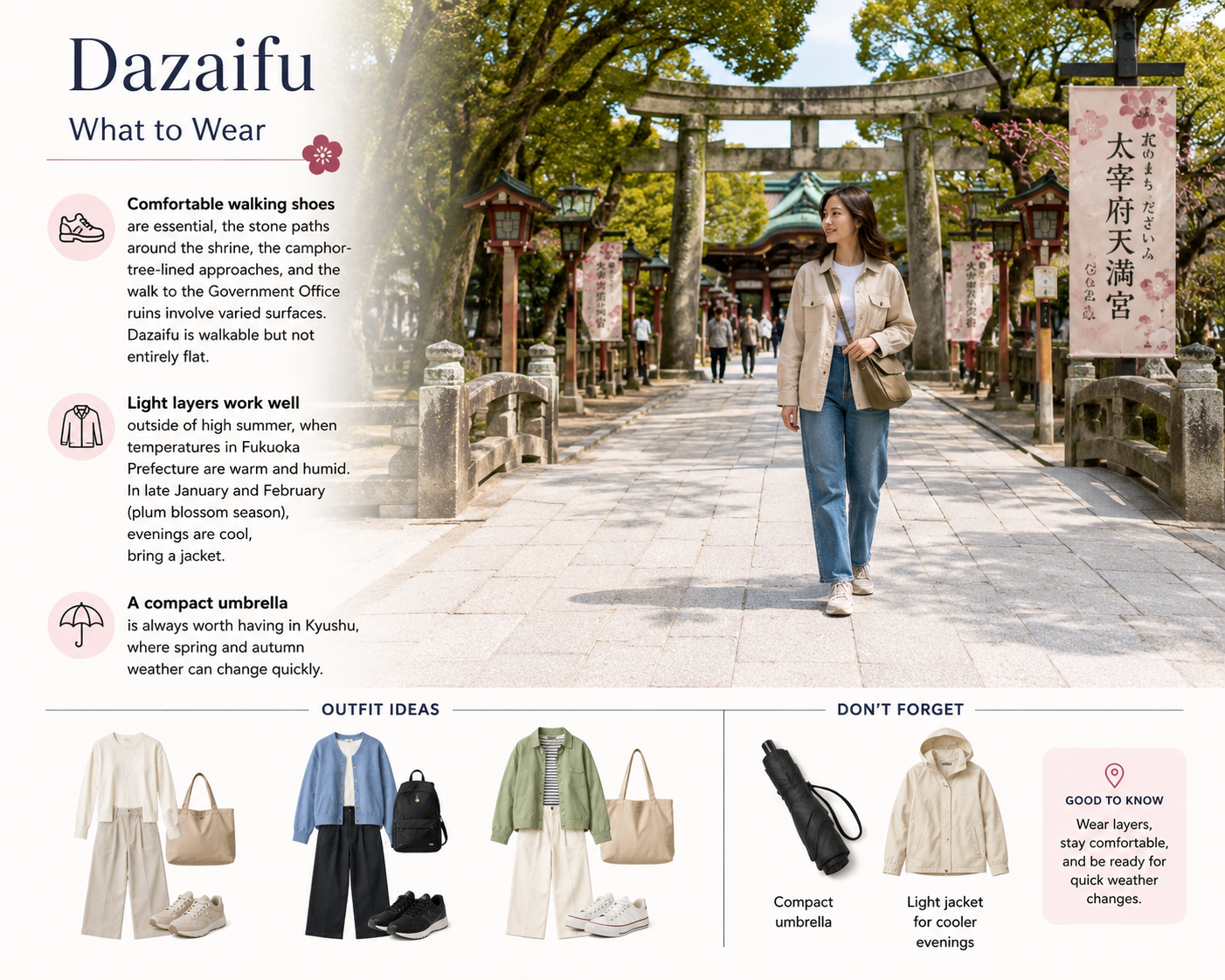
Comfortable walking shoes are essential, the stone paths around the shrine, the camphor-tree-lined approaches, and the walk to the Government Office ruins involve varied surfaces. Dazaifu is walkable but not entirely flat. Light layers work well outside of high summer, when temperatures in Fukuoka Prefecture are warm and humid. In late January and February (plum blossom season), evenings are cool, bring a jacket. A compact umbrella is always worth having in Kyushu, where spring and autumn weather can change quickly.
How to Get to Dazaifu
There are 4 main ways to get to Dazaifu: by Nishitetsu Train; by JR Train + Nishitetsu; by Dazaifu Liner Bus, and by Shinkansen.
From Fukuoka (Tenjin) by Nishitetsu Train — Recommended
The most straightforward route is via the Nishitetsu Tenjin-Omuta Line, departing from Nishitetsu Fukuoka (Tenjin) Station. Take the Nishitetsu train to Nishitetsu Futsukaichi Station (approximately 25 minutes), then transfer to the Nishitetsu Dazaifu Line for the final two stops to Dazaifu Station (approximately 5 minutes). Trains to Futsukaichi run every 10–15 minutes throughout the day. Total journey time: approximately 25–40 minutes. Total cost: approximately ¥480. The Nishitetsu is a private rail line and is not covered by the Japan Rail Pass.
IC cards (Suica, ICOCA, PASMO, Nimoca) work on Nishitetsu trains, tap in and out as normal. During morning peak hours (9:00–12:00), a direct Limited Express service runs from Nishitetsu Fukuoka (Tenjin) to Dazaifu without requiring a transfer.
Nishitetsu Fukuoka (Tenjin) Station |
Starting point. In the Tenjin district, not at Hakata Station. |
From Hakata Station |
Take the Fukuoka City Subway to Tenjin Station (~5 min, ~¥210), then transfer to Nishitetsu. |
Transfer point |
Nishitetsu Futsukaichi Station — change to Nishitetsu Dazaifu Line. |
Final station |
Nishitetsu Dazaifu Station — approximately 250 metres from the shrine approach. |
Total time |
~25–40 minutes from Tenjin |
Total cost |
~¥480 from Tenjin |
JR Pass coverage |
Not covered. Nishitetsu is a private line. |
From Fukuoka by JR Train + Nishitetsu (JR Pass Partial Saving)
If you want to use your JR Pass for part of the journey: take the JR Kagoshima Line from JR Hakata Station to JR Futsukaichi Station (approximately 15–25 minutes, covered by JR Pass), then walk approximately 10–15 minutes to Nishitetsu Futsukaichi Station. From there, take the Nishitetsu Dazaifu Line to Dazaifu Station (approximately 5 minutes, ¥180, not covered by JR Pass). Total journey approximately 30–60 minutes. Note: JR Futsukaichi and Nishitetsu Futsukaichi are not the same station and are not adjacent.
By Dazaifu Liner Bus
A direct bus, the Dazaifu Liner ‘Tabito’, connects Hakata Bus Terminal with Dazaifu Station, departing every 15–30 minutes. The journey takes approximately 40 minutes and costs approximately ¥800 one-way. The bus also stops at Fukuoka Airport International Terminal (approximately 25 minutes to Dazaifu, ¥700). Useful if you are arriving directly from the airport.
Getting to Fukuoka by Shinkansen
From Tokyo: Tokaido Shinkansen to Shin-Osaka (approximately 2h 30min), then transfer to the Sanyo Shinkansen to Hakata (approximately 2h 30min). Total approximately 5 hours. Covered by JR Pass on Hikari and Kodama services (Nozomi requires a supplement).
From Osaka: Sanyo Shinkansen from Shin-Osaka to Hakata (approximately 2h 15min on Sakura or Hikari). Covered by JR Pass.
From Hiroshima: Sanyo Shinkansen to Hakata (approximately 1 hour on Sakura or Kodama). Covered by JR Pass.
Nearby Recommendations
Food — Omotesando Approach: The umegae mochi are non-negotiable. Beyond that, look for shops selling yuzu sweets, Hakata-style mentaiko products, and local Dazaifu honey. Kasanoya, just off the approach, is highly regarded for traditional Japanese confectionery.
Food — Saifu Udon: A simple bowl of udon at one of the teahouses along the approach is a genuinely good and cheap meal. The combination of saifu udon (approximately ¥550) and a warm umegae mochi is the classic Dazaifu lunch.
Tenkai Inari Shrine: A hidden inari shrine in the forested hills behind the main Tenmangu complex, reached via a path lined with red torii gates. Far fewer visitors than the main shrine; the atmosphere shifts completely once you are under the trees. Worth 20 minutes.
Kaidan-in Temple: One of the oldest temples in Dazaifu, dating to the Nara period. It sits a short walk from the main shrine area and is often overlooked in favour of Komyozenji. Its history as the site of Japan’s earliest Buddhist ordination ceremonies is worth knowing.
Hotels: Dazaifu is typically visited as a day trip from Fukuoka City, where accommodation is well-priced and plentiful around Hakata and Tenjin stations. JapanDen has Fukuoka accommodation options across a range of budgets.
More About Dazaifu
Dazaifu’s history as Japan’s western administrative capital extended from the late 7th century into the Kamakura period, a span of roughly five to six centuries. During that time it functioned as a genuine second capital: governing Kyushu’s tax collection and security, receiving foreign embassies, educating government officials, and serving as the site of major Buddhist and Shinto institutions. Its layout was modelled on the Tang capital of Chang’an, one of the greatest cities in 8th-century Asia.
The plum’s connection to Dazaifu predates Michizane. The earliest plum trees in Japan arrived from China during the Nara period as an exotic novelty; the first plum-blossom viewing parties on record were held here, at the Governor-General’s residence, with poems about the newly arrived flower being composed and collected into the Man’yoshu. By the time Michizane was exiled here in 901, the plum was already Dazaifu’s flower. His story simply made it inseparable from the shrine that bears his name.
The Kyushu National Museum opened in 2005 as the first national museum outside of the Tokyo–Kyoto–Nara triangle, a deliberate choice given Dazaifu’s historical identity as Japan’s gateway to Asia. The building was designed by Kikutake Architects and sits on the forested hillside above the shrine grounds, connected by a covered moving walkway through the trees.
Dazaifu has been designated part of Japan Heritage under the theme “The Western Capital of Ancient Japan, Exchange Hub with East Asia,” recognising the city’s layered significance as both a political and cultural crossroads.
Planning Your Visit
Dazaifu combines well with:
Fukuoka food and nightlife: The classic combination: Dazaifu in the morning, return to Fukuoka by mid-afternoon, spend the evening at the yatai (open-air food stalls) along the Naka River or in Hakata’s food streets.
Yanagawa: The Nishitetsu Tenjin-Omuta Line continues south past Futsukaichi toward Yanagawa, known for its canal boat rides and eel cuisine. A combined Dazaifu–Yanagawa day is feasible but long, leave Fukuoka early.
A wider Kyushu itinerary: Fukuoka is the Kyushu Shinkansen hub, connecting directly to Kumamoto (approximately 40 minutes), Nagasaki (via the West Kyushu Shinkansen), Beppu (by limited express), and Kagoshima-Chuo (approximately 1h 20min). A JR Pass or the Kyushu Rail Pass makes a multi-city Kyushu loop straightforward.
Accommodation: JapanDen has options across Fukuoka City. Staying near Hakata or Tenjin stations is the most practical base for both Dazaifu and wider Kyushu travel.
Stay connected: A Pocket Wi-Fi makes navigating Nishitetsu timetables, checking Kyushu National Museum exhibition schedules, and finding the less-visited corners of Dazaifu considerably easier.
Final Thought
Dazaifu is 30 minutes from Fukuoka and about 1,300 years from the Japan most visitors see. It requires a private train, a small fare, and the decision to go slightly off the standard itinerary. Every one of those is worth it.
The approach through the camphor trees to the arched bridges. The plum tree that flew across Japan for love, still blooming first every late January. The 2,000 cedar sticks woven into a forest inside a Starbucks. The grilled rice cakes you will eat more than one of, standing in the street, slightly embarrassed by how good they are.
Most people skip Dazaifu. Most people miss something genuinely wonderful. The day trip is easy, the history is deep, and the 30-minute train is waiting.
FAQs About Dazaifu
Q: How long does a day trip to Dazaifu take?
A: A comfortable half-day — four to five hours including travel from central Fukuoka, is enough to cover the shrine, the Omotesando approach, and either the Kyushu National Museum or the Government Office Ruins. A full day allows you to go deeper: all of the above, plus Komyozenji (when interior viewing is available), the Tenkai Inari Shrine behind the main complex, and a proper sit-down lunch.
Q: Is Dazaifu covered by the JR Pass?
A: The Nishitetsu train, the most direct and convenient route to Dazaifu, is a private line and is not covered by the JR Pass. The JR Pass does cover the JR Kagoshima Line from Hakata to JR Futsukaichi Station, from where a 10–15 minute walk connects to Nishitetsu Futsukaichi Station and the Nishitetsu Dazaifu Line (the final leg, approximately ¥180, is not covered). The full Nishitetsu route from Tenjin costs approximately ¥480 round-trip and is the simpler option.
Q: When is the best time to visit Dazaifu?
A: Late January to mid-March for the plum blossoms, the Tobiume typically blooms from late January, with the full 6,000 trees in peak bloom during late February to early March. Autumn (October–November) is also excellent for foliage. Summer is warm and humid but busy with students visiting before the autumn exam season. Weekdays are considerably quieter than weekends year-round.
Q: Who was Sugawara no Michizane?
A: Sugawara no Michizane (845–903 AD) was a scholar, poet, and statesman of the Heian period who rose to become Minister of the Right, one of the two highest political offices in the imperial government. He was exiled to Dazaifu in 901 through the political machinations of the Fujiwara clan and died there two years later. After his death, a series of disasters convinced the imperial court that his spirit was exacting revenge; he was posthumously pardoned and deified as Tenman-Tenjin, the kami of scholarship and culture. He is now enshrined at over 12,000 Tenmangu shrines across Japan.
Q: What is umegae mochi?
A: Dazaifu’s signature food: a small grilled rice cake filled with sweet red bean paste, stamped on the surface with a plum blossom (ume) motif. The name references the plum branch associated with Michizane’s legend. Shops along the Omotesando approach sell them warm from the grill for approximately ¥130–¥150 per piece. They are best eaten immediately. Buying one from multiple shops to compare is strongly recommended.
Q: Who designed the Dazaifu Starbucks?
A: Kengo Kuma, one of Japan’s most celebrated contemporary architects. The store was designed in 2011 and features over 2,000 cedar wood sticks woven diagonally in an interlocking latticework, a technique based on the Chidori, a traditional Japanese interlocking toy. The cedar pieces range from 1.3 to 4 metres in length and have a combined total length of approximately 4 kilometres. Kuma described the intention as making customers feel they are “drinking coffee in a forest.” It is on the Omotesando approach, approximately 270 metres from Dazaifu Station.
Q: Do I need to buy tickets in advance for Dazaifu?
A: No advance booking is required for the shrine grounds (free), the Omotesando, or most of the outdoor experiences. The Kyushu National Museum and the shrine’s own Treasure Hall have entry fees payable at the door. During peak periods (plum blossom season, Golden Week, autumn weekends), arriving early is strongly recommended to avoid crowds on the Omotesando approach.