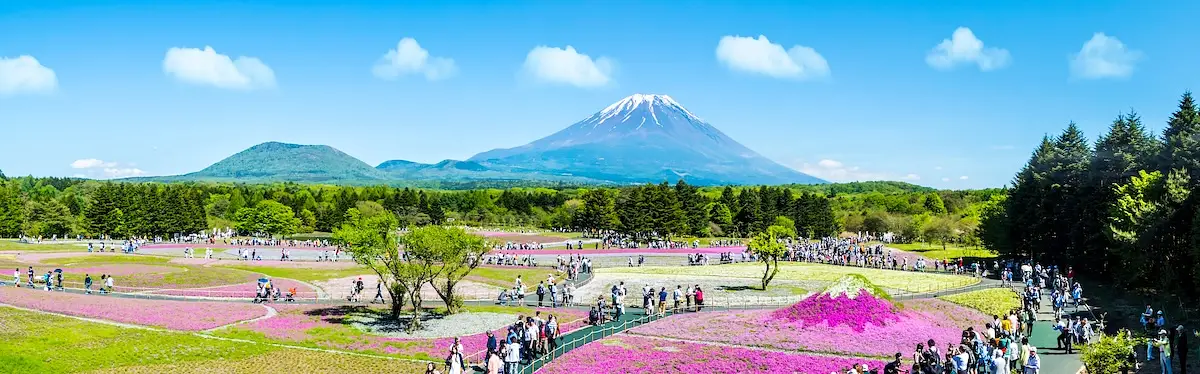
A pink carpet beneath Mt. Fuji
Venue: Fuji Motosuko Resort, Yamanashi Prefecture
When: April to May annually (2026 dates: April 11 – May 24)
The Fuji Shibazakura Festival is one of Japan’s most photogenic spring events, transforming the foothills of Mt. Fuji into a sea of vibrant pink moss phlox (shibazakura). Held at Fuji Motosuko Resort near Lake Motosuko in the Fuji Five Lakes region, the festival combines spectacular floral displays with one of the country’s most iconic mountain views. With hundreds of thousands of blooms, creative photo installations, and the charming Peter Rabbit™ English Garden, it’s a must-visit destination for photographers, families, and spring travelers alike.
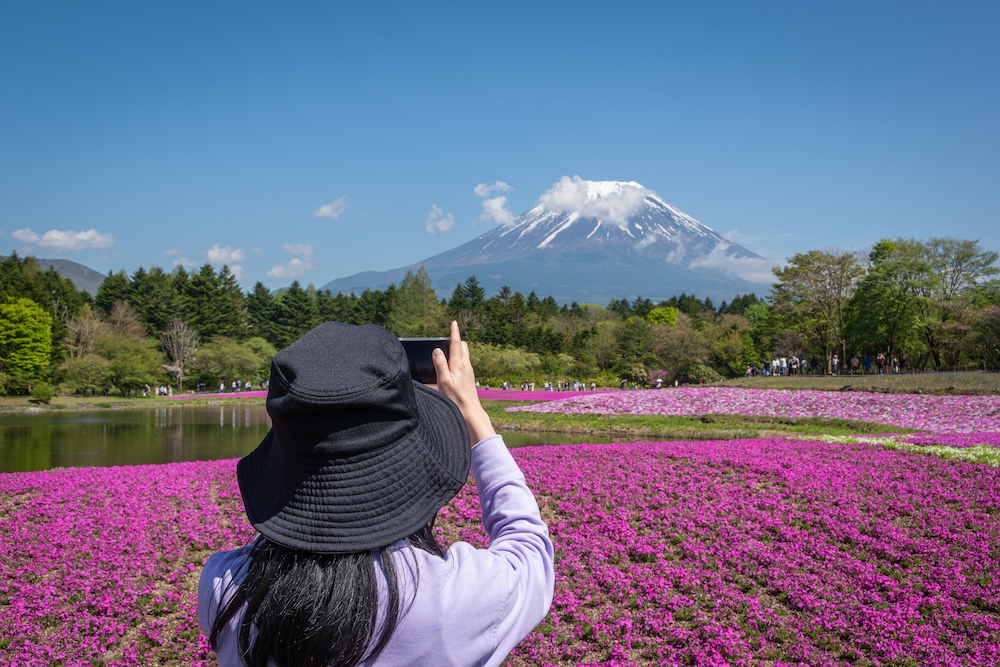
Fuji Shibazakura Festival 2026 Key Details
Dates |
April 11 – May 24, 2026 |
Opening Hours |
Generally 8:00 AM – 4:00 PM (extended during peak dates) |
Location |
Fuji Motosuko Resort, Fujikawaguchiko, Yamanashi |
Admission |
Adults (For junior high school students and older)¥1,000–¥1,300 / Children ¥500–¥700 ※Online tickets are 100 yen off. |
Official Website |
|
Nearest Station |
Kawaguchiko Station (Fujisanroku Electric Railway Fujikyu Line) |
Organizer |
Fuji Motosuko Resort |
What to Expect at Fuji Shibazakura Festival
The festival is famous for its vast fields of moss phlox (Phlox subulata), known in Japanese as shibazakura. Depending on annual growing conditions, visitors can see approximately 500,000 to 800,000 flowers spread across roughly 1.5–2.4 hectares.
Six Varieties of Shibazakura
Visitors can enjoy six colorful varieties:
Scarlet Frame
McDaniel’s Cushion
Autumn Rose
Little Dot
Oakington Blue-Eyes
Tama-no-Nagare
These varieties create striking bands of pink, white, and purple against the backdrop of Mt. Fuji.
Why It Pairs Perfectly with Mt. Fuji
Many flower festivals in Japan offer beautiful blooms, but few provide the iconic combination of pink moss phlox and snow-capped Mt. Fuji. Clear mornings often deliver the best visibility, making this one of the country’s most sought-after spring photography locations.
Peter Rabbit™ English Garden
Included within the resort area is the Peter Rabbit™ English Garden, featuring around 300 plant varieties, themed displays, a café, gallery, and gift shop. It adds another layer of color and family-friendly charm to the visit.
Who Is Fuji Shibazakura Festival For?
This event appeals to:
First-time visitors to Japan
Photographers
Families with children
Couples
Flower lovers
Mt. Fuji enthusiasts
Day-trippers from Tokyo
The festival is tourist-friendly and attracts both domestic and international visitors each spring. English information is available through official tourism channels and event materials.
Pro Tips
Best arrival time
Arrive Early(Morning visits offer)
Better Mt. Fuji visibility/Fewer crowds/Softer photography light
Items to bring (cash, water, power bank)
・Mobile battery: Battery consumption will be rapid when taking photos and videos.
・Cash: Cash may be required at in-park shops and for some dining .
Navigation tips
・Optimal Viewing Time: The festival features about 500,000 shiba-zakura (moss phlox) blooms across 1.5 hectares. A standard stroll around the entire venue takes approximately 60 minutes.
・Photo Spots & Mt. Fuji Background: Dozens of specially designed photo spots are scattered throughout the park, offering iconic views of the pink floral carpet with a snow-capped Mt. Fuji in the background.
・Locker Availability: If you have large bags, 24 paid coin lockers (¥500 each) are available in the group parking area.
・Digital Ticketing: To avoid delays at the entrance, it is highly recommended to have your digital QR code (via the Fever app or email) ready on your smartphone, or bring a printed copy if you do not have a smartphone.
Crowds and wait times
Peak bloom often overlaps with Japan’s Golden Week holiday period (roughly April 25 – May 6). While this is usually when the flowers look best, it is also the busiest and most crowded time to visit. Expect heavy traffic, longer bus waits, and packed photo spots.
Accessibility notes
・The outdoor venue is generally accessible to wheelchair users. However, please note that no wheelchairs are available for loan/rental at the park. Visitors must bring their own.
・The event is fully open and welcoming to individuals with visual or hearing impairments. No strobe lights are used in the venue.
・Restrooms: Accessible restroom facilities are available on-site.
・Service Dogs & Pets:Service dogs are welcome.
For pets (small to medium dogs under 50 cm), they must be kept in a cart or cage during peak crowded seasons (e.g., late April to early May).
On regular weekdays, they are allowed on a leash. *Note: Pet carts/cages are not available for rent and must be brought by the visitor.
What to Wear at Fuji Shibazakura Festival
Daytime high temperatures will be around 15°C to 20°C, while morning and evening temperatures will drop to around 5°C to 10°C.
You will need clothing that can be easily layered and removed, such as a light jacket or fleece.
How to Get to Fuji Shibazakura Festival
Closest train/subway stations: Kawaguchiko Station (Fujisanroku Electric Railway Fujikyu Line)
Transfer information: From Shinjuku, take the Limited Express Fuji Excursion to Kawaguchiko (approximately 1 hour 54 minutes), then take the Shibazakura Liner Shuttle (approximately 40 minutes, 2,500 yen round trip, admission fee included). Alternatively, take a highway bus from Shinjuku Expressway Bus Terminal. Or rent a car (approximately 2.5 to 3 hours from Tokyo).
Maps or linked directions
https://fujishibazakurafestival.com/#location
Nearby Recommendations
Food (cafes, local restaurants)
Peter Rabbit™ English Garden: The adjoining cafe offers Instagrammable sweets such as "Sakura Churros" and "Sakura Soft Serve," inspired by the world of the Peter Rabbit picture books.
Restaurant Honjin Tsukasa: A long-established drive-in style eatery located on the road towards Lake Shoji. You can enjoy warm local cuisine such as Yamanashi's specialty "Hoto," as well as udon and soba noodles, in a relaxed atmosphere.
Attractions or sightseeing
Lake Kawaguchi: The most famous of the Fuji Five Lakes, offering lakeside views, cafés, and seasonal flowers.
Fuji-Q Highland: One of Japan’s best-known amusement parks, home to record-breaking roller coasters and family attractions.
Saiko Iyashi no Sato: A reconstructed traditional village showcasing historic thatched-roof houses and local crafts.
Hotels or ryokans
・Traditional ryokan stays around Lake Kawaguchi
・Lakeside hotels with Mt. Fuji views
・Fuji-Q Highland area hotels
For travelers planning an overnight trip, we recommend the Japan Den.
Booking several months ahead is highly recommended during bloom season.
More About Fuji Shibazakura Festival
The festival began in 2008 at the Fuji Motosuko Resort. What started as a local initiative to create a new springtime landmark has evolved into the largest spring flower event in the Tokyo metropolitan area. Today, the festival regularly welcomes over 300,000 to 400,000 visitors during its limited month-long opening, establishing itself as an essential stop on Japan’s spring travel calendar.
What’s in a Name?
In Japanese, these flowers are called Shibazakura (芝桜).
Shiba means lawn or grass.
Zakura is a variation of Sakura (cherry blossoms).
The name literally translates to "Lawn Cherry Blossoms" because the five-petaled flowers closely resemble cherry blossoms, but they creep along the ground like a thick, vibrant lawn.
Cultural Significance
While traditional Hanami (flower-viewing) in Japan usually focuses on looking up at cherry blossom trees, Shibazakura offers a completely different sensory experience—inviting visitors to look down into a vast, sprawling "floral carpet."
The design of the fields is deeply connected to local folklore. Look closely at the flower arrangements; they are patterned to reflect the breathtaking scenery of the Fuji Five Lakes, including "Sakasa-Fuji" (the mirror reflection of Mt. Fuji on the water) and a Dragon design inspired by the legend of the Ryujin (Dragon God) said to protect Lake Motosu.
Recommended Photo Spots
The festival features various photo spots designed for travel photos and social media-worthy shots. Here are some of our top recommendations:
The Yellow Door of Happiness: A door that looks like it jumped out of a picture book, with Mount Fuji beautifully visible beyond a field of pink flowers.
The Pink Ship: A fantastical installation that makes you feel like you're sailing on a sea of pink flowers.
Observation Deck: Enjoy a panoramic view of the entire flower field with Mount Fuji in the background from this elevated vantage point.
Rainbow Circle Bench: A brightly colored bench perfect for wide-angle landscape photography.
Love Heart Bench: A romantic heart-shaped bench, perfect for couple photos.
Mount Fuji Love Sign: A popular photo spot for social media posts.
*A little tip: To capture Mount Fuji in its clearest form and the flowers beautifully illuminated, we highly recommend visiting early in the morning before the clouds roll in.
Planning Your Visit
Booking accommodation early
For nearby lodging with stunning views, the Fujigoko (Fuji Five Lakes) area, such as Kawaguchiko, is highly recommended. For day trips or exploring other regions, areas like Shinjuku in central Tokyo offer excellent direct transportation access (via highway buses or limited express trains) and vibrant nightlife. Search for nearby hotels based on your travel style.
Using JR Pass or local transport to reach events
Transport: Choosing the right rail pass or transport option can save you significant time and money. Your choice depends mainly on your itinerary:
JR Pass (Nationwide): Ideal if you are planning long-distance travel covering major routes like Tokyo to Kyoto, Osaka, and Hiroshima over a continuous period. It covers the JR lines up to Otsuki Station, but please note that additional fares apply for the Fujikyu Railway line leading to Kawaguchiko.
Regional Options & Buses: If your visit is concentrated around Mt. Fuji, regional options or direct highway buses from Shinjuku are more economical and convenient. From Kawaguchiko Station, a dedicated "Shibazakura Liner" (shuttle bus) operates directly to the festival venue during the event period.
*Note: Be sure to check whether your chosen pass covers the local Fujikyu lines and the shuttle bus, as separate fares are often required.
Stay connected
Staying connected is seamless with two main options. For traveling with a group and needing fast, unlimited data to share those stunning flower photos, a[Pocket Wi-Fi] is often recommended. Alternatively, an [eSIM or SIM card] is excellent for solo travelers who prefer a hassle-free, card-free setup.
*Note: Digital entry tickets (via QR code) are highly recommended for this festival, making reliable internet access at the venue entrance essential.
Get assistance upon arrival
We can arrange a [Meet & Greet service] where an English-speaking guide will meet you directly at the airport upon arrival. They can assist with your luggage, currency exchange, activate your transport passes, and provide guidance on transferring from the airport rail link to your accommodation or your way toward the Mt. Fuji area. This service provides peace of mind and personalized support from the moment you arrive.
Japanese etiquette basics
Show respect to elders; exchange business cards and cash with both hands; tipping is not expected.
IC Cards: IC cards like Suica/Pasmo facilitate smooth payments on public transport (like the Fujikyu Railway) and at convenience stores.
Accessibility: The outdoor venue is generally wheelchair-accessible, but please note that no wheelchair rentals are available on-site, so visitors must bring their own. Further accessibility information is available from JNTO.
Cash and credit card usage
While digital ticketing is preferred for entry, cash is highly essential for buying local street food, snacks, and traditional souvenirs at the venue's outdoor stalls. Always carry sufficient Japanese Yen.
FAQs About Fuji Shibazakura Festival
Q: Is the festival kid-friendly?
A: Yes. Families make up a significant portion of visitors each year.
Q: Are there food options inside the venue?
A: Yes. Food trucks, cafés, and themed dining options are available.
Q: What is the Fuji Shibazakura Festival?
A: It is a spring flower festival featuring massive displays of moss phlox beneath Mt. Fuji near Lake Motosuko.
Q: Is the Fuji Shibazakura Festival worth visiting?
A: Yes. It is widely considered one of Japan’s most spectacular spring flower events thanks to its unique combination of colorful moss phlox and Mt. Fuji views.