Key Details
Annual date | Second Sunday of October | 2026: October 11 |
Hours | Approximately 10:00 AM – 7:00 PM (check official site for 2026 confirmation) |
Location | Kagurazaka Main Street (Kagurazaka O-dori) and surrounding streets, Shinjuku Ward, Tokyo |
Admission | Free to attend and watch | Parade participation fee: ¥3,300 (includes costume and makeup placement for 2026 — confirm on official site) |
Cat makeup | Professional stage makeup available on the day from ¥2,000 (adults) / ¥500 (children) |
Nearest stations | Kagurazaka Station (Tokyo Metro Tozai Line) — 1-min walk | Iidabashi Station (JR Chūo-Sōbu Line, Tokyo Metro Tozai/Yūrakuchō/Namboku) — 5-min walk | Ushigome-Kagurazaka Station (Toei Ōedo Line) — 1-min walk |
JR Pass access | JR Chūo-Sōbu Line to Iidabashi Station (JR Pass covered) — 5-minute walk to Kagurazaka Main Street |
Official site | Confirm details on the Bakeneko Festival official channels before visiting — date confirmed second Sunday October annually |
Founded | 2010 |
In the Shinto tradition of Japanese folklore, a bakeneko is a supernatural cat, a feline that has lived long enough, or grown large enough, to acquire strange powers: walking upright, speaking in human voices, shapeshifting, and, in the more dramatic accounts, raising the dead.
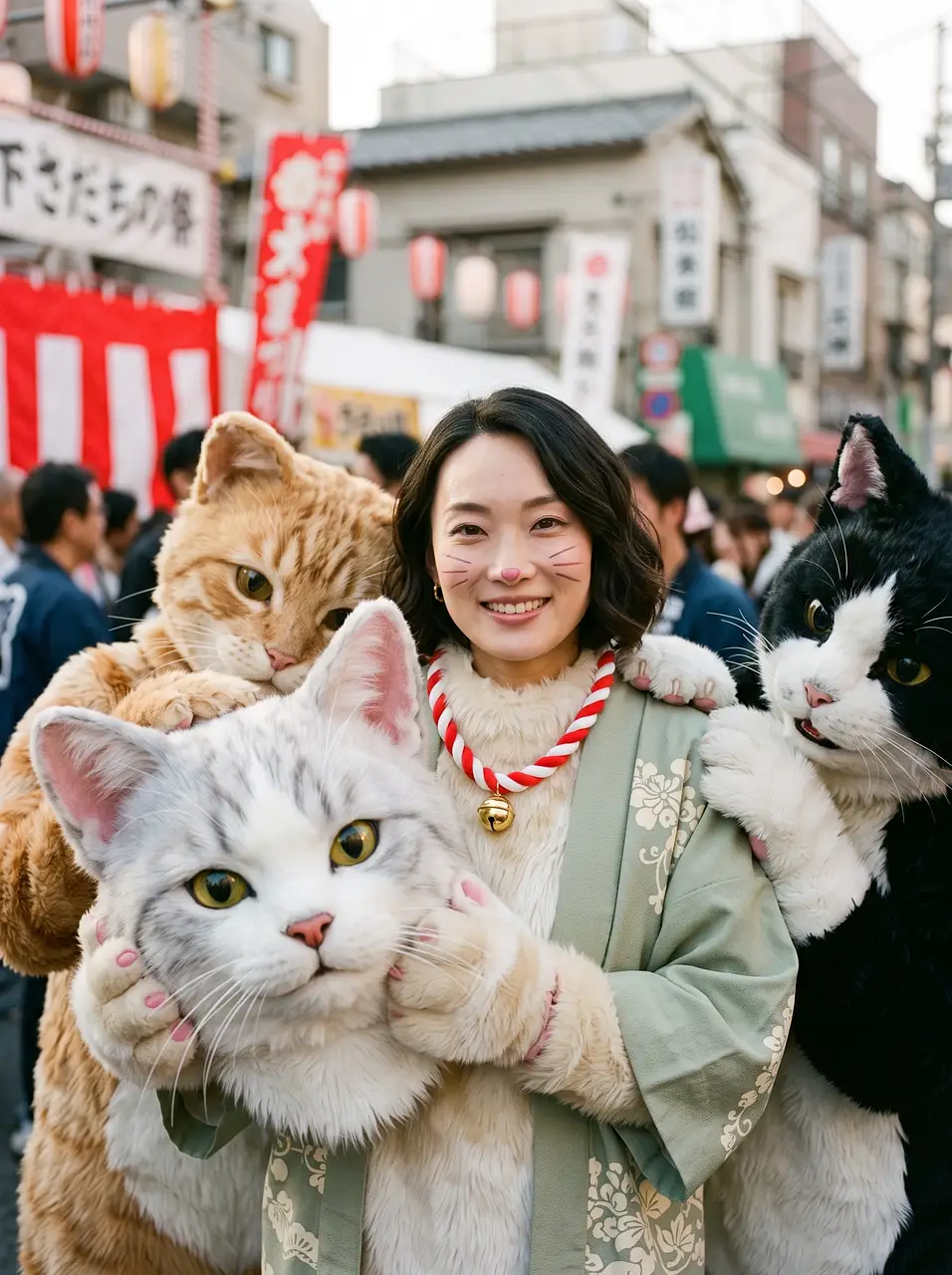
Every October, the neighbourhood of Kagurazaka in Tokyo pays tribute to this yokai tradition by filling its streets with hundreds of people dressed as cats and parading through the district in what has become one of the city’s more enjoyable autumn events.
The Kagurazaka Bakeneko Festival is not ancient. It launched in 2010 as a deliberate community initiative to bring life to one of Tokyo’s most distinctive old neighbourhoods, and it has grown steadily since. It takes place each year on the second Sunday of October, which places it neatly in that window before Halloween when the weather in Tokyo is finally bearable and the instinct to wear a cat costume feels suddenly justified. The festival is participatory, family-friendly, free to watch, and entirely approachable for international visitors.
What Is a Bakeneko?
The bakeneko (化け猫) is a yokai. a supernatural creature from Japanese folklore, that takes the form of an unusually powerful cat. The name translates roughly as ‘transformed cat’ or ‘monster cat.’ In traditional belief, a domestic cat could become a bakeneko by meeting certain conditions: living for more than thirteen years, growing heavier than approximately 3.5 kilograms, or developing an abnormally long tail. The long tail in particular was considered the key to transformation — it allowed the cat to stand upright and begin acquiring human characteristics.
The powers attributed to bakeneko are extensive: walking on two legs, speaking in human voices, shapeshifting into human form, manipulating people by wearing their clothes, and, in some stories, replacing a deceased household member so convincingly that the family doesn’t notice for years. A bakeneko was said to be especially drawn to oil lamp fuel — a hazardous enthusiasm in a city of paper and wood. It is also distinct from the nekomata, a closely related but even more powerful supernatural cat distinguished by having two tails.
The story that launched a fashion: the association between long cat tails and supernatural power reportedly drove a 17th-century craze in Edo (present-day Tokyo) for short-tailed cats, as a precaution. The Japanese bobtail breed, with its naturally abbreviated tail, became popular partly for this reason. The bobtail remains the image most associated with Japanese cat culture today.
Why Kagurazaka? The Neighbourhood and Its Cat Connections
Kagurazaka is one of Tokyo’s most characterful neighbourhoods — a former geisha district from the Edo period that still has narrow stone-paved alleys (yokocho), traditional restaurants, and a pace that feels measurably slower than the rest of Shinjuku Ward. It is also, crucially, the neighbourhood most associated with Natsume Soseki (1867–1916), one of Japan’s greatest novelists and the author of ‘Wagahai wa Neko de Aru’ — ‘I Am a Cat’ — published in 1905–06. The novel is narrated entirely by an unnamed cat living in the household of a bumbling schoolteacher, and it remains one of the most beloved works in Japanese literature.
Soseki was born in Kagurazaka and the neighbourhood has embraced that connection. Cat imagery appears in shopfronts, cafe names, and street art throughout the area. The Bakeneko Festival’s founding motto — ‘a town where cats can live is a town where people can live’ — captures exactly this local identity. The festival was created by community organisers specifically to celebrate Kagurazaka’s character and draw visitors who would explore the neighbourhood rather than just passing through on the main street.
What to Expect at the Festival
The day runs from approximately 10:00 AM to 7:00 PM, spread across Kagurazaka Main Street and the surrounding streets and alleys. It is divided into several distinct elements, and how you experience it depends on whether you come as a spectator or a participant.
The Bakeneko Parade
The centrepiece is the Bakeneko Parade — a procession of costumed participants in cat makeup and costumes of every conceivable style, from simple painted whiskers to elaborate full-face theatrical transformations. Participants register in advance and pay the participation fee (approximately ¥3,300 in 2026, which includes costume and makeup placement — confirm current details on the official site). On the day, registration and makeup happen from the morning, with the parade itself taking place in the afternoon along Kagurazaka O-dori toward Iidabashi Station and back.
The parade is deliberately inclusive: all ages, all nationalities, all levels of cat commitment are welcome. International visitors regularly participate, and the crowd is warm and visually spectacular. If you want to join rather than watch, book in advance as participation spots fill.
Anya Odori — The Cat Dance
One of the festival’s most distinctive recurring features is the Anya Odori — a cat-themed version of the traditional Awa Odori dance from Tokushima, choreographed specifically for the festival. Workshops happen throughout the day, and spectators can join in. The Awa Odori’s characteristic flowing arm movements translate surprisingly well to a feline interpretation.
Neko Kiriko
A cat-themed version of the traditional Kokiriko-bushi folk performance, in which participants experience the rhythm-stick folk art tradition through a cat-costumed lens. Another example of the festival’s approach of filtering traditional Japanese cultural forms through the bakeneko theme.
The Bakeneko Yami Market
Running alongside the main events, the Yami Market (‘dark market’, a playful name) sells cat-themed goods: costume accessories, handmade craft items, cat-shaped bread, cat-themed sweets, and merchandise. It is a useful stop if you arrive without a costume and want to add something before the parade passes.
Cat Makeup Services
Professional stage makeup artists are on hand throughout the day, available for both participants and visitors who want to join the visual spirit of things without a full costume. Adult makeup runs approximately ¥2,000; children approximately ¥500. Makeup tickets are distributed from the registration desk from around 9:30 AM and are limited — arrive early if this is your plan.
Who Is the Bakeneko Festival For?
The honest answer is: almost anyone, but it suits certain travellers particularly well.
Cat people: obviously. The festival is unapologetically feline and the crowd reflects this. You will not feel out of place caring more about cats than you perhaps should.
Families with children: genuinely one of the better family events in Tokyo in October. The daytime hours, the free admission to watch, the cat makeup option for children, and the Yami Market’s food all make it a manageable and enjoyable day with kids. Children under preschool age can participate in the parade for free.
Photographers: the combination of theatrical cat makeup, traditional Kagurazaka alleys, and a crowd in full costume produces excellent photographs. The afternoon parade light is particularly good.
Visitors who want to participate: unlike many Japanese festivals, this one actively encourages visitor participation. Signing up for the parade means you are in it, not watching it. The Anya Odori workshop is also open to anyone.
Those who want to explore Kagurazaka: the festival is as much a reason to walk around Kagurazaka’s backstreets as it is to watch the parade. The yokocho alleys, the traditional restaurants, the Soseki connections, and the general neighbourhood character make a festival day here more rewarding than a festival held in a generic venue.
Pro Tips
Arrive early for makeup. Makeup tickets are distributed from 9:30 AM and are finite. If professional cat makeup is part of your plan, this is where the day starts.
Book the parade in advance. Participation spots are not unlimited. Check the official site before the festival and register ahead if you want to be in the parade rather than watching it.
Explore the side streets. The festival spreads well beyond the main street. Kagurazaka’s stone-paved yokocho alleys are beautiful and less crowded than the main drag. Follow the festival into them.
Come as a cat. This is optional, obviously. But showing up in any level of cat costume — even just painted whiskers — puts you in the spirit of the day and makes the whole experience more enjoyable. The Yami Market can supply accessories if you arrive unprepared.
Carry cash. Many smaller stalls and food vendors at the Yami Market are cash-only. There are convenience stores nearby but plan for yen in hand.
The neighbourhood rewards lingering. If you are in Kagurazaka for the festival, stay for dinner. The area has an excellent restaurant scene, and October evenings in Tokyo are some of the best of the year.
How to Get There
Kagurazaka is well connected from central Tokyo and easy to reach without a complex transfer.
JR Chuo-Sobu Line to Iidabashi Station: approximately 10 minutes from Shinjuku or Akihabara, covered by the Japan Rail Pass. Five-minute walk to Kagurazaka Main Street from the station’s west exit.
Tokyo Metro Tozai Line to Kagurazaka Station: the most direct option for many parts of the city — one minute to the main street. Not covered by JR Pass; use a Suica or ICOCA IC card.
Tokyo Metro Tozai/Yurakucho/Namboku Lines or JR to Iidabashi: multiple lines converge at Iidabashi, making it accessible from most parts of Tokyo. The JR Chuo-Sobu Line is the one covered by JR Pass.
Toei Oedo Line to Ushigome-Kagurazaka Station: one-minute walk to the upper end of Kagurazaka. Not JR Pass.
For visitors based in central Tokyo, the JR Chuo-Sobu Line from Shinjuku or Akihabara to Iidabashi is the most practical JR Pass-covered route. From there, follow the main street uphill — it becomes Kagurazaka O-dori and the festival is immediately apparent.
Kagurazaka Beyond the Festival
One of the reasons the Bakeneko Festival works so well is that Kagurazaka is an excellent place to spend a day regardless of the festival itself. A few things worth building into the visit:
The Bishamon-ten Temple (Zenkoku-ji): the main Bishamonten temple at the top of Kagurazaka hill, one of the Seven Lucky Gods of Tokyo, with a calm courtyard and a gate that feels genuinely old in a city that rebuilt itself repeatedly.
The yokocho alleys: the stone-paved back alleys of Kagurazaka — particularly the side streets off Kagurazaka-dori — still have the character of an Edo-period geisha district: narrow, quiet, traditional restaurants with small lanterns outside. The festival makes these more animated than usual.
The Natsume Soseki Museum: a small museum dedicated to the author of ‘I Am a Cat,’ near the site of his birthplace in the neighbourhood. Worth fifteen minutes for context on why this neighbourhood and this festival are connected.
Iidabashi and the Outer Moat: the canal area near Iidabashi Station is pleasant in October and a good walk before or after the festival, with views of the old moat of Edo Castle.
FAQs About the Kagurazaka Bakeneko Festival
The following answers are based on confirmed festival information from multiple sources. Always check the official site before visiting as exact details (parade timing, participation fees) can shift year to year.
Q: What is the Kagurazaka Bakeneko Festival?
A: An annual community festival in the Kagurazaka neighbourhood of Tokyo, held every second Sunday of October. It celebrates the bakeneko — the supernatural cat of Japanese folklore — through a cat costume parade, dance events, a market, and professional cat makeup services. Founded in 2010, it is open to visitors of all ages and nationalities.
Q: When is the Bakeneko Festival in 2026?
A: The second Sunday of October, which in 2026 falls on October 11. The festival runs from approximately 10:00 AM to 7:00 PM. Confirm specific timing on the official festival site before visiting.
Q: Is it free to attend?
A: Free to watch. The parade participation fee is approximately ¥3,300 in 2026 (includes costume and makeup placement — confirm current pricing on the official site). Professional cat makeup is available separately from approximately ¥2,000 for adults and ¥500 for children. Children of preschool age can participate in the parade for free.
Q: Do I need to book in advance to participate in the parade?
A: Yes. Parade participation requires advance registration and has a participation fee. Check the official Bakeneko Festival channels for the registration link and current pricing. Walking in on the day is possible for spectatorship, but parade spots are limited.
Q: What is a bakeneko?
A: A bakeneko (化け猫) is a supernatural cat from Japanese folklore — a domestic cat that has lived long enough or grown large enough to acquire uncanny abilities: walking upright, speaking, shapeshifting, and in some stories controlling households or raising the dead. To become a bakeneko, a cat traditionally needed to be at least thirteen years old, weigh over 3.5 kilograms, or have an abnormally long tail.
Q: Why is the festival held in Kagurazaka specifically?
A: Two reasons. First, Kagurazaka is the birthplace of Natsume Soseki (1867–1916), who wrote ‘I Am a Cat’ (1905–06), one of the most famous novels in Japanese literature — narrated entirely by a cat. Second, Kagurazaka is a former Edo-period geisha district with a strong local identity and community — the festival was created in 2010 to celebrate that character and draw visitors into its side streets and alleys.
Q: Can international visitors participate in the parade?
A: Yes. The festival is explicitly open to participants of all ages, genders, and nationalities, and international visitors regularly join the parade. The participation fee covers costume placement and makeup. Some level of cat costume is expected for parade participants; the Yami Market sells accessories if you don’t have one.
Q: What is the Anya Odori?
A: A cat-themed version of the Awa Odori — the traditional dance from Tokushima Prefecture, famous for its flowing arm movements and energetic processions. The Bakeneko Festival created a cat interpretation of this dance form, with workshops open to spectators throughout the day.
Q: How do I get to Kagurazaka by JR Pass?
A: Take the JR Chuo-Sobu Line to Iidabashi Station — the JR Pass covers this line from Shinjuku (approximately 10 minutes) or Akihabara (approximately 10 minutes). From Iidabashi Station’s west exit, Kagurazaka Main Street is a 5-minute walk uphill. The Tozai Line also serves Kagurazaka Station directly (1 minute from the street) but is a Tokyo Metro line not covered by the JR Pass.
Q: Is the festival suitable for children?
A: Very much so. The free admission to watch, the cat makeup option for children (¥500), the Yami Market’s food and craft stalls, and the Anya Odori dance workshops all work well for families. Preschool children can participate in the parade for free. The daytime hours (10 AM–7 PM) make it practical for families with young children.
Planning Your Visit
The Bakeneko Festival is a relaxed, walkable day out — no need to arrive hours early for a spot, no reserved seating system, no complex logistics. The main practical decisions are whether to join the parade (book in advance) and whether to get the makeup (arrive by 9:30 AM for tickets).
Book accommodation near central Tokyo — Shinjuku, Shibuya, or Akihabara all put you within 10–15 minutes of Iidabashi by JR or Metro. JapanDen has hotel options across all three areas.
Travel by JR Pass — the JR Chuo-Sobu Line gets you to Iidabashi from almost anywhere in central Tokyo. If you’re combining the Bakeneko Festival with other Tokyo day trips or a wider Japan itinerary, a Japan Rail Pass pays for itself quickly. Check jrpass.com for current pricing and options.
Stay connected with a Pocket Wi-Fi — useful for navigating Kagurazaka’s alley system and confirming last-minute festival programme details.