Key Details
Dates |
August 2–7 annually |
August 1 (Eve) |
3:00 PM – 9:00 PM | Pre-festival events at Rasseland (Aoi-Umi-Koen) |
August 2–3 (evening) |
Parade from 7:00 PM | ~10 children’s nebuta + ~10 large nebuta (~25 total) |
August 4–6 (evening) |
Parade from 6:45 PM | ~20 large nebuta | Award-winning floats paraded on August 6 |
August 7 (daytime) |
Parade from 1:00 PM | ~15 children’s + large nebuta combined |
August 7 (evening) |
7:15 PM – 9:00 PM | Marine procession on Aomori Port + fireworks | Floats placed on boats, ferried around Aomori Bay |
Location |
3.1 km route through central Aomori City | 10-min walk from JR Aomori Station |
Admission |
Free (roadside viewing) | Paid reserved seating available — book in advance |
Haneto dancing |
Open to all in haneto costume | No advance booking required | Costumes available at department stores in Aomori City; some stores also rent |
Contact |
|
Organiser |
Aomori Nebuta Festival Executive Committee |
Picture this: it is past seven in the evening, the summer air is heavy and warm, and somewhere ahead of you, drums start. Not one drum. Many drums, building in waves. Then the first nebuta float rounds the corner — nine metres wide, seven metres deep, five metres tall, a warrior’s face glowing from inside with colour so vivid it looks radioactive — and suddenly the crowd around you erupts. Hundreds of dancers in white costumes surge around the float, leaping and spinning, arms raised, chanting “Rassera! Rassera!”
The Aomori Nebuta Matsuri is one of the three great festivals of the Tohoku region — alongside Akita’s Kanto Matsuri and Sendai’s Tanabata — and by most measures the loudest and most physically spectacular of the three. Over three million visitors descend on Aomori City every August for six nights of illuminated floats, thundering taiko, and communal energy on a scale that is genuinely difficult to describe.

What to Expect
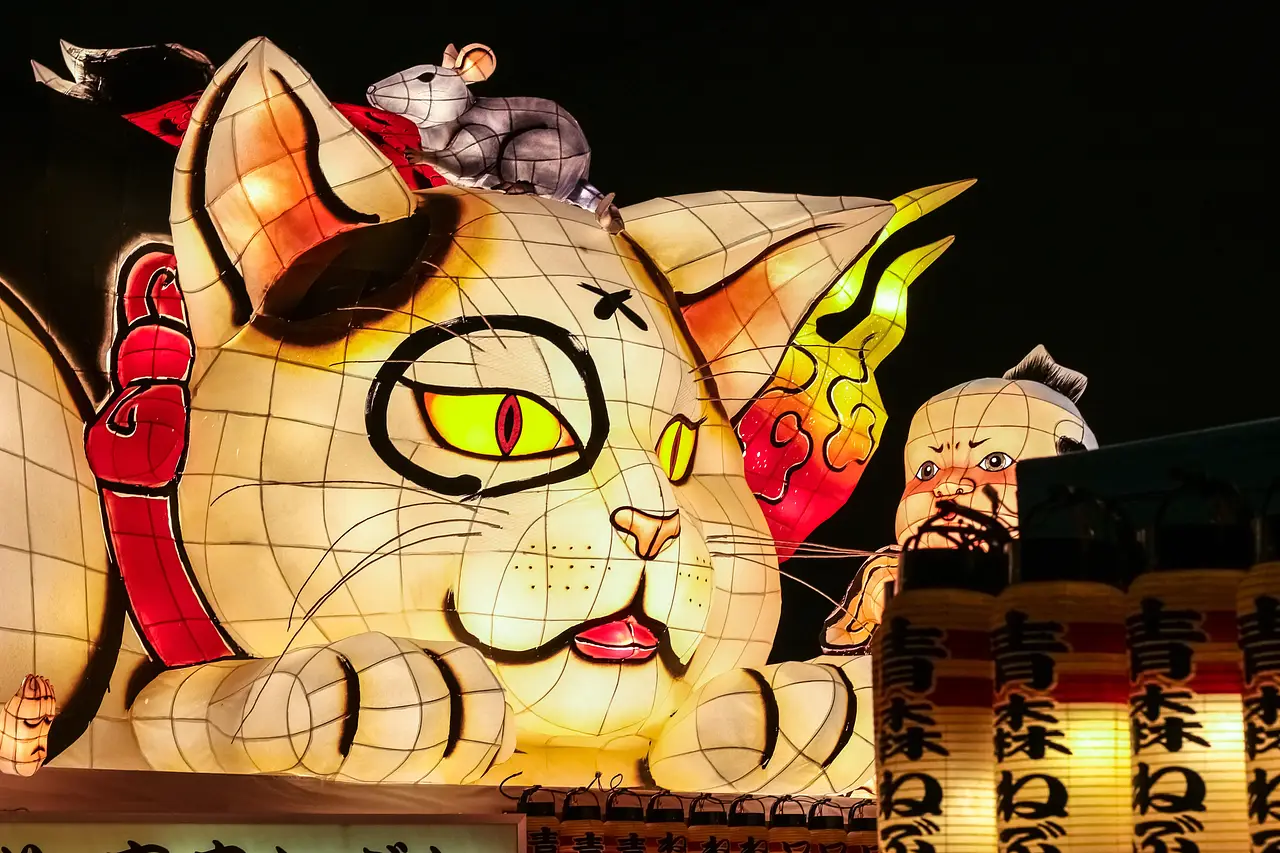
The centrepiece of each evening is the parade of nebuta floats along the 3.1-kilometre route through central Aomori. The floats are constructed from painted washi paper stretched over wire frames and illuminated from inside. Each large nebuta is 9 metres wide, 7 metres deep, and 5 metres tall, and most depict ancient warlords, historical figures, or kabuki characters in dramatic poses. The programme changes across the festival: the earlier nights feature a mix of children’s nebuta (smaller floats created by local councils and children’s associations) alongside large ones; from August 4 to 6, around twenty large nebuta parade exclusively, with the award-winning floats appearing on the final night, August 6.
Around the floats, the haneto dancers are what make the experience physical. Anyone wearing a haneto costume can join the parade and dance — no advance booking, no registration required. You simply wear the costume and fall in. The haneto costume consists of a white yukata with the hem rolled to the knee, a triangular straw hat (hanagasa) decorated with colourful artificial flowers, a bright shoulder strap, and bells worn at the waist. The dance is a two-step bounce with arms raised, turning in the procession as the taiko drums set the rhythm, the flutes carry the melody, and the hand cymbals (teburigane) accentuate the beat. Costumes can be purchased at department stores in Aomori City, and some stores also rent them and provide dressing assistance.
The festival closes on August 7 with a daytime parade followed by the marine procession in the evening. From 7:15 PM to 9:00 PM, the nebuta floats are placed on boats and ferried around Aomori Bay from Tsutsumi Wharf, with fireworks overhead. It is the most cinematic moment of the entire festival and worth staying for.
Rain does not cancel the event. If it rains, the floats are covered with large vinyl sheets and the procession continues. Bring a raincoat rather than an umbrella, which obstructs the view of other visitors.
The Floats and the People Who Build Them
The creators of the large nebuta are called nebutashi, or nebuta masters. After each festival ends, the masters begin planning the following year’s float immediately. The design is finalised in draft form during the winter. By May, the entire structure is built in studios using wood and wire. Light bulbs are installed inside, and the wire structure is covered on the inside with traditional Japanese washi paper. Once the paper is pasted to the complete structure, the craftsperson draws outlines in black charcoal ink, then traces patterns with melted candle wax, and finally applies colour with paintbrushes and spray. The finished float holds its light differently depending on which layer of the process produced each element — the wax-resist patterns, the ink outlines, the paint — creating a depth of colour under illumination that flat printing cannot replicate.
There are also children’s nebuta, created by local councils and children’s associations rather than professional nebutashi. These smaller floats parade on August 2, 3, and 7, and give younger participants and community groups their own space in the festival.

The Origins of the Festival
The Aomori Nebuta Matsuri is said to have originated as a variant of the Tanabata Festival, though the authenticity of the full origin story is uncertain — the official festival website is explicit about this. What the historical record supports is that the Tanabata traditions that arrived from China blended with the customs and events of the Tsugaru region, and that as paper, bamboo, and candles became widely available, simple lanterns grew into the elaborate illuminated structures seen today. Traditionally, nebuta were created by local councils and paraded every year. They have been getting larger and more detailed with each generation.
Who Is the Nebuta Matsuri For?
In short: everyone. But specifically:
Culture lovers: A living tradition with roots in the Tanabata customs of hundreds of years ago, now one of Japan’s most designated cultural properties.
Families: Particularly good during the August 2–3 and August 7 programmes, when children’s nebuta parade alongside the large floats. Daytime float viewing at Rasseland is excellent for families.
Solo travellers: Easy to navigate, impossible to feel isolated in. The haneto costume is an open invitation to participate.
Photographers: Giant illuminated warrior faces, costumed dancers mid-jump, and fireworks over a bay at night. The conditions here are exceptional.
People who want to actually do something: The haneto dancing is open to everyone, requires no booking, and is one of the more memorable things you can do at any festival anywhere. Arrive in costume, fall in behind a float, and bounce.
The festival is welcoming to international visitors. English information is available at nebuta.jp.
Pro Tips
Buy paid reserved seating in advance. Roadside spots fill early. Reserved seating gives you a guaranteed position and is available for overseas visitors through the official website (nebuta.jp). Check for vacancies on the day if you missed advance booking.
For the haneto dancing: no booking needed. Wear the costume and join any nebuta group from the starting point. Costumes can be purchased at Aomori City department stores; some stores also rent and will help you dress.
Bring cash. Street food vendors around the festival area operate largely cash-only. Kiritanpo (grilled rice skewers) and kakigori (shaved ice) are the local festival foods.
Stay hydrated. August in Aomori is warm and humid. A compact foldable fan and a water bottle are practical necessities for a two-hour evening parade.
Plan your exit in advance. The route empties into a city centre with limited late-night rail capacity. Know how you are getting home before the finale.
Book accommodation immediately. Multiple millions of visitors, six nights, a city of 270,000. Festival-date hotels near Aomori Station sell out months in advance.
If it rains, the festival continues. Floats are covered with vinyl. Bring a raincoat; umbrellas obstruct other visitors’ views and are not appropriate at the roadside.
What to Wear
Light breathable summer clothing and comfortable shoes — you will be standing for two hours or more. If you plan to dance as a haneto, the costume is specified: white yukata with hem rolled to the knee, pink or light blue undergarment (okoshi), triangular hanagasa straw hat with artificial flowers, bright shoulder strap, bells at the waist, and white split-toe tabi socks with zori sandals. Bind the sandals to your feet with cloth so they do not come off while dancing. Costumes are available for purchase at department stores in Aomori City; some stores also offer rental and dressing assistance.
How to Get There
The parade route is a 10-minute walk from JR Aomori Station. The station is served by the Aoimori Railway and, one stop south, by the Tohoku Shinkansen at Shin-Aomori Station.
From Tokyo: Tohoku Shinkansen (Hayabusa or Hayate) to Shin-Aomori Station — approximately 3 hours 10 minutes to 3 hours 45 minutes depending on service. JR Pass covered. One additional stop on the Aoimori Railway to JR Aomori Station, then 10 minutes on foot.
From Sendai: Tohoku Shinkansen to Shin-Aomori — approximately 1 hour 20 minutes. JR Pass covered. The Sendai Tanabata Festival runs August 6–8, which makes both festivals possible in a single Tohoku trip.
From Akita: JR Ou Main Line to Aomori — approximately 2–2.5 hours. The Akita Kanto Festival runs August 3–6. Combined with Sendai Tanabata (August 6–8), the Tohoku three-festival circuit is a genuinely outstanding August itinerary.
From Aomori Airport: Approximately 30 minutes by car. Domestic flights serve Aomori from Tokyo Haneda and other hubs.
If your trip covers multiple Tohoku cities, a JR Pass or Tohoku area pass is worth comparing against individual ticket prices. JRPass.com’s fare calculator works out the cheaper option for your specific itinerary.
The JR East–South Hokkaido Rail Pass — The Best Option for a Tohoku Multi-Stop Trip
If you are travelling to Aomori specifically for the Nebuta Matsuri and planning to combine it with other Tohoku destinations — or arriving from or continuing to Hokkaido — the JR East–South Hokkaido Rail Pass is worth considering seriously alongside the standard Japan Rail Pass.
The pass is valid for six consecutive calendar days and covers unlimited travel on JR East lines across the Kanto and Tohoku regions (including the Tohoku Shinkansen to Aomori), JR Hokkaido lines as far as Sapporo, the Aoimori Railway (which serves Aomori Station directly), the Tokyo Monorail, and several partner lines. It includes the Hokkaido Shinkansen, meaning you can travel from Tokyo all the way to Shin-Hakodate-Hokuto in Hokkaido on a single pass — useful for anyone doing the Tohoku–Hokkaido circuit in either direction. Adults pay $262 for six days; children aged 6–11 pay $135. Children under 6 who do not require a reserved seat travel free.
The pass is available to holders of non-Japanese passports only, and can be purchased at <a href="https://www.jrpass.com/" data-cta="hero"></a>
.
.jpeg "Hayabusa Shinkansen in Aomori")
Nearby Recommendations
Food and Drink
Kiritanpo and Aomori izakayas: Local izakayas near the station serve Aomori specialities including kiritanpo (grilled rice skewers in hot pot) and fresh seafood from the bay.
Furukawa Fish Market: The morning destination for the city’s freshest seafood, including Aomori Bay scallops, sea urchin, and tuna.
Ringo (apple) products: Aomori produces approximately 60% of Japan’s apples. Apple juice, cider, and confectionery are excellent and widely available.
Attractions and Experiences
Warasse – Nebuta Museum: Purpose-built museum on the waterfront displaying winning floats from recent festivals, fully illuminated. Live taiko and flute performances daily. Admission approximately ¥620. Open year-round — the best way to experience the floats outside the festival period.
Aomori Museum of Art: Contemporary Japanese art with a permanent installation by Yoshitomo Nara, who is from nearby Hirosaki.
Hirosaki Castle: 40 minutes by JR train. One of Japan’s twelve original surviving Edo-period castle structures. Famous for cherry blossoms but worth visiting year-round.
Hakkoda Mountains: 45 minutes by bus. Cable car access, hiking, and hot springs. A completely different landscape from the festival city below.
Sukayu Onsen: A legendary hot spring inn in the Hakkoda Mountains with a 1,000-person mixed-gender cypress bathing hall. Reserve well in advance.
Where to Stay
Hotels near JR Aomori Station are the most practical base — a 10-minute walk from the parade route, with easy access to Rasseland and the waterfront. August 2–7 is peak demand for the entire year in Aomori City. Book as early as possible, ideally months in advance. JapanDen has accommodation options across the city.
Planning Your Visit
Book accommodation immediately. Festival-date hotels near JR Aomori Station sell out months ahead. This is the highest-demand period of the year in Aomori City. JapanDen has options across the city.
Reserve parade seating in advance. Check the official website (nebuta.jp) for overseas visitor seat reservation details. Walk-up availability is not guaranteed.
Use a JR Pass or compare individual ticket prices if your trip includes multiple Tohoku cities. JRPass.com’s fare calculator works this out for your specific itinerary.
Stay connected with a Pocket Wi-Fi for real-time navigation around the festival route and updates on the evening’s programme.
Japan runs on etiquette. Be respectful, keep the space around you tidy, do not use an umbrella if it rains, and queue properly. And if you are wearing a haneto costume and you can hear the taiko starting — bounce.
FAQs About Aomori Nebuta Matsuri
Q: What is the Aomori Nebuta Matsuri?
A: One of Japan’s most famous summer festivals, held annually August 2–7 in Aomori City. The main attraction is a parade of large illuminated floats called nebuta — 9 metres wide, 7 metres deep, and 5 metres tall — depicting warriors, historical figures, and kabuki characters, accompanied by taiko drums, flutes, and hand cymbals, with haneto dancers leaping around the floats chanting “Rassera.”
Q: When is the Nebuta Matsuri?
A: August 2 to 7 each year. Pre-festival events at Rasseland run on August 1 (3:00 PM – 9:00 PM). Evening parades on August 2–3 start at 7:00 PM; August 4–6 start at 6:45 PM. August 7 has a daytime parade from 1:00 PM and an evening marine procession and fireworks from 7:15 PM to 9:00 PM.
Q: Is the Nebuta Matsuri free to attend?
A: General roadside viewing is free. Paid reserved seating is available along the route and is recommended — book in advance through the official website. If there are vacancies they can be purchased on the day of the event.
Q: Can I join the parade as a haneto dancer?
A: Yes. Anyone wearing a haneto costume can join — no advance booking or registration required. Walk to the starting point in costume and join any nebuta group. Haneto costumes are available for purchase at department stores in Aomori City; some stores also rent costumes and provide dressing assistance.
Q: What does the haneto costume look like?
A: A white yukata with the hem rolled to the knee, a pink or light blue undergarment (okoshi), a triangular straw hat (hanagasa) with colourful artificial flowers, a bright shoulder strap, bells at the waist, white split-toe tabi socks, and zori sandals. Bind the sandals to your feet with cloth before dancing so they do not come off.
Q: What happens on August 7?
A: A daytime parade of approximately 15 children’s and large nebuta combined runs from 1:00 PM. In the evening, from 7:15 PM to 9:00 PM, the floats are placed on boats and ferried around Aomori Bay in a marine procession, accompanied by the Aomori Fireworks Festival. The venue is Aomori Port, from Tsutsumi Wharf to the Hakkodamaru.
Q: What happens if it rains?
A: The festival continues regardless of rain. The nebuta floats are covered with large vinyl sheets. Visitors are asked to bring a raincoat rather than an umbrella, as umbrellas obstruct the view of other spectators along the route.
Q: How do I get from Tokyo to Aomori?
A: Take the Tohoku Shinkansen (Hayabusa or Hayate services) from Tokyo Station to Shin-Aomori Station — approximately 3 hours 10 minutes to 3 hours 45 minutes.
Covered by the Japan Rail Pass. Transfer one stop on the Aoimori Railway to JR Aomori Station; the parade route is then a 10-minute walk.
Q: Can I combine Nebuta with other Tohoku festivals?
A: Yes — this is one of Japan’s best August itineraries. The Akita Kanto Festival (August 3–6, bamboo pole lantern balancing) and Sendai Tanabata (August 6–8, decorated paper streamers) are the other two Tohoku Sandai Matsuri. All three are linked by Shinkansen and a JR Pass covers the connections.
Q: Where can I find official information?
A: The official English-language website is nebuta.jp. The Aomori Nebuta Festival Executive Committee can be reached by email at [email protected] for specific enquiries including overseas visitor seat reservations.