Workation in Japan

Work hard, play hard
Japan has evolved into a premier destination for remote workation seekers. Whether you are looking for the neon energy of Shinjuku or the serene temples of Kyoto, a workation in Japan (a portmanteau of "work" and "vacation") i.e a holiday combining work and play, offers the perfect balance of professional productivity and cultural immersion.
With the 2024 launch of the official Digital Nomad Visa and a nation-wide push for "work-style reform," Japan’s infrastructure for remote work trips is better than ever.

A workation works well if you:
・Can work remotely with a laptop
・Don’t need constant late-night calls
・Want structure (work hours) + freedom (travel)
Japan is especially suited because:
・Trains are fast and punctual
・Cafes and coworking spaces are everywhere
・Cities are compact and walkable
・Public safety and cleanliness reduce stress
This time zone overlaps mostly with the Asia-Pacific region.
It also overlaps partially with the morning hours in Europe.
This may be difficult for US-based schedules unless you adjust your time.
Most business hotels and apartment hotels offer speeds of over 100Mbps. Pocket Wi-Fi or an eSIM/SIM card is essential for reliability on the go. You can operate and join calls from anywhere.
Visa: Most tourists from over 70 countries can enter the country visa-free for 90 days.
If your annual income exceeds ¥10 million, a six-month Digital Nomad Visa is an option.(Must have medical insurance)
Expect to spend around ¥150,000 to ¥300,000 per month, depending on your lifestyle. Tokyo is the most expensive, while cities like Fukuoka and Osaka are more cost-effective.
Accommodation: ¥7,000-¥15,000 per night (longer stays are cheaper)
Coworking space: ¥1,500-¥3,000 per day
Transportation: Use a JR Pass or Regional Pass for savings.
Food: ¥1,000-¥1,500 per meal (snacks)
Example:
Morning (8:00-12:00): Focus on work (3-4 hours)
Afternoon (12:00-3:00 PM): Take a break after lunch and visit a cafe or sightseeing
Evening (3:00-7:00 PM): Light work (2-3 hours)
Evening (after 7:00 PM): Walk, eat local food
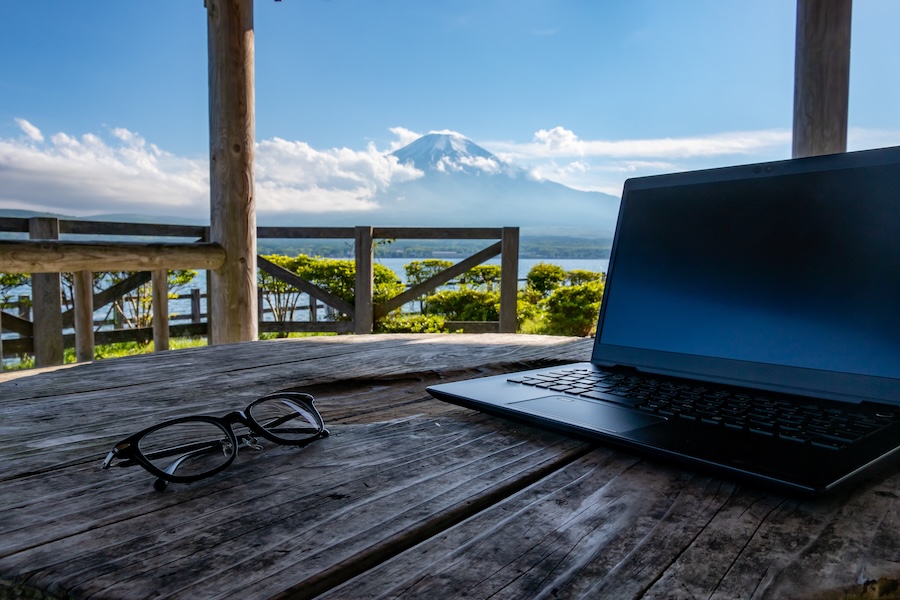
Here are the latest recommended spots for this year, combining the convenience of the city with the laid-back pace of the countryside.
For other tips on finding the best places in Japan for workation, check out JRPass blog.
・Why: An overwhelming number of coworking spaces, 24-hour cafes, and convenience.
・Work Environment: AWS Loft (Meguro) and various WeWork locations. For cafes, Daikanyama and Shibuya are home to many "nomad-friendly" establishments with power outlets and Wi-Fi.
・Accommodation: Apartment hotels in Shinjuku and Shibuya (such as MIMARU), or shared houses with long-term discounts.
・Best Season: Year-round (especially spring and fall).
・Weekend Trips: Kamakura (beach) and Hakone (hot springs), both an hour away by train.
・Why: Prices are lower than Tokyo, and the community is friendly.
・Work Environment: The DECK (Honmachi) and FUTRWORKS (Umeda). Networking is popular in lively lounges.
・Accommodation: Business hotels around Namba or monthly apartments with kitchens.
・Best season: Autumn (October-November).
・Weekend trip: Kyoto, a 30-minute train ride away, or Nara, where you can spot deer.
・Why: Surrounded by temples and gardens, it's an environment conducive to deep concentration.
・Work environment: Popular options include offices and accommodation converted from century-old townhouses, such as Unknown Kyoto (Gojo).
・Accommodation: Private Kyoto townhouses or designer hostels in the Higashiyama area.
・Best season: November (autumn leaves) or May (fresh greenery).
・Weekend trip: Glamping around Lake Biwa in Shiga Prefecture or touring the tea fields of Uji.
・Reason: Close to the airport, city, and sea, making it easy to refresh after work.
・Work Environment: Engineer Cafe (a red brick Important Cultural Property) or andwork fukuoka.
・Accommodation: Serviced apartments in Tenjin and Hakata.
・Best Season: Spring (April-May) and Autumn.
・Weekend Trips: Itoshima (a drive along the coast) or Oita/Beppu (hot springs).
・Reason: Cool summer temperatures and powder snow in winter. Urban functions concentrated in a compact area.
・Work Environment: Village Sapporo. Cafes around Odori Park are also work-friendly.
・Accommodation: Long-term stay hotels around Sapporo Station.
・Best Season: July-August (refreshing summer), February (Snow Festival).
・Weekend Trips: Otaru (canals and seafood) or Niseko (ski resort).
・Reason: The blue ocean outside the window. Relieve work stress in a resort atmosphere.
・Work Environment: ESTINATE HOTEL (Naha) or a coworking space with a terrace overlooking the ocean.
・Accommodation: Condominium with kitchen in Onna Village.
・Best Season: April-June (before the rainy season) or October-November.
・Weekend Trips: Kerama Islands (snorkeling) or Kouri Island.
・Reason: One hour from Tokyo by Shinkansen. A high-altitude resort that's cool even in summer.
・Work Environment: Karuizawa Prince The Workation Core. A quiet space surrounded by forest.
・Accommodation: Rented villas (log cabins) or small highland hotels.
・Best season: May to September (to escape the summer heat).
・Weekend trips: Jigokudani Monkey Park (snow monkeys) or Matsumoto Castle.
・Reason: Nicknamed "Little Kyoto," it's packed with art museums and historical sites within walking distance.
・Work environment: KUMU Kanazawa. The hotel's first floor features a stylish shared space.
・Accommodation: Renovated hotel near Korinbo.
・Best season: Spring (April) or winter (snow scenery and crabs).
・Weekend trips: Noto Peninsula (Wajima Morning Market) or Shirakawa-go (World Heritage Site).
For a successful workation, be sure to check the following amenities.
・High-Speed Wi-Fi: When booking a hotel, don't just look for "Wi-Fi in all rooms"—check reviews to see if the speed is 30Mbps or higher. Ideally, speeds of 30Mbps or higher are ideal for Zoom meetings.
・Desk and Chair Quality: For long-term work, you'll need a chair with a back (not a round stool) and a desk large enough to accommodate your laptop.
・Check Quiet Hours: For late-night or early-morning meetings with overseas partners, consider a soundproof business hotel or a coworking space with 24-hour access.
・Laundry Facilities: If you're staying for a week or more, check whether the hotel has a washer/dryer or a nearby coin laundry.
・Long-Term Stay Discounts: For stays of 7 or more nights, look for weekly/monthly plans that offer savings of 20-40% off regular rates.
Here are two ideas: one for a week plan, and the other for an entire workation month.
This plan minimizes travel for first-timers.
Based in Shibuya or Shinjuku, experience the latest coworking spaces. Dine in the neon-lit streets at night.
One-hour train ride from Tokyo. Work at a cafe with an ocean view in the morning, then relax on the beach in the evening.
Museum visits and shopping. Return home on Sunday.
Recommended Pass: "Suica/Pasmo" or "JR TOKYO Wide Pass" for travel within the Tokyo metropolitan area.
A long-term plan that explores Japan's diversity from north to south.
Enjoy Hokkaido's cool climate and fresh seafood while working in an urban environment.
A week to immerse yourself in traditional Japanese culture. Focus on creative work in a quiet environment.
Feel the energy of the gateway to Asia. Savor street food in between work.
Spend your final week at the beach. Relax at a resort and catch up on any remaining tasks.
Recommended Pass: For long-distance travel between cities, the JR Pass is the most efficient option.
・Reserve a Pocket Wifi/SIM card
(essential as a backup connection, especially if your accommodation Wi-Fi is unstable or you need to work from cafés, coworking spaces, or on the move)
・Purchase a JR Pass or Regional Pass
(to lock in your main intercity travel plan, save time booking tickets last-minute, and make it easier to move between cities during your workation)
・Find work-friendly accommodation through JapanDen
(so you don’t gamble on internet quality, desk setup, noise levels, or location. Prioritize fast Wi-Fi, a real workspace, and easy access to transport)
・Noise-canceling headset
(to stay productive in cafés, trains, and shared spaces, and to keep calls professional even when your environment isn’t)
・Purchase international and domestic travel insurance
(for medical coverage and peace of mind, and to protect you financially if plans change, including delays or cancellations during your stay)
・By using Meet & Greet, you can enjoy a smooth journey from the moment you arrive in Japan.
(it removes friction on day one. someone meets you at the airport, helps you navigate arrivals, and gets you on track fast so you can settle in and start your trip calmly)
Q: Is it legal to work remotely in Japan on a tourist visa?
A: Generally, short-term remote work for overseas companies is permitted as long as the income is not sourced in Japan or related to a Japanese company. For stays longer than 90 days, please check the specific requirements for your Digital Nomad Visa.
Q: What's the best way to ensure a stable internet connection?
A: There are plenty of cafes, but some have time limits. Pocket Wi-Fi is the most reliable "safety net" for full-scale remote work to avoid the security risks of public Wi-Fi.
Q: Where can I find English-speaking coworking spaces?
A: Major brands like WeWork and The Executive Centre offer full English support and premium amenities in Tokyo, Osaka, and Fukuoka.
Q:Is Japan a good place for digital nomads?
Yes. Japan is safe, has excellent public transportation, and offers a growing number of coworking and accommodation options.
Why should I book with JapanDen?
How do I book a hotel or ryokan through JapanDen?
What types of accommodations do you offer in Japan?
How can JapanDen help with planning my trip?
As well as booking accommodation, JapanDen is a place to learn more about Japan and how you can make the most of your time in this special country. From in-depth region guides to stories from Japan, we’ll be regularly publishing carefully curated insights from Japanese culture, with recommendations for the best activities and attractions and the latest news. Looking forward, we’ll also be adding special community features so you can share ideas and inspiration with like-minded people. Please come back and visit us regularly as we continue to add new content. We want JapanDen to be your home away from home too.
Do you offer guided tours in Japan, and how can I book one?
As part of the JRPass.com group, we offer a dedicated Meet and Greet service with expert personal assistance on your arrival in Japan booked via JRPass.com, alongside nationwide and regional rail passes for travel. As JapanDen grows, we will be offering more services and activities to provide a complete Japan travel experience.
Can I purchase Japan Rail Passes through your website?
JapanDen is part of the JRPass.com group, book your passes and tickets directly on JRPass.com
.jpg)