teamLab Botanical Garden Osaka: A Guide to the Night Exhibition at Nagai Botanical Garden
Key Details
Venue | Nagai Botanical Garden, inside Nagai Park, Osaka |
Type | Outdoor night art exhibition |
Organiser | teamLab |
Admission (Adults, 16+) | JPY 2,200 |
Admission (Children, 6–15) | JPY 700 |
Disability Discount | JPY 1,100 (holder + up to one accompanying person) |
Children — Osaka residents | Free (elementary and junior high school students residing in Osaka Prefecture; ID required at admission) |
Re-entry | Not permitted |
Duration | No time limit after admission — you may stay until closing time |
Tickets | Set admission dates and times. Available online in advance or on the day if not sold out. On-site purchase available at different prices; may sell out. |
At the centre of Nagai Park in Osaka sits a botanical garden that opened in 1974. It covers 240,000 square metres, contains a large lake, and changes character completely with the seasons. In the fifty years since it opened, the garden has become home to wild birds including Northern goshawks and owls, species that occupy the top of the food chain and can only exist where the ecosystem beneath them is healthy. In the middle of a major city, the garden and its lake sustain a living ecosystem that includes human beings as part of it.
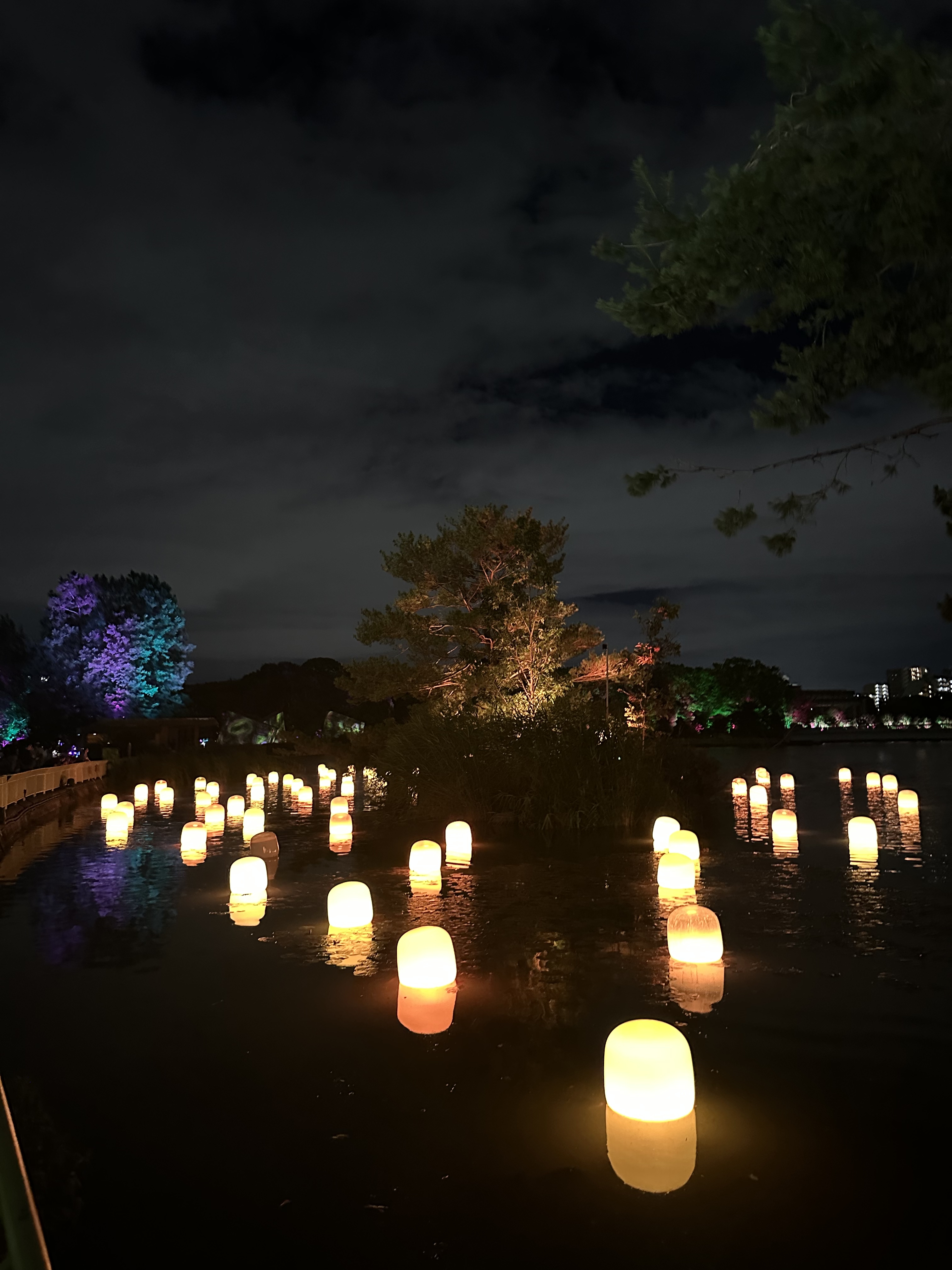
After dark, teamLab transforms this space into an outdoor art exhibition. The installation artworks are not placed in the garden as separate objects — they are designed to be directly influenced by the trees, birds, wind, rain, and people that exist in the same space. The result is an experience that is harder to categorise than a conventional art exhibition and more immediate than a light show: the garden remains a living ecosystem, and the artworks are continuous with everything that moves through it.
Special update: You can now buy single rail tickets for Japan’s Golden Route on JRPass.com - single fares, one-way, fully digital, including the Shinkansen 'bullet' train.
.jpg "teamLab Botanical Garden Osaka")
teamLab’s philosophical framework for this exhibition is built around a single question: where are the contours of the existence of life?
Objects like stones maintain a stable structure on their own. A stone can sit in a sealed box, cut off from the outside world, and continue to exist. Life cannot. A living thing consumes matter and energy from its environment, processes and discharges it, and sustains its ordered structure precisely because it is not sealed off. Life is more like a vortex in water than a stone: remove a vortex from the ocean and place it in a closed container, and it disappears immediately, because it has no independent structure. The vortex exists only in the continuous flow of water moving in and out. Its contour — the boundary of its existence — is ambiguous.
The same is true of living organisms. The contour of life is not a physical bodily boundary but an ambiguous one that includes continuity with its environment. Life is not defined by physical borders. It is continuous with its environment.
teamLab’s ongoing project Digitized Nature explores how nature can become art through non-material digital technology — a process that transforms nature into art without harming it. In this exhibition, that principle has a specific consequence: the artworks are influenced by the trees and birds that live in the garden. If the wildlife disappears, the artworks disappear with them. The trees and birds cannot be separated from the forest and lake that sustain them, so if the ecosystem is not maintained, both the wildlife and the artworks cease to exist. The artworks’ existence is not defined by a physical surface or boundary. It is continuous and ambiguous with the surrounding environment.
The works also transform interactively in response to wind, rain, and the movements of people within them. The environment and the people who move through it become part of the artworks themselves. People, artworks, trees, forest, lake, ecosystem, and environment form a continuity without boundaries.
Two permanent interactive installations form the core of the exhibition.
Resonating Microcosms in the Common Camellia Garden — Solidified Light Color, Dusk to Dawn
teamLab, 2022. Interactive Installation. Sound: Hideaki Takahashi. Production Support: Hirohito Saito (OryZa Design), Shinya Yoshida (SYD INC.)
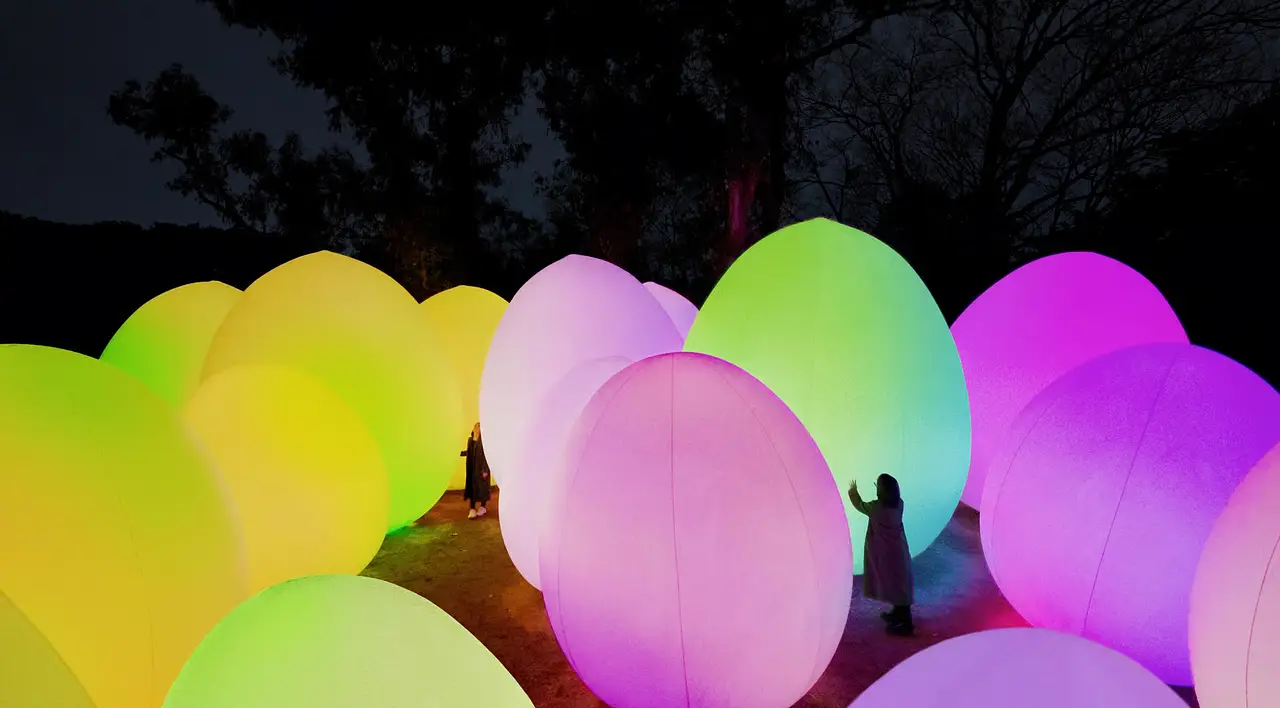
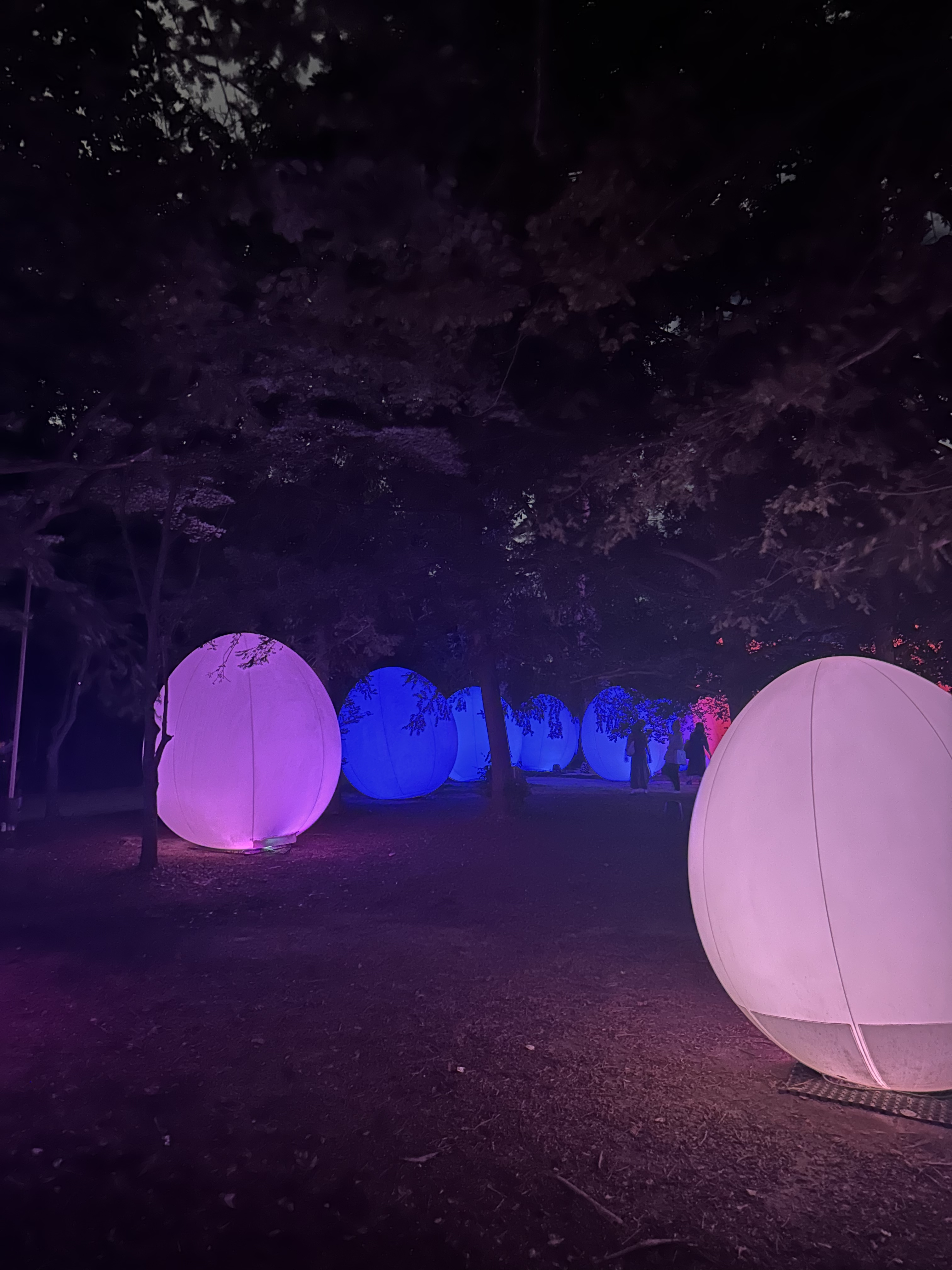
This installation fills the camellia garden with ovoids — rounded forms that change their behaviour entirely as the light shifts from day to night. Under sunlight, the ovoids reflect the world around them. As the sun sets, they begin to emit their own light.
When an ovoid is pushed by a person, blown by the wind, or struck by rain, it shines brightly and produces a tone as it rights itself. The surrounding ovoids respond in sequence, resonating with the same tone and the same light colour. When the wind is quiet and no one is interacting with them, the ovoids begin to flicker slowly on their own. The ovoids can change into a total of 61 newly defined Solidified Light Colors.
Forest of Autonomous Resonating Life — Eucalyptus
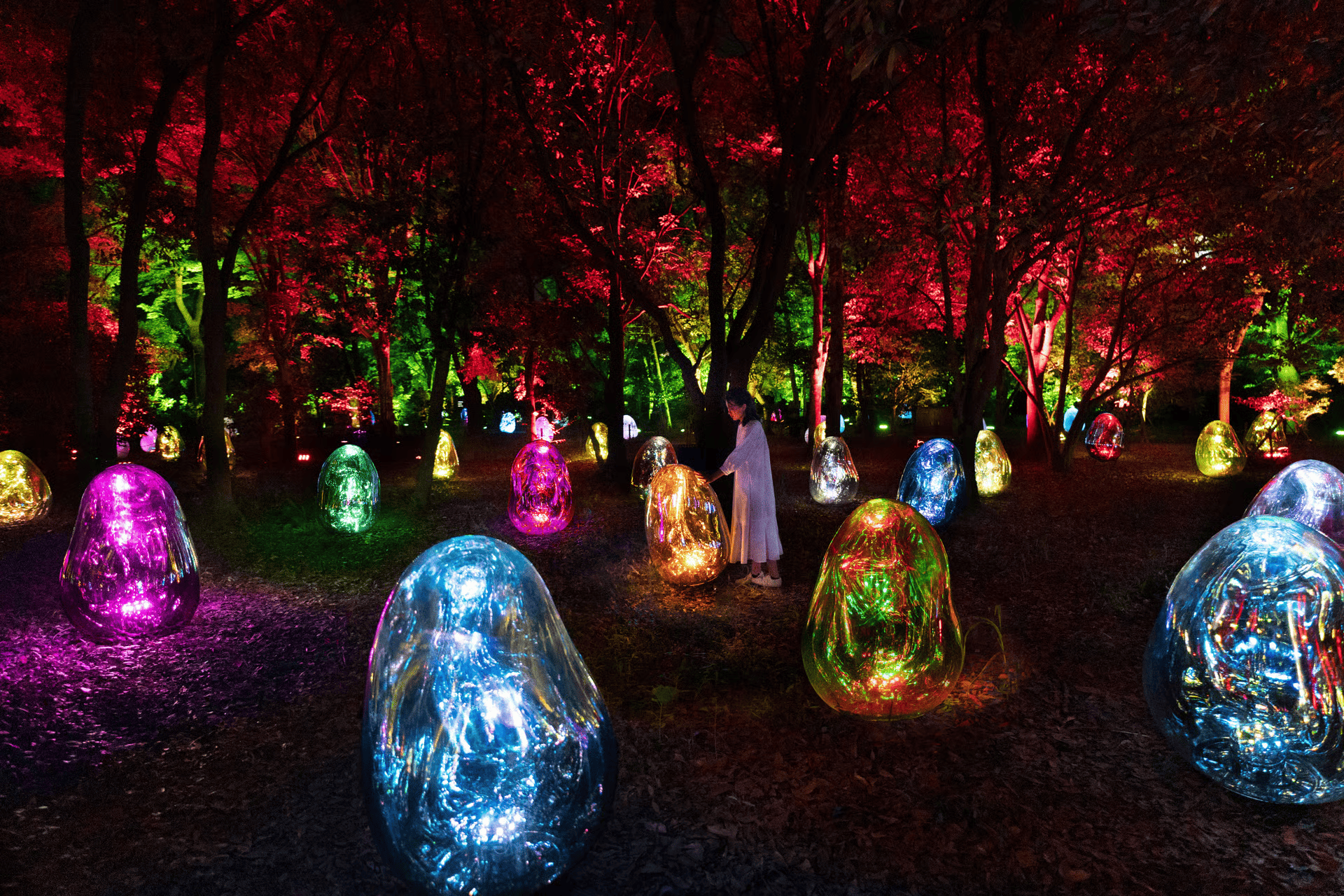
teamLab, 2018. Interactive Installation, Endless. Sound: Hideaki Takahashi, teamLab.
In the Eucalyptus park, densely packed ovoids of light stand as autonomous entities. When an ovoid is knocked over — by a person moving through the space or by the wind — it rises back up as the colour of its light changes and emits a tone specific to that colour. The surrounding ovoids respond one after another, resonating with the same tone and colour.
When the wind is not blowing and no one nearby is interacting with the ovoids, their lights begin to blink slowly. If a wave of light arrives from the far side of the installation, it indicates the presence of other people in that part of the space. Visitors develop a heightened awareness of the existence of other people sharing the same environment, mediated through light and sound rather than sight.
.jpg "teamLab, 2018, Interactive Installation, Endless, Sound: Hideaki Takahashi, teamLab")
Opening Hours
The exhibition is an evening event. Opening times vary by season; last entry is at 20:30 throughout the run. If you arrive after the last admission time, entry is not permitted.
June 1 – July 31, 2026 (Mon–Fri) | 19:45 – 21:30 | Last entry 20:30 |
August 1 – 14, 2026 (Sat–Fri) | 19:15 – 21:30 | Last entry 20:30 |
August 15 – 31, 2026 (Sat–Mon) | 19:30 – 21:30 | Last entry 20:30 |
September 1 – 13, 2026 (Tue–Sun) | 19:00 – 21:30 | Last entry 20:30 |
September 15 – 30, 2026 (Tue–Wed) | 18:30 – 21:30 | Last entry 20:30 |
Hours vary depending on the season. Always check the official teamLab website before visiting to confirm current hours.
The exhibition is closed on irregular dates. The following closure dates are listed for 2026:
July 6, 2026
July 27, 2026
August 24, 2026
September 14, 2026
September 28, 2026
Tickets have set admission dates and times. Once inside, there is no limit on how long you can stay — you may remain until closing time. Re-entry is not permitted after leaving.
Adults (16 and above) | JPY 2,200 |
Children (6–15 years) | JPY 700 |
Disability Discount | JPY 1,100 — available to holders of a disability certificate, along with up to one accompanying person. Each person must have a ticket to enter. |
Children living in Osaka Prefecture | Free — open to elementary and junior high school students residing in Osaka Prefecture. ID showing age and Osaka Prefecture residency required at admission (health insurance card, passport, personal number card, basic resident registration card, or any other book issued by a public institution). |
Tickets can be purchased in advance through the official ticket website. If not sold out, tickets are also available on the day of the event from the official website. On-site purchase is available but at different prices, and tickets may sell out.
teamLab was founded in 2001 and is an international art collective whose collaborative practice navigates the confluence of art, science, technology, and the natural world. The interdisciplinary group includes artists, programmers, engineers, CG animators, mathematicians, and architects. Through art, the collective aims to explore the relationship between the self and the world, and new forms of perception.
In order to understand the world around them, people separate it into independent entities with perceived boundaries between them. teamLab seeks to transcend these boundaries — in our perceptions of the world, in the relationship between the self and the world, and in the continuity of time. Everything exists in a long, fragile yet miraculous, borderless continuity.
teamLab’s works are in the permanent collection of institutions including the National Gallery of Victoria (Melbourne), the Art Gallery of New South Wales (Sydney), the Art Gallery of South Australia (Adelaide), the National Gallery of Australia (Canberra), Amos Rex (Helsinki), the Museum of Contemporary Art Los Angeles, the Asian Art Museum San Francisco, Borusan Contemporary Art Collection (Istanbul), and the Asia Society Museum (New York), among others.
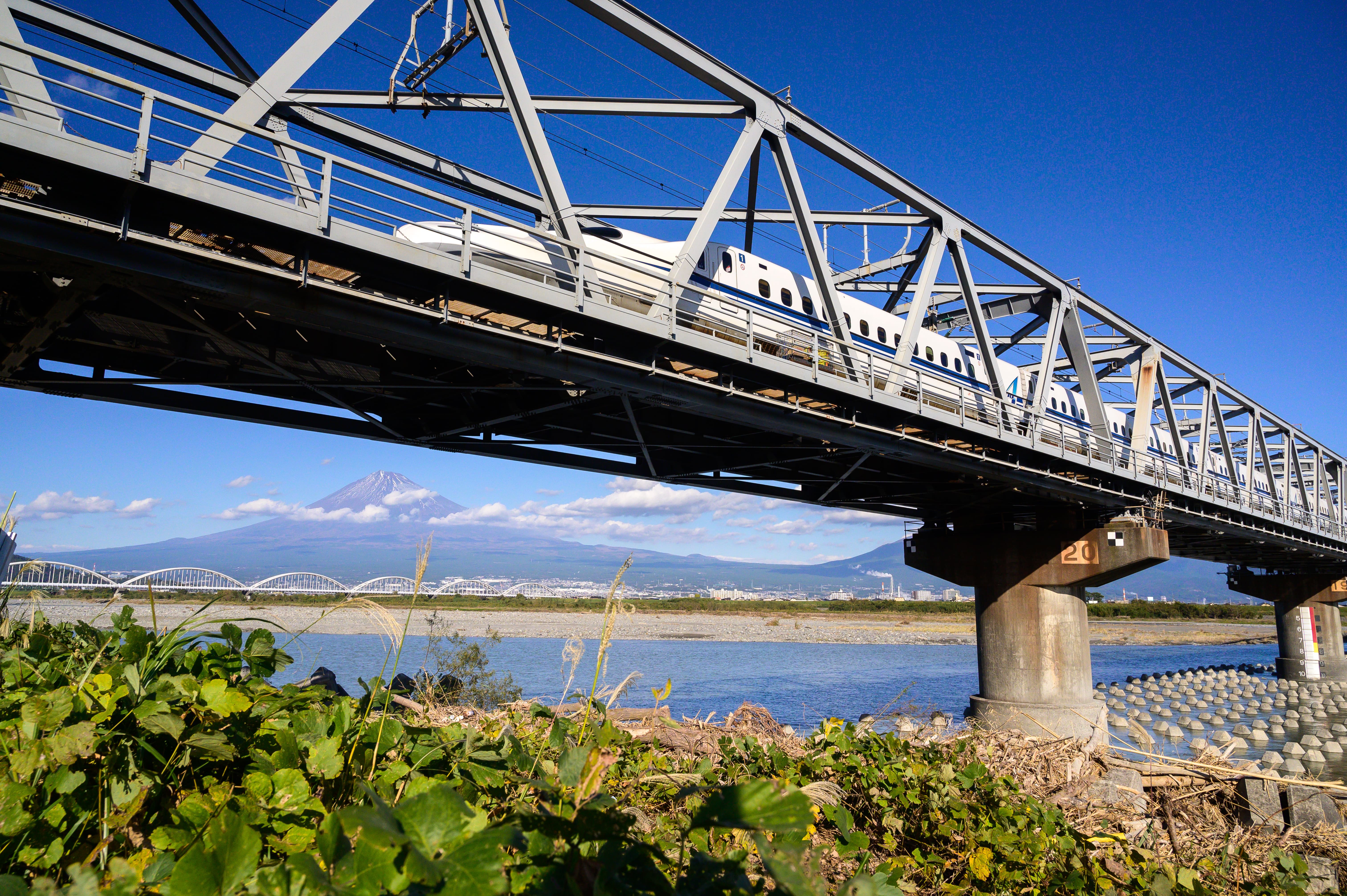
Osaka is approximately 2 hours 30 minutes from Tokyo on the Tokaido Shinkansen. It is one of the most travelled rail routes in Japan and the backbone of what travellers call the Golden Route — the circuit connecting Tokyo, Mount Fuji, Hakone, Kyoto, Nara, and Osaka that covers most of what first-time visitors want to see in a single trip.
There are now three ways to cover this route, and the right one depends on how your wider trip is structured.
JR Pass — Best for Multi-City Itineraries
The Japan Rail Pass covers Shinkansen travel between Tokyo and Osaka (on Hikari and Kodama services), as well as trains to Kyoto, Hiroshima, Nara, and dozens of other destinations. If your trip spans a week or more and includes multiple cities, the pass typically saves money and removes the friction of buying individual tickets at each stop. A 7-day JR Pass starts from approximately ¥50,000.
Regional Pass — Best for Focused Kansai Stays
If you are spending most of your time in Osaka, Kyoto, Nara, and the Kansai region specifically, a JR Kansai Pass or Kansai Wide Area Pass covers the routes you need within that area at a lower price than the national pass. Useful for visitors who fly into Osaka and plan to stay in the region rather than travel the full length of Honshu.
Point-to-Point Shinkansen Tickets — Best for Shorter Trips
JRPass.com now sells individual Shinkansen tickets for the Tokyo–Osaka route, from ¥14,720 one way. The ticket is delivered as a QR code by email, shown at the gate on your phone — no printing, no Japanese, no queuing at a ticket machine. The booking takes under two minutes.
This is the right option if you are doing a short trip (five days or fewer), already know exactly which cities you are visiting, or are travelling primarily between Tokyo and Osaka without needing a pass for local JR trains. Two single tickets cost around ¥29,440 — significantly less than a 7-day JR Pass if your itinerary only requires those two journeys. JRPass.com also has a fare calculator that works out which option saves more money for your specific trip.
Tokyo → Osaka by Shinkansen | ~2 hours 30 minutes | Tokaido Shinkansen (Hikari or Kodama for JR Pass; Nozomi fastest but requires supplement) |
7-day JR Pass | From ~¥50,000 | Covers Tokyo–Osaka + all other JR routes including Kyoto, Nara, Hiroshima |
The following questions are based on the information provided by the official exhibition source.
Q: What is teamLab Botanical Garden Osaka?
A: It is an outdoor night art exhibition held at Nagai Botanical Garden inside Nagai Park, Osaka. The exhibition is produced by teamLab and features interactive digital art installations that respond to the garden’s ecosystem, including its trees, birds, wind, rain, and visitors.
Q: What are the opening hours?
A: Hours vary by season. During the summer months the exhibition opens between 18:30 and 19:45 depending on the period, and closes at 21:30. Last entry is always at 20:30. Check the official teamLab website for the current period’s hours before visiting.
Q: How much does it cost to enter?
A: Adults (16 and above): JPY 2,200. Children aged 6–15: JPY 700. Disability discount: JPY 1,100 (certificate holder plus up to one accompanying person). Children who are elementary or junior high school students residing in Osaka Prefecture enter free, with valid ID.
Q: Can I stay as long as I want once inside?
A: Yes. There is no time limit on your visit once you have been admitted. You may stay until closing time (21:30). Re-entry is not permitted after you leave.
Q: Do I need to book tickets in advance?
A: Tickets have set admission dates and times, and advance booking through the official ticket website is recommended. If tickets are not sold out, they can also be purchased on the day from the official website or on-site, though on-site prices differ and tickets may sell out.
Q: Are there any dates when the exhibition is closed?
A: Yes. Irregular closure dates in 2026 include July 6, July 27, August 24, September 14, and September 28. Always confirm the current closure schedule on the official teamLab website before your visit.
Q: What artworks are in the exhibition?
A: The exhibition includes two interactive installations: Resonating Microcosms in the Common Camellia Garden – Solidified Light Color, Dusk to Dawn (teamLab, 2022), in which light-emitting ovoids respond to touch, wind, and rain; and Forest of Autonomous Resonating Life – Eucalyptus (teamLab, 2018), in which autonomous ovoids of light in the Eucalyptus park resonate with each other and with the movements of visitors.
Q: Why do the artworks respond to the garden’s ecosystem?
A: teamLab’s concept for this exhibition is that the artworks are directly influenced by the trees and birds living in the garden. If the wildlife disappears, the artworks disappear with them. The artworks’ existence is not defined by a physical boundary but is continuous with the surrounding environment — including the ecosystem, the weather, and the people who move through the space.
Q: Is the exhibition suitable for children?
A: Yes. Children aged 6–15 are admitted at a reduced rate of JPY 550, and children who are elementary or junior high school students residing in Osaka Prefecture enter free with valid ID. Under-6s are not listed with a separate ticket price; check the official website for the current policy on very young children.
Q: Where is Nagai Botanical Garden?
A: Nagai Botanical Garden is an outdoor botanical garden inside Nagai Park, Osaka. The garden opened in 1974 and covers 240,000 square metres, with a large lake at its centre. Nagai Park itself opened in 1944 as an urban park that includes facilities such as a baseball stadium.
Why should I book with JapanDen?
How do I book a hotel or ryokan through JapanDen?
What types of accommodations do you offer in Japan?
How can JapanDen help with planning my trip?
As well as booking accommodation, JapanDen is a place to learn more about Japan and how you can make the most of your time in this special country. From in-depth region guides to stories from Japan, we’ll be regularly publishing carefully curated insights from Japanese culture, with recommendations for the best activities and attractions and the latest news. Looking forward, we’ll also be adding special community features so you can share ideas and inspiration with like-minded people. Please come back and visit us regularly as we continue to add new content. We want JapanDen to be your home away from home too.
Do you offer guided tours in Japan, and how can I book one?
As part of the JRPass.com group, we offer a dedicated Meet and Greet service with expert personal assistance on your arrival in Japan booked via JRPass.com, alongside nationwide and regional rail passes for travel. As JapanDen grows, we will be offering more services and activities to provide a complete Japan travel experience.
Can I purchase Japan Rail Passes through your website?
JapanDen is part of the JRPass.com group, book your passes and tickets directly on JRPass.com