Sumiyoshi Matsuri: Osaka's Oldest Shrine Festival
The festival that closes Osaka's summer, and somehow gave Japan stand-up comedy
Venue: Sumiyoshi Taisha, Osaka
When: July 30 – August 1 (main procession August 1)
Osaka considered the concept and responded, "Let's purify everyone's soul, parade portable shrines through the streets, and accidentally invent comedy." Welcome to Sumiyoshi Matsuri, the great festival of Sumiyoshi Taisha, one of Japan's most ancient and significant temples. It isn't as well-known internationally as Tenjin Matsuri, but that doesn't seem to concern it. For generations, this festival has quietly closed Osaka's summer with purifying ceremonies, stunning mikoshi processions, and enough food vendors to convince you that festival calories have their own legal category. Come for the history.
Stay because someone will serve you grilled squid while a movable shrine passes beneath one of Japan's oldest shrine gates. Suddenly, your itinerary has become much more fascinating.

Here's what you should know before your visit. Every year, the celebration runs from July 30 to August 1, with the mikoshi procession drawing the most people on the last day.
Dates |
July 30 – August 1 |
Opening Hours |
Depending on the days it can vary between 4:00 PM to 8:00 PM |
Location |
Sumiyoshi Taisha, Sumiyoshi Ward, Osaka |
Admission |
Free |
Official Website |
|
Nearest Station |
Nankai Main Line – Sumiyoshi Taisha Station (3-minute walk) |
Organizer |
Sumiyoshi Taisha Shrine administration |

Some festivals dazzle you with noise. Sumiyoshi Matsuri astounds you by making eight centuries of tradition feel startlingly contemporary. Across three days, you'll see purification ceremonies, shrine maidens dressed in elegant historical costumes, priests performing rituals that have changed remarkably little over the centuries, and, finally, the famous Sumiyoshi mikoshi procession, in which portable shrines leave the sanctuary and travel through the surrounding streets accompanied by music, dancers, and hundreds of people. Approximately 300 food vendors normally line the approach to the temple. Between grilled seafood, shaved ice, and festival activities, you'll realize you've unwittingly spent half the afternoon eating. Again.
Unlike fireworks festivals, which build to ninety minutes in the evening, Sumiyoshi Matsuri unfolds gradually. It's less about going to one amazing moment than about immersing yourself in a tradition that has shaped Osaka over generations.
This isn't just a festival for history enthusiasts. It's for travellers who enjoy seeing how a city celebrates itself. It's especially rewarding for:
First-time visitors wanting an authentic Osaka festival beyond Dotonbori.
Culture lovers interested in Shinto traditions.
Photographers drawn to historic architecture and colourful processions.
Families, thanks to the lively yet welcoming atmosphere.
Solo travellers looking for a festival that's easy to explore independently.
If you have limited mobility, keep in mind that festival days can be highly crowded, with people standing for extended periods of time. Families with young children should arrive earlier, before the biggest crowds form. English information is provided throughout the temple, but a translation program and Pocket Wi-Fi make exploring much more convenient.

The festival is free. Good planning, however, is priceless.
Arrive before late afternoon on August 1.
Carry cash for food stalls.
Bring water and a portable fan, because Osaka summers rarely believe in moderation.
Expect queues for toilets during the main procession.
Cross the Taikobashi Bridge early before crowds build.
Stay until evening to enjoy the atmosphere after many day visitors leave.
A yukata is ideal for this setting, although comfortable summer attire would suffice. So wear supportive shoes. Festival days require more walking than most people imagine, and the famed Taikobashi Bridge is much steeper than it appears in photos. It has an excellent sense of drama. Your ankles might not always agree.

Fortunately, reaching Sumiyoshi Taisha is much easier than remembering how to pronounce it. The most convenient route is the Nankai Main Line from Namba to Sumiyoshi Taisha Station, followed by a three-minute walk to the west entrance.
Alternatively, take the charming Hankai Tramway Uemachi Line from Tennoji to Sumiyoshi or Sumiyoshikoen stations. The journey takes around 15 minutes and costs approximately ¥200. If you're using a JR Pass, remember these final connections are private railway lines and require a separate local fare.
If you're already making the journey to Sumiyoshi Taisha, don't treat the festival like a one-hour appointment. Osaka rewards people who linger.
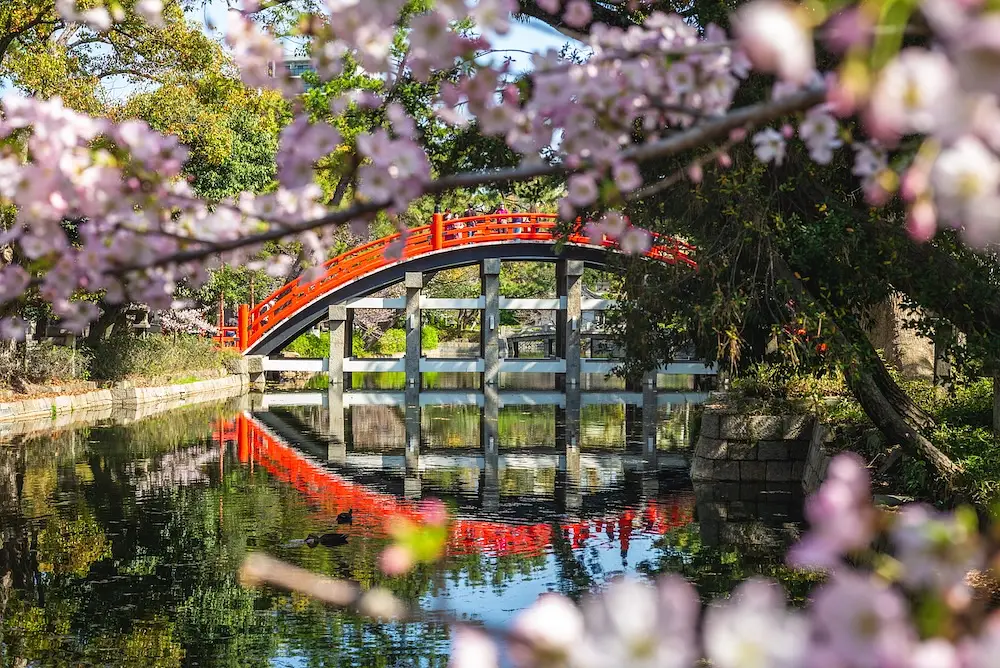
Start with the shrine itself. Cross the dramatic Taikobashi Bridge, whose steep arch traditionally symbolises purification before entering the sacred grounds. It photographs beautifully from below. Walking across it is a slightly more athletic experience than Instagram suggests.
If you have extra time, explore central Osaka afterwards or compare the atmosphere with Tenjin Matsuri, Osaka's other famous summer festival. If your trip continues beyond the city, JapanDen's Osaka hotel guides make it easy to stay nearby without racing across town after the evening crowds.
Some festivals are famous because they are massive, however Sumiyoshi Matsuri is significant because it has never forgotten why it exists. Sumiyoshi Taisha was created in 211 AD, according to shrine tradition, however historians consider this to be a tradition rather than an objectively verifiable date. Today, it serves as the head shrine of over 2,300 Sumiyoshi shrines throughout Japan, devoted to the Sumiyoshi Sanjin, the three sea deities, and Empress Jingū, who have long been associated with safe journeys, maritime trade, and Osaka's ancient port The shrine merits equal attention as the festival.
Its four main rooms are National Treasures constructed in Sumiyoshi-zukuri style, one of Japan's oldest surviving shrine designs. Unlike Kyoto's exquisite curved roofs, these buildings feature straight rooflines, modest timber construction, and surprising restraint. It embodies architectural assurance without the use of superfluous jewelry. Then there's the festival's best conversation starter.
Most people do not expect to discover the origins of stand-up comedy during a Shinto festival. However, on July 31, at Nagoshi no Harae Shinji, priests perform the Tokamai ceremony, which consists of a formal welcome accompanied by meticulously planned motions. Many experts see this ceremonial debate as one of the earliest cultural roots of manzai, Japan's well-known two-person comic tradition. This suggests that Osaka's reputation for producing comedians may have begun long before anyone picked up a microphone.

A little planning makes Sumiyoshi Matsuri considerably more enjoyable.
Book accommodation early if you're visiting Osaka during festival season, particularly if you also plan to attend Tenjin Matsuri or explore the city's other summer events.
If Osaka is one stop on a wider journey, compare whether a JR Pass or a regional rail pass suits your itinerary. Although the final approach to Sumiyoshi Taisha uses private railway lines, rail passes remain valuable for travelling between major cities.
Reliable Pocket Wi-Fi or a Japanese SIM card makes navigation, translations and live train information much easier, especially when festival crowds affect normal routes. First-time visitors arriving at Kansai International Airport may also appreciate a Meet & Greet service before diving straight into Osaka's wonderfully energetic pace.
Most importantly, arrive with curiosity rather than a strict timetable. Festivals have an amusing habit of rewarding people who leave room for the unexpected.
Q: What is Sumiyoshi Matsuri?
A: Sumiyoshi Matsuri is the annual summer festival of Sumiyoshi Taisha in Osaka. It combines purification rituals, traditional ceremonies and a lively mikoshi procession that closes the city's summer festival season.
Q: When is Sumiyoshi Matsuri?
A: The festival takes place every year from July 30 to August 1, with the largest public procession held on August 1.
Q: Where is Sumiyoshi Taisha?
A: Sumiyoshi Taisha is located at 2 Chome-9-89 Sumiyoshi, Sumiyoshi Ward, Osaka, about a three-minute walk from Sumiyoshi Taisha Station on the Nankai Main Line.
Q: Is Sumiyoshi Matsuri free to attend?
A: Yes. Entry to both the shrine grounds and the festival is free, although you'll need cash for food stalls and optional purchases.
Q: What is the Taikobashi Bridge at Sumiyoshi Taisha?
A: The steep vermilion Taikobashi is one of the shrine's best-known landmarks. Crossing it is traditionally considered a symbolic act of purification before entering the sacred grounds.
Q: What makes Sumiyoshi Taisha's architecture special?
A: The shrine is built in Sumiyoshi-zukuri, one of Japan's oldest native architectural styles, with straight rooflines and simple wooden construction that predates later Chinese influences.
Q: How is Sumiyoshi Matsuri connected to Japanese stand-up comedy?
A: The Tokamai ritual performed during Nagoshi no Harae Shinji is widely regarded as one of the cultural origins of manzai, Osaka's famous two-person comedy tradition.
Q: Is Sumiyoshi Taisha worth visiting outside the festival?
A: Absolutely. Visitors come year-round for its historic architecture, peaceful grounds, Taikobashi Bridge and seasonal events, including one of Japan's busiest New Year shrine visits.
Q: How does Sumiyoshi Matsuri relate to Tenjin Matsuri?
A: Both are among Osaka's great summer festivals. Tenjin Matsuri is internationally famous for its river procession and fireworks, while Sumiyoshi Matsuri traditionally brings the city's summer festival season to a close with purification rituals and its mikoshi procession.
Q: Can I visit Sumiyoshi Taisha using a JR Pass?
A: A JR Pass covers travel into Osaka, but the most convenient routes to Sumiyoshi Taisha use the Nankai Railway or Hankai Tramway, which require separate local tickets.
Why should I book with JapanDen?
How do I book a hotel or ryokan through JapanDen?
What types of accommodations do you offer in Japan?
How can JapanDen help with planning my trip?
As well as booking accommodation, JapanDen is a place to learn more about Japan and how you can make the most of your time in this special country. From in-depth region guides to stories from Japan, we’ll be regularly publishing carefully curated insights from Japanese culture, with recommendations for the best activities and attractions and the latest news. Looking forward, we’ll also be adding special community features so you can share ideas and inspiration with like-minded people. Please come back and visit us regularly as we continue to add new content. We want JapanDen to be your home away from home too.
Do you offer guided tours in Japan, and how can I book one?
As part of the JRPass.com group, we offer a dedicated Meet and Greet service with expert personal assistance on your arrival in Japan booked via JRPass.com, alongside nationwide and regional rail passes for travel. As JapanDen grows, we will be offering more services and activities to provide a complete Japan travel experience.
Can I purchase Japan Rail Passes through your website?
JapanDen is part of the JRPass.com group, book your passes and tickets directly on JRPass.com