Skiing in Japan: Epic Powder & Top Resorts

Powder? Onsen? Après? Done!
If "Japow" (Japan+Snow, see what they did there?) isn't already on your bucket list, it will be by the end of this guide. Skiing in Japan is a heady combination of light powder, steamy hot springs, ramen that will corrupt you for life, and resorts that range from family-friendly to full-throttle. Whether you're planning a Hokkaido powder pilgrimage, a trendy Nagano weekender, or a near-Tokyo day trip that will make your buddies envy, we've got you covered. Let's lace up, layer smartly, and chase the snow in style.
Key Categories |
Details |
Activity Type |
Skiing/Snowboarding; hot-spring detours encouraged |
Location |
Various regions across Japan: from northern wilderness to slopes near Tokyo. |
Some Addresses |
Japan’s ski resorts are spread across several prefectures.
|
Opening Hours |
Typical lift operation: 8:30 am – 4:30 pm, varying slightly by resort and weather conditions. Night skiing available at select resorts (e.g., Niseko, Rusutsu, Naeba). |
Admission/Ticket |
Lift passes required. Day pass average: ¥5,000 – ¥9,000 depending on resort. Multi-day discounts and combination passes available (e.g., Hakuba Valley Pass). |
Official Websites |
|
Nearest Stations |
Hokkaido: JR Kutchan Station (for Niseko), ~2.5h from New Chitose Airport Nagano: JR Nagano Station - express bus (~1h) to Hakuba Niigata: JR Echigo-Yuzawa Station (direct Shinkansen to GALA Yuzawa) Tohoku: JR Yamagata Station (for Zao Onsen), JR Morioka Station (for Appi Kogen) |
Languages/Signage |
English is widely available at major resorts (Niseko, Hakuba, GALA). Japanese-only signage more common in smaller local hills, translation apps help. |
Best For |
Couples (romantic alpine villages, onsen stays) Solo travelers (friendly ski culture, hostel options) Adventurers (off-piste and backcountry access with guides) Families (easy slopes, ski schools, kids’ play parks) |

Imagine this: you step off a lift, the trees surrounding you are laden with fresh snow, the air is crisp, and the powder is so light that it practically floats beneath your skis. Off the slopes, a cozy onsen awaits, hot springs releasing steam into the pink winter sky, followed by a bowl of ramen that may ruin every other post-ski meal you have back home.
What surprises many first-time visitors is that skiing in Japan is about far more than the snow itself. Resorts often sit beside traditional villages, local restaurants, and hot spring towns, making it easy to combine outdoor adventure with Japanese culture. One moment you're carving through powder, the next you're warming up over regional specialties, soaking in a mountainside bath, or wandering lantern-lit streets after dark. It's this combination of exceptional snow, hospitality, food, and scenery that makes a ski trip in Japan feel different from almost anywhere else in the world.
One of the best things about skiing in Japan is how broad the appeal is. Whether you're clipping into skis for the first time or chasing waist-deep powder, there's likely a resort and region that fits your travel style.
Many Japanese ski resorts are designed with newcomers in mind. Wide beginner runs, dedicated learning zones, ski schools, children's snow parks, and English-speaking instructors make it easy for first-timers to build confidence. Resorts such as Niseko, Hakuba, and Nozawa Onsen also offer plenty to do off the slopes, which is helpful if not everyone in the group wants to ski all day.
Japan is famous for its powder for a reason. Experienced skiers and snowboarders come for the deep snow, tree runs, off-piste terrain, and consistent winter conditions, particularly in Hokkaido and the Japanese Alps. Resorts such as Niseko, Rusutsu, Hakuba Valley, and Myoko are especially popular with riders looking for challenging terrain and fresh tracks.
You don't need to dedicate an entire holiday to skiing. Several resorts can be reached from Tokyo in just a few hours by Shinkansen and local transport, making skiing surprisingly accessible even on a short itinerary. Destinations such as Gala Yuzawa, Karuizawa, and parts of Nagano work well as day trips or overnight escapes from the capital.
Skiing in Japan isn't just about the snow. It's about soaking in an onsen after a day on the mountain, wandering through traditional hot spring towns, and enjoying regional dishes that taste even better after hours in the cold. Resorts such as Nozawa Onsen, Kinosaki Onsen, and Zao Onsen combine winter sports with experiences that feel distinctly Japanese.
Japan is also a great choice for mixed groups. Many resort areas offer snowshoeing, winter festivals, hot springs, sightseeing, shopping, local food experiences, and scenic mountain views. It's entirely possible to enjoy a memorable winter trip without spending every day on the slopes.
If you've heard people talk about "Japow," this is your crowd. Japan's exceptionally light, dry powder has earned a near-mythical reputation among skiers and snowboarders worldwide. For many winter sports enthusiasts, skiing in Japan is a bucket-list experience that lives up to the hype.
Japan can be surprisingly good value compared with major ski destinations in North America and parts of Europe, particularly once you factor in food, transport, and accommodation. Your total budget will depend heavily on where you ski, when you visit, and whether you're bringing your own equipment.
Lift passes are usually one of the biggest expenses after accommodation.
Typical daily prices:
Smaller regional resorts: around ¥4,000–¥7,000 ($25–45 / £20–35)
Major resorts such as Niseko, Hakuba, and Rusutsu: around ¥7,000–¥12,000 ($45–80 / £35–60)
Multi-day passes often reduce the daily cost and are worth considering if you're skiing for three days or more.
Many resorts also offer discounted passes for children, seniors, and early-season or late-season visitors.
If you're not bringing your own gear, rental shops are widely available at major resorts.
Typical daily prices:
Skis or snowboard only: around ¥3,000–¥6,000 ($20–40 / £15–30)
Full equipment set (skis or board, boots, poles): around ¥5,000–¥10,000 ($35–65 / £25–50)
Clothing rental packages are available at many resorts for an additional fee.
Helmets are sometimes charged separately, but they're strongly recommended regardless of ability level.
Japan is increasingly popular with international visitors, and English-speaking instructors are widely available at major resorts.
Typical prices:
Group lessons: approximately ¥5,000–¥15,000 ($35–100 / £25–75) per session
Private lessons: approximately ¥30,000–¥80,000+ ($200–530 / £150–400+) depending on duration and resort
Booking ahead is strongly recommended during peak winter periods.
Accommodation costs vary dramatically between destinations and travel dates.
Typical nightly rates per person:
Hostels and budget lodges: ¥4,000–¥10,000 ($25–65 / £20–50)
Mid-range hotels and pensions: ¥10,000–¥25,000 ($65–165 / £50–125)
Ryokan and ski-in/ski-out resorts: ¥25,000–¥60,000+ ($165–400+ / £125–300+)
Peak weekends, holidays, and powder season can push prices significantly higher.
Food is one area where Japan often feels more affordable than many overseas ski destinations.
Typical costs:
Convenience store breakfast: ¥300–¥800
Casual lunch: ¥1,000–¥2,000
Restaurant dinner: ¥1,500–¥5,000+
Onsen day pass: typically ¥500–¥2,000 if not included with accommodation
One of the pleasant surprises for many visitors is that excellent ramen, curry, donburi, and local specialties are often available at prices that would be difficult to find in major ski destinations elsewhere.
As a rough guide, expect:
Budget skier: ¥12,000–¥20,000 ($80–130 / £60–100) per day
Mid-range skier: ¥20,000–¥40,000 ($130–265 / £100–200) per day
Premium ski holiday: ¥40,000+ ($265+ / £200+) per day
The good news? Japan's famous powder snow is often more affordable than comparable ski experiences in North America, Switzerland, or France.
Snow quality: Some of the lightest and most consistent powder snow in the world
Terrain: Wide groomed runs, tree skiing, backcountry access, and reliable snowfall throughout the season
Crowd profile: Strong international presence, especially in Niseko; Rusutsu and Kiroro tend to feel slightly less crowded
Best for: Powder seekers, multi-day ski trips, and travelers prioritizing snow quality
Snow quality: Excellent powder, generally a little denser and less consistent than Hokkaido
Terrain: Extremely varied, from beginner slopes to steep alpine terrain; Hakuba hosted events during the 1998 Winter Olympics
Crowd profile: Mix of Japanese and international visitors
Best for: Travelers who want both skiing and traditional Japanese culture, especially onsen towns and easy access from Tokyo
Snow quality: Excellent snowfall, cold temperatures, and fewer tracked-out runs
Terrain: Scenic, less crowded, and generally more relaxed than Japan's most famous ski regions
Crowd profile: Predominantly domestic, though international awareness is growing
Best for: Travelers seeking quieter resorts, fewer crowds, and unique winter experiences such as Zao's famous "snow monsters" (juhyo)
The good news is that you don't need to arrive in Japan with a suitcase full of ski equipment. Most major resorts offer high-quality rental gear, including skis, snowboards, boots, helmets, and even clothing. However, packing the right layers and accessories can make a huge difference to your comfort, especially if you're visiting Hokkaido or spending long days on the mountain.
As a general rule, focus on staying warm and dry rather than packing bulky clothing. Japan's ski regions can receive significant snowfall, and conditions can change quickly throughout the day.
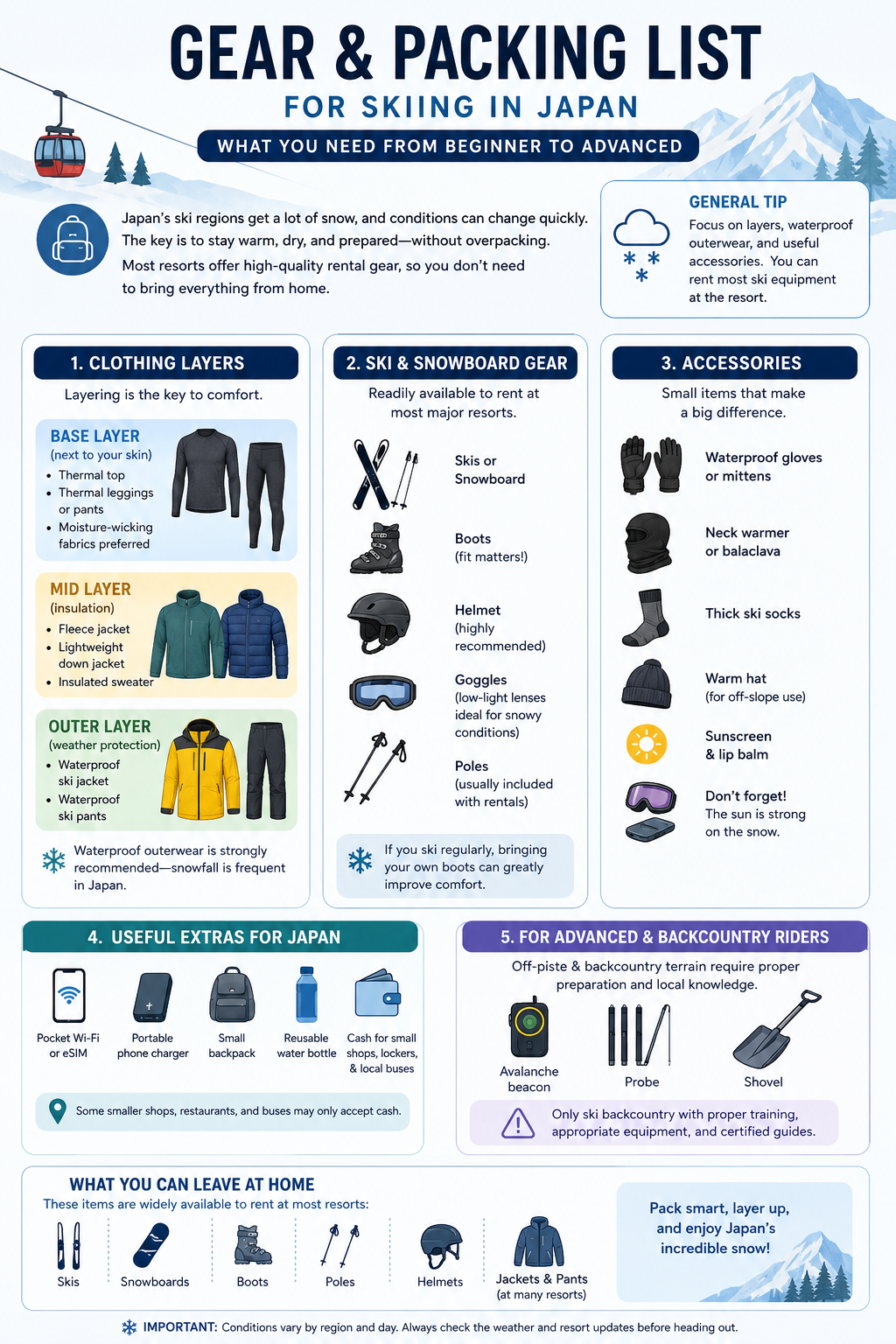
A proper layering system is more important than expensive ski gear.
Base Layer (next to your skin)
Thermal top
Thermal leggings or pants
Moisture-wicking fabrics preferred
Avoid cotton, which traps moisture and becomes cold when wet.
Mid Layer (insulation)
Fleece jacket
Lightweight down jacket
Insulated sweater
This layer provides warmth and can be adjusted as temperatures change.
Outer Layer (weather protection)
Waterproof ski jacket
Waterproof ski pants
Snowfall is often frequent in Japan, so waterproof outerwear is strongly recommended.
Most visitors rent these items at the resort.
Commonly available rentals
Skis or snowboard
Boots
Poles
Helmet
If you ski regularly, bringing your own boots can improve comfort since fit matters more than almost any other piece of equipment.
These small items are often forgotten but can dramatically improve your day on the slopes.
Don't forget:
Waterproof gloves or mittens
Goggles (low-light lenses work especially well during snowy conditions)
Neck warmer or buff
Warm hat for off-slope use
Thick ski socks
Lip balm
Sunscreen
Many first-time visitors underestimate how strong the sun can be when reflected off snow.
A few non-ski items are worth carrying during your trip.
Portable phone charger
Pocket Wi-Fi or eSIM
Small backpack
Reusable water bottle
Cash for smaller restaurants, lockers, and local buses
Japan has a world-famous powder scene, but off-piste and backcountry terrain should never be treated casually.
If you're planning to ski beyond resort boundaries, carry:
Avalanche beacon
Probe
Shovel
Most importantly, only enter backcountry terrain with proper training, appropriate equipment, and local knowledge. Hiring a certified guide is strongly recommended, especially after heavy snowfall.
Many travelers overpack for a ski trip to Japan.
You can usually rent:
Skis
Snowboards
Boots
Poles
Helmets
Jackets and pants at many larger resorts
Unless you're a dedicated skier or snowboarder, renting equipment is often easier than transporting it across Japan.
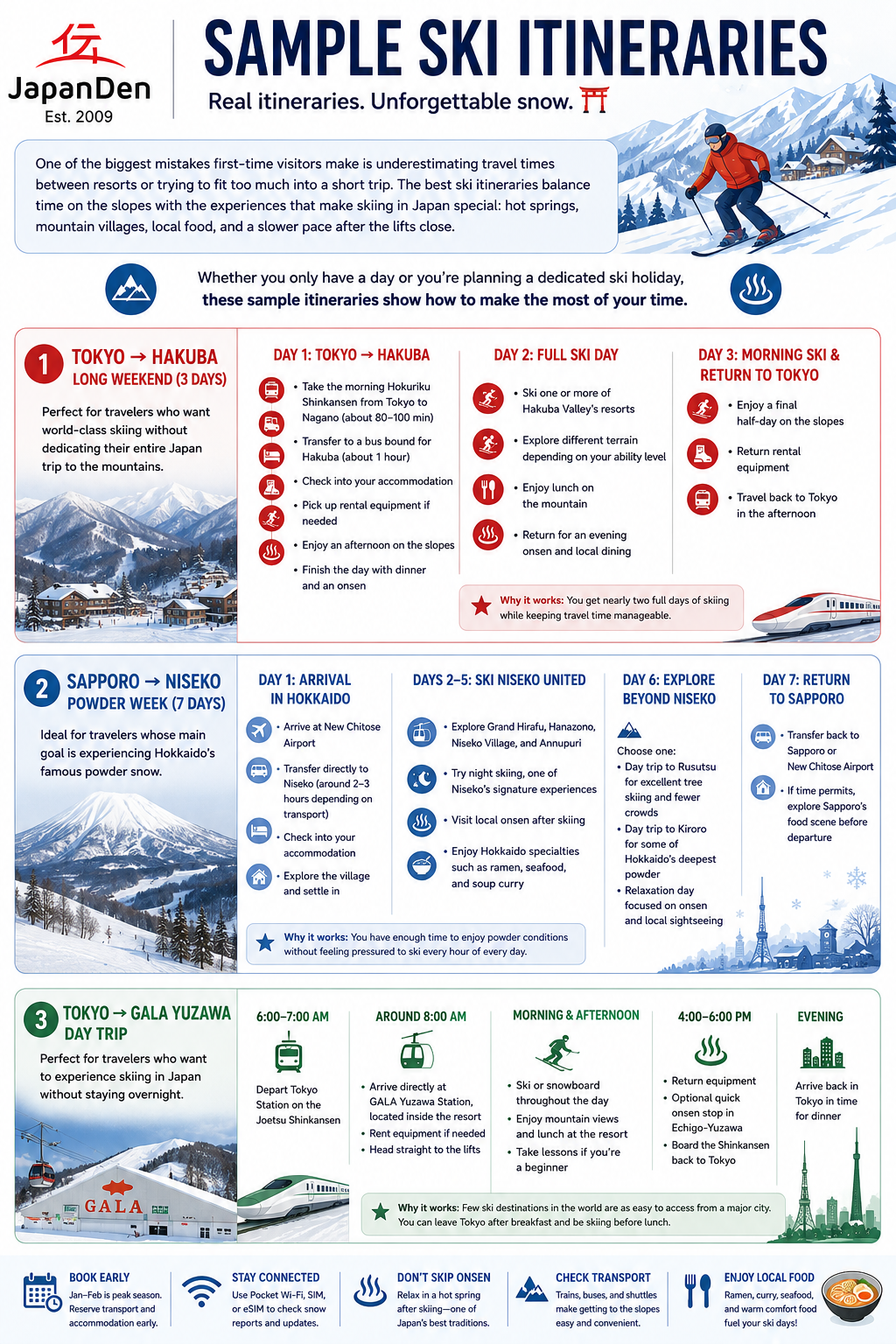
One of the biggest mistakes first-time visitors make is underestimating travel times between resorts or trying to fit too much into a short trip. The best ski itineraries balance time on the slopes with the experiences that make skiing in Japan special: hot springs, mountain villages, local food, and a slower pace after the lifts close.
Whether you only have a day or you're planning a dedicated ski holiday, these sample itineraries show how to make the most of your time.
Perfect for travelers who want world-class skiing without dedicating their entire Japan trip to the mountains.
Day 1: Tokyo → Hakuba
Take the morning Hokuriku Shinkansen from Tokyo to Nagano (about 80–100 minutes)
Transfer to a bus bound for Hakuba (about 1 hour)
Check into your accommodation
Pick up rental equipment if needed
Enjoy an afternoon on the slopes
Finish the day with dinner and an onsen
Day 2: Full Ski Day
Ski one or more of Hakuba Valley's resorts
Explore different terrain depending on your ability level
Enjoy lunch on the mountain
Return for an evening onsen and local dining
Day 3: Morning Ski & Return to Tokyo
Enjoy a final half-day on the slopes
Return rental equipment
Travel back to Tokyo in the afternoon
Why it works: You get nearly two full days of skiing while keeping travel time manageable.
Ideal for travelers whose main goal is experiencing Hokkaido's famous powder snow.
Day 1: Arrival in Hokkaido
Arrive at New Chitose Airport
Transfer directly to Niseko (around 2–3 hours depending on transport)
Check into your accommodation
Explore the village and settle in
Days 2–5: Ski Niseko United
Explore Grand Hirafu, Hanazono, Niseko Village, and Annupuri
Try night skiing, one of Niseko's signature experiences
Visit local onsen after skiing
Enjoy Hokkaido specialties such as ramen, seafood, and soup curry
Day 6: Explore Beyond Niseko
Choose one:
Day trip to Rusutsu for excellent tree skiing and fewer crowds
Day trip to Kiroro for some of Hokkaido's deepest powder
Relaxation day focused on onsen and local sightseeing
Day 7: Return to Sapporo
Transfer back to Sapporo or New Chitose Airport
If time permits, explore Sapporo's food scene before departure
Why it works: You have enough time to enjoy powder conditions without feeling pressured to ski every hour of every day.
Perfect for travelers who want to experience skiing in Japan without staying overnight.
6:00–7:00 AM
Depart Tokyo Station on the Joetsu Shinkansen
Around 8:00 AM
Arrive directly at GALA Yuzawa Station, located inside the resort
Rent equipment if needed
Head straight to the lifts
Morning & Afternoon
Ski or snowboard throughout the day
Enjoy mountain views and lunch at the resort
Take lessons if you're a beginner
4:00–6:00 PM
Return equipment
Optional quick onsen stop in Echigo-Yuzawa
Board the Shinkansen back to Tokyo
Evening
Arrive back in Tokyo in time for dinner
Why it works: Few ski destinations in the world are as easy to access from a major city. You can leave Tokyo after breakfast and be skiing before lunch.
The ski season in Japan normally begins in late November or early December, particularly in northern areas such as Hokkaido, and lasts until April, with some resorts continuing into May. Where is the sweet spot for powder? From January to February, expect frigid temperatures, heavy snowfall, and deep covering.
If you prefer fewer crowds and slightly milder temperatures (but still a terrific time), visit between March and early April.
One of the biggest surprises for first-time visitors is how easy it is to access Japan's ski resorts. Whether you're planning a quick ski day from Tokyo, a long weekend in the Japanese Alps, or a dedicated powder trip to Hokkaido, Japan's combination of airports, Shinkansen lines, buses, and resort shuttles makes getting to the mountains remarkably straightforward.
The best airport depends on which ski region you plan to visit.
For Nagano, Niigata, and Tohoku resorts
Fly into:
Tokyo Haneda Airport (HND)
Tokyo Narita Airport (NRT)
From Tokyo, you can continue by Shinkansen to many of Japan's most popular ski destinations.
For Hokkaido resorts
Fly into:
New Chitose Airport (CTS)
Located near Sapporo, New Chitose is the main gateway to Niseko, Rusutsu, Kiroro, Furano, and other Hokkaido ski areas.
If you're combining Tokyo sightseeing with skiing in Hokkaido, flying is usually the fastest option.
Typical route:
Haneda Airport → New Chitose Airport
Flight time: approximately 1 hour 30 minutes
This is often significantly quicker than traveling between Tokyo and Sapporo entirely by rail.
Japan's bullet trains are one of the easiest ways to reach ski resorts near Tokyo.
Hokuriku Shinkansen
Tokyo Station → Nagano Station
Approximately 80–100 minutes
Followed by a bus transfer to Hakuba (about 1 hour)
Joetsu Shinkansen
Tokyo Station → GALA Yuzawa Station
Approximately 75–90 minutes
One of the most convenient ski trips in Japan, as the station is directly connected to the resort.
Hokuriku Shinkansen to Iiyama Station
Approximately 1 hour 40 minutes
Followed by a bus transfer of around 25 minutes
Yamagata Shinkansen to Yamagata Station
Approximately 2 hours 30 minutes
Followed by a local bus to Zao Onsen
Tohoku Shinkansen to Morioka Station
Approximately 2 hours 15 minutes
Followed by a local train or resort shuttle
If you prefer rail travel, Hokkaido is accessible from Tokyo entirely by train.
Route:
Hayabusa Shinkansen from Tokyo Station to Shin-Hakodate-Hokuto Station
Approximately 4 hours
Transfer to a Limited Express train bound for Sapporo
Approximately 3.5 additional hours
The total journey takes around 7.5–8 hours, making it best suited to travelers who enjoy rail travel or are already using a nationwide JR Pass.
Many ski resorts operate direct bus services during winter.
Popular routes include:
New Chitose Airport → Niseko
New Chitose Airport → Rusutsu
New Chitose Airport → Kiroro
Nagano Station → Hakuba Valley
Iiyama Station → Nozawa Onsen
These services are designed specifically for skiers and snowboarders, making them a convenient option when traveling with luggage or equipment.
January and February are the busiest months in most ski regions. Airport transfers, resort shuttles, and long-distance buses can fill up quickly, especially after major snowfall events. Reserving transportation in advance is strongly recommended during peak season.
Wherever you ski in Japan, the fun doesn’t stop when the lifts close. Here are a few must-try spots near top resorts:
Onsen: Yugokorotei in Niseko, outdoor baths with mountain views.
Food & Drinks: The Barn by Odin for après-ski cocktails; Ezo Seafoods for legendary Hokkaido crab.
Shops: Kutchan town has charming boutiques and gear stores.
Onsen: Mimizuku-no-Yu, soak under the shadow of Mount Happo.
Dining: Sounds Like Café for brunch, Hie Izakaya for sake and small plates.
Attraction: Day trip to Jigokudani Snow Monkey Park.
Onsen: Yuzawa Kogen Outdoor Spa, ski, soak, repeat.
Food: Ponshu-kan, a sake tasting wall inside Echigo-Yuzawa Station.
Onsen: Zao Onsen Village, atmospheric, sulfur-scented springs.
Sight: Night walk among the “Snow Monsters”, eerie, otherworldly, and unforgettable.
Japan's modern ski industry grew rapidly during the second half of the twentieth century, gaining international attention after the 1972 Winter Olympics in Sapporo and again after the 1998 Winter Olympics in Nagano. Today, the country is home to hundreds of ski areas, ranging from small community hills to internationally known destinations such as Niseko, Hakuba Valley, Rusutsu, Nozawa Onsen, and Appi Kogen.
What truly sets Japan apart is its snow. The famous "Japow" powder is created when cold air masses move from Siberia across the Sea of Japan, collecting moisture before reaching Japan's mountains. The result is frequent snowfall and exceptionally light, dry powder, particularly in Hokkaido and parts of northern Honshu. While every season is different, many ski regions receive far more snowfall than major resorts in North America or Europe.
Yet skiing in Japan is about much more than the snow itself. A typical ski day might start with fresh tracks in the morning, continue with a bowl of ramen or curry rice for lunch, and end in a natural hot spring overlooking snowy mountains. Many resorts are connected to traditional onsen towns, historic villages, and regional food cultures, creating a travel experience that extends well beyond the slopes.
This combination of world-class snow, efficient transport, excellent food, and Japanese hospitality is why so many visitors return year after year. Whether you're chasing powder in Niseko, exploring the Olympic terrain of Hakuba, or soaking in an outdoor bath in Nozawa Onsen after a day of skiing, Japan offers a style of ski trip that is difficult to find anywhere else.
A little preparation goes a long way when planning a ski trip to Japan.
Book early for January and February. These are the busiest months at most resorts, particularly during holiday periods and after major snowfall events. Accommodation in Niseko, Hakuba, and popular onsen towns can sell out months in advance.
Consider March for better value. Snow conditions often remain excellent in many regions, especially Hokkaido and higher-altitude resorts, while crowds are smaller and accommodation prices may be lower.
Stay connected. A Pocket Wi-Fi device or eSIM makes it much easier to check weather forecasts, lift status, transport updates, and trail maps throughout the day.
Pack for changing conditions. Japanese ski regions can experience sunshine, snowfall, wind, and low visibility on the same day. A good layering system and quality goggles are often more important than heavy clothing.
Understand local safety rules. Many resorts have designated off-piste zones and specific policies regarding side-country or backcountry access. Always follow local guidance and signage.
Plan transport before arrival. Some resorts are directly connected to train stations, while others require shuttle buses, local buses, or transfers from nearby cities. Confirm your route in advance, especially if you're arriving late in the day.
Don't skip the onsen. For many visitors, soaking in a hot spring after skiing becomes just as memorable as the skiing itself. If you're staying in an onsen town, leave time in your itinerary to enjoy it properly.
A little planning can make the difference between a good ski trip and a great one. Unlike many ski destinations, Japan combines trains, airports, resort shuttles, onsen towns, and regional passes into a travel experience that's surprisingly easy to navigate, provided you organize the essentials before you arrive.
Think about four things early: where you'll stay, how you'll get there, how you'll stay connected, and whether you'll need rental equipment or lessons. Once those pieces are in place, you can focus on what really matters: enjoying the snow.
Choose a place based on your priorities: ski-in/ski-out luxury? Boutique lodge? Family condo? Check JapanDen options.

JR Pass: Awesome if you’re hopping regions (e.g., Tokyo, Nagano, Hokkaido).
Regional Passes: Ideal if sticking to one area (e.g., Nagano-Niigata region).
Airport/resort transfers: book bus or train ahead (especially peak season).
Local shuttles/buses: many resorts include free or low-cost transfers between base area + lifts.
Grab a Pocket Wi-Fi / SIM / eSIM so you can check snow reports, weather, maps, and translation.
Rentals: common at big resorts; book ahead for gear + boots + helmets.
Lessons: English-speaking instructors available at major resorts; strongly recommended for beginners.
Bring or rent good quality outerwear, being cold ruins a great snow day.
If it’s your first time landing in Japan, or you just like things smooth, a Meet & Greet service at the airport is worth every yen.
A: For deep powder and a strong international resort scene, choose Hokkaido, especially Niseko, Rusutsu, or Kiroro. For variety, easy access from Tokyo, and dramatic alpine terrain, Hakuba Valley in Nagano is one of the best choices. For quieter slopes, fewer crowds, and a more local feel, look at Tohoku resorts such as Zao Onsen and Appi Kogen.
A: Most Japanese ski resorts operate from December to March, with some opening in late November and staying open into April or early May depending on snowfall. January and February usually offer the most reliable powder conditions, especially in Hokkaido and the Japanese Alps.
A: Skiing in Japan is often better value than major resorts in North America or Europe. Lift passes typically range from around ¥4,000–¥12,000 per day depending on the resort, while accommodation, rentals, and lessons vary widely by destination and season. January and February are usually the most expensive months.
A: Choose Niseko if your priority is consistent powder, a polished international resort atmosphere, and Hokkaido’s famous snow. Choose Hakuba if you want more varied terrain, easier access from Tokyo, and a stronger mix of skiing, mountain scenery, and Japanese village atmosphere. Both are excellent, but they suit different trips.
A: Yes, if you want reliable powder, excellent infrastructure, English-friendly services, nightlife, restaurants, and a resort that is easy for international visitors. However, it is also one of Japan’s busiest and most expensive ski areas, so travelers looking for a quieter or more local experience may prefer Rusutsu, Kiroro, Furano, Myoko, or Tohoku.
A: Yes. Many major resorts have beginner slopes, ski schools, equipment rentals, children’s areas, and English-speaking instructors. Niseko, Hakuba, Rusutsu, Nozawa Onsen, and Karuizawa are all popular choices for first-time skiers and families.
A: Not always. Many ski resorts can be reached by Shinkansen, train, bus, or resort shuttle. GALA Yuzawa is directly connected to a Shinkansen station, while Hakuba, Nozawa Onsen, Niseko, and many Hokkaido resorts have train-plus-bus or airport transfer options. A car is useful for remote resorts or multi-resort trips, but it is not essential for most first-time visitors.
A: Yes. Major ski resorts are used to international visitors and often have English signage, rental shops, ski schools, and accommodation support. Smaller resorts may have limited English, so a translation app and reliable internet connection are helpful.
A: March can still be a good time to ski, especially in Hokkaido and higher-elevation resorts. Snow quality is usually less consistent than in January or February, but March often brings fewer crowds, lower prices, milder weather, and longer daylight hours.
A: “Japow” is the nickname for Japan’s famous powder snow. It refers to the light, dry snow that falls in many Japanese ski regions, especially Hokkaido, when cold air from Siberia moves across the Sea of Japan and brings heavy snowfall to the mountains.
Why should I book with JapanDen?
How do I book a hotel or ryokan through JapanDen?
What types of accommodations do you offer in Japan?
How can JapanDen help with planning my trip?
As well as booking accommodation, JapanDen is a place to learn more about Japan and how you can make the most of your time in this special country. From in-depth region guides to stories from Japan, we’ll be regularly publishing carefully curated insights from Japanese culture, with recommendations for the best activities and attractions and the latest news. Looking forward, we’ll also be adding special community features so you can share ideas and inspiration with like-minded people. Please come back and visit us regularly as we continue to add new content. We want JapanDen to be your home away from home too.
Do you offer guided tours in Japan, and how can I book one?
As part of the JRPass.com group, we offer a dedicated Meet and Greet service with expert personal assistance on your arrival in Japan booked via JRPass.com, alongside nationwide and regional rail passes for travel. As JapanDen grows, we will be offering more services and activities to provide a complete Japan travel experience.
Can I purchase Japan Rail Passes through your website?
JapanDen is part of the JRPass.com group, book your passes and tickets directly on JRPass.com
.jpg)