Airports in Japan: The No-Stress Guide to Landing Like a Pro

Land confident, travel smoother.
You're not being "extra" when you Google airports in Japan: you're being smart. Choosing the appropriate airport can result in you arriving at your hotel looking radiant or showing up at a vending machine sweating, perplexed, and doubting your life decisions.
This guide is intended for first-time visitors, families, lone travelers, and budget planners who want the essentials: main airports in Japan, international airports in Japan, the reality of Tokyo's two airports, and how to choose the best arrival for your itinerary, all without the need for a spreadsheet and a prayer.
Topic type: |
Transport + planning |
|---|---|
Best moment to read this: |
Before you book flights (and again before you book your first hotel) |
Ideal for: |
First-time visitors, multi-city travelers, families, nervous planners |
|
|
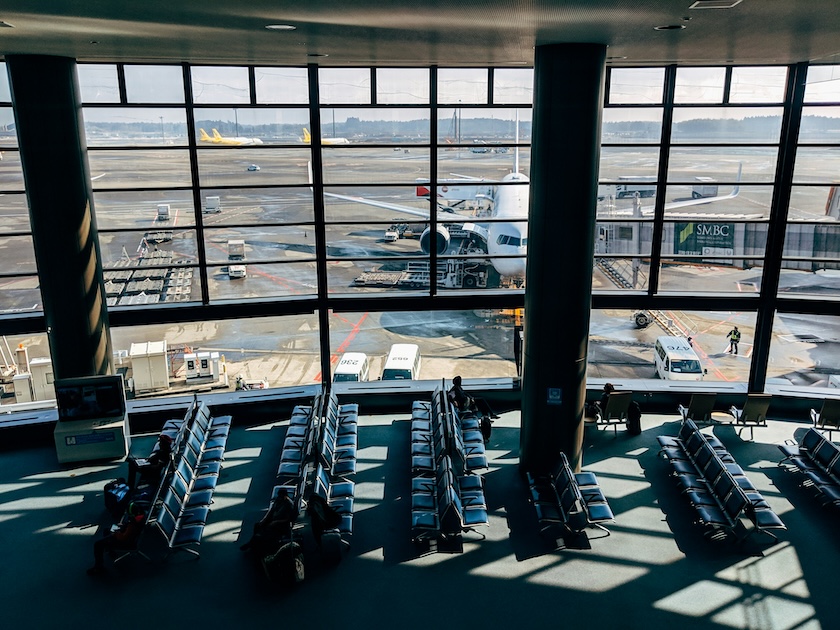
Japan has lots of airports, a total of 98 airports in standard references, but totals can change over time; some are global gateways, many are domestic/regional workhorses.
International gateways vs domestic/regional airports:
International airports in Japan: handle significant overseas routes (your likely entry points).
Domestic/regional airports: mostly internal flights, useful for connecting to islands, remote regions, or quick hops.
These are the major airports in Japan that show up again and again in top guides, and for good reason.
Airport |
IATA code |
Serves |
Best for |
Tokyo Haneda |
HND |
Tokyo |
Fastest city access (closest to central Tokyo) |
Tokyo Narita |
NRT |
Tokyo |
Many international routes + Tokyo region |
Kansai International |
KIX |
Osaka/Kyoto region |
Western Japan gateway (Osaka/Kyoto) |
Chubu Centrair |
NGO |
Nagoya/Chubu |
Great for Nagoya + central Japan |
New Chitose |
CTS |
Sapporo/Hokkaido |
Hokkaido base airport |
Fukuoka |
FUK |
Fukuoka/Kyushu |
Kyushu (super close to the city) |
Naha |
OKA |
Okinawa |
Okinawa gateway |
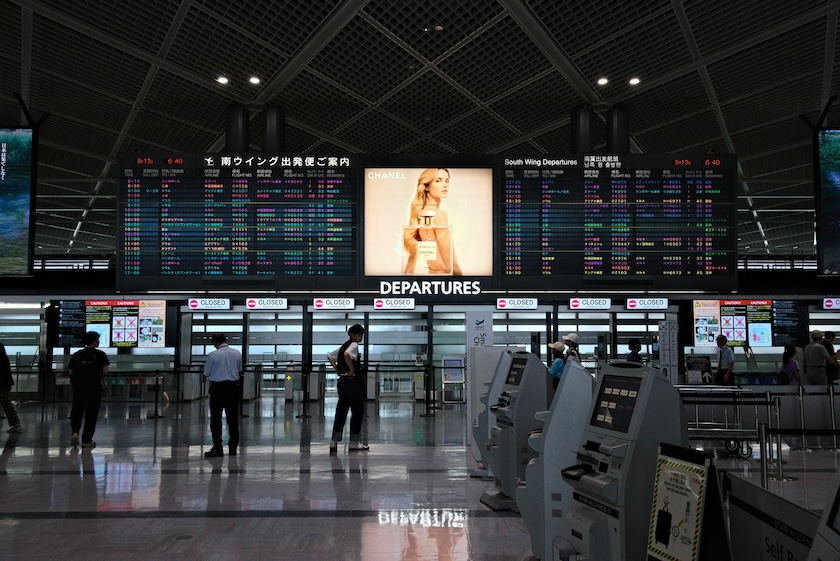
What airport you choose in Japan can shape your entire trip more than many first-time visitors expect. The difference between arriving at the “right” airport versus the “wrong” one can mean saving hours of transfers, avoiding unnecessary backtracking, and starting your trip feeling calm instead of overwhelmed.
For some travelers, the best choice is flying directly into Tokyo. For others, landing in Osaka, Sapporo, Fukuoka, or Okinawa makes far more sense. The key is matching your airport to your actual itinerary, accommodation, arrival time, and transport plans.
Here are some common travel scenarios and how airport choice can either simplify your trip or quietly make it much harder.
What happens: You land at either Haneda or Narita.
What can go wrong: You assume all Tokyo airports are “close enough.”
What works: Knowing Haneda is much closer to central Tokyo saves time immediately.
What happens: You land in western Japan or transfer from Tokyo.
What can go wrong: Flying into Tokyo when Kansai (KIX) would have been simpler.
What works: Landing directly at Kansai International Airport.
What happens: You combine flights and trains.
What can go wrong: Poor airport choice creates awkward backtracking.
What works: Matching your arrival airport to your first real destination.
What happens: You arrive tired and jet-lagged.
What can go wrong: Long transfers to the city.
What works: Choosing airports with fast city access and nearby accommodation.
By Place (Cities, Countryside, Popular Areas)
Tokyo
Tokyo has two main airports: Haneda (HND) and Narita (NRT). Choice matters here more than anywhere else.
Osaka / Kyoto
Kansai International Airport (KIX) is the primary international gateway. Itami (ITM) is domestic only.
Regional Japan
Places like Hokkaido, Kyushu, and Okinawa have their own major airports, making domestic flights practical.
By Season or Trip Style
Short city trips: Airport proximity matters more
Multi-city trips: First landing point defines flow
Peak seasons: Simpler transfers reduce stress
Especially helpful for:
First-time visitors to Japan
Families traveling with children
Multi-city itineraries
Travelers arriving late at night
Budget travelers optimizing transport costs
Not critical but still useful if:
You’ve visited Japan before
You’re staying in one city only
You enjoy optimizing logistics (yes, some people do)
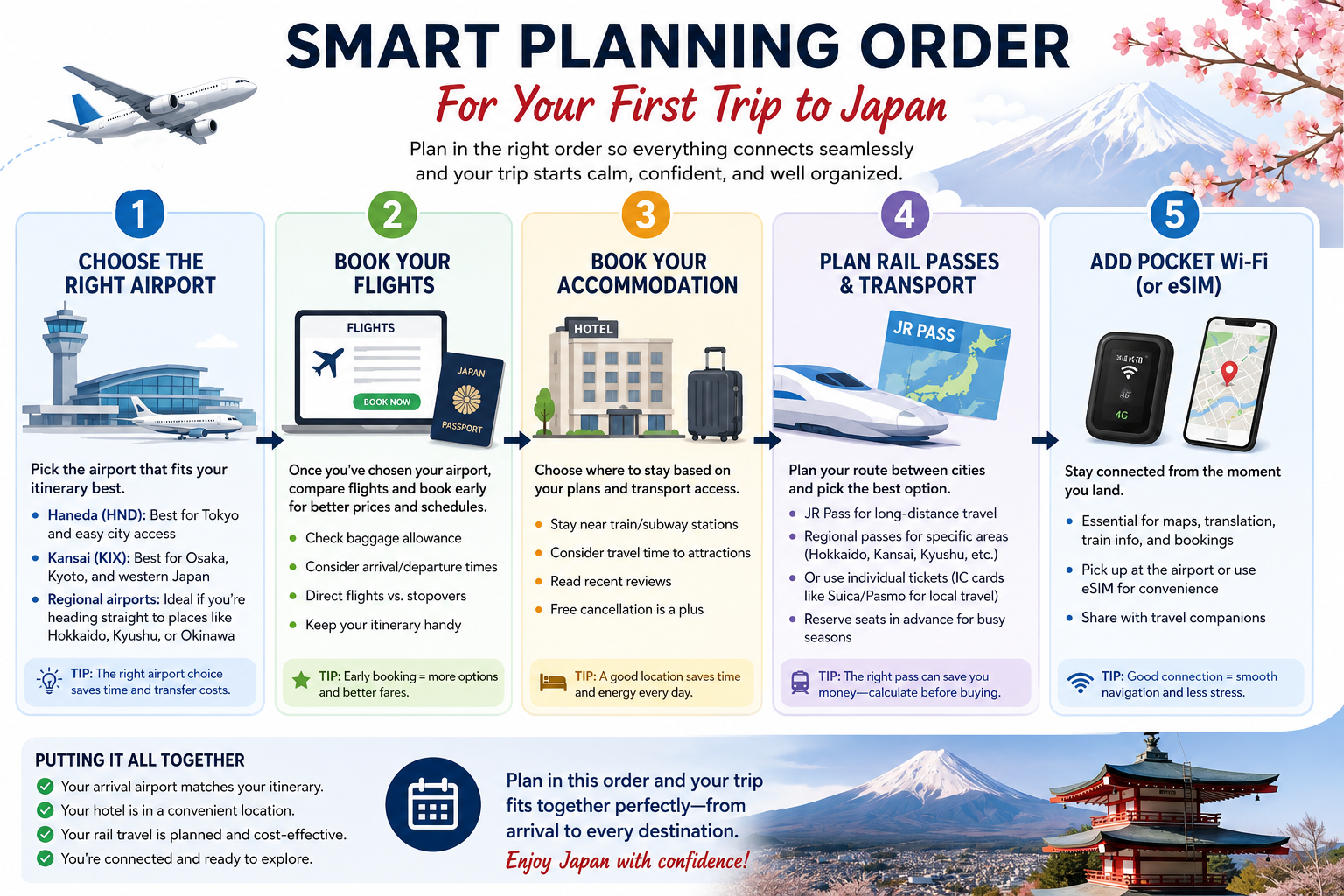
Start by choosing the right airport for your itinerary, then book your flights. Haneda is usually easiest for Tokyo, Kansai works well for Osaka and Kyoto, and regional airports can save time if you’re heading straight to places like Hokkaido, Kyushu, or Okinawa.
Once your flights are confirmed, book accommodation based on where you’ll spend most of your time and how easy it is to reach train stations. After that, plan your route between cities and decide whether a JR Pass, regional rail pass, or individual train tickets offer the best value.
Finally, arrange essentials such as Pocket Wi-Fi or an eSIM, airport transfers, luggage forwarding, and any major attractions that need advance booking.
This way, your trip fits together properly from the start, from arrival airport to hotel location, rail journeys, connectivity, and daily navigation.
A little planning before you fly can make your arrival in Japan much smoother, especially if it’s your first time navigating Japanese airports, trains, and city transfers. Use this checklist to connect the basics before you travel.
Choose your first city based on your itinerary, not just the cheapest flight.
Check which airport makes the most sense for your plans. Haneda is usually easiest for Tokyo, Kansai works well for Osaka and Kyoto, and regional airports can save time for places like Hokkaido, Kyushu, and Okinawa.
Check how far the airport is from your accommodation before booking.
Compare total transfer time, not just flight price. A cheaper flight may cost more time and money if the airport is far from your first stop.
Book accommodation near a convenient train or subway station.
Decide whether you need a JR Pass, Regional Pass, or individual train tickets.
Reserve airport transfers or check your airport-to-city route in advance.
Download useful apps such as Google Maps, Google Translate, and a transport app.
Save your hotel name and full address in English and Japanese.
Keep your passport somewhere easy to access for check-in, rail pass exchange, and hotel registration.
Pocket Wi-Fi or an eSIM for maps, translations, and train updates.
Some Japanese yen for transport, lockers, taxis, and smaller shops.
A printed or offline copy of your hotel address.
Your airport code, such as HND, NRT, KIX, NGO, CTS, FUK, or OKA.
Offline directions from the airport to your first hotel.
Any rail pass exchange order, QR code, booking confirmation, or ticket reference.
A small day bag for passport, phone, charger, wallet, and travel documents.
Know which airport you are landing at.
Know how you are getting from the airport to your hotel.
Have your hotel address ready to show station staff or taxi drivers.
Keep cash and a transport card ready for your first journey.
Make sure your phone is charged before landing.
Match airport to itinerary
Consider total travel time, not just flight duration
Book first-night accommodation near transport hubs
Plan rail travel in advance
Assume all Tokyo airports are equal
Ignore transfer time after landing
Book flights before understanding your route
Ask airport staff (they’re helpful)
Use information desks
Adjust plans calmly, Japan makes recovery easy
Q: How many airports are there in Japan?
A: Japan is commonly listed as having around 98 airports, although the exact number can vary depending on classification and military/shared facilities. Most international travelers only need to focus on the country’s major hubs.
Q: What are the main international airports in Japan?
A: The main international airports are Haneda (HND), Narita (NRT), and Kansai International (KIX), alongside major regional hubs such as Chubu Centrair (NGO), New Chitose (CTS), Fukuoka (FUK), and Naha (OKA).
Q: Where is Haneda Airport in Japan?
A: Haneda Airport (HND) is located in Ōta City, Tokyo, south of central Tokyo and much closer to the city center than Narita Airport.
Q: What are the main airports in Japan?
A: The airports most travelers use are Tokyo Haneda (HND), Tokyo Narita (NRT), and Kansai International (KIX) for Osaka and Kyoto, plus major regional hubs like Chubu Centrair (NGO), New Chitose (CTS), Fukuoka (FUK), and Naha (OKA).
Q: Which airport is better to fly into in Japan?
A: It depends on your itinerary. Haneda (HND) is best for quick access to Tokyo, Kansai International (KIX) is ideal for Kyoto and Osaka, and regional airports are more convenient if you are heading directly to Hokkaido, Okinawa, or other parts of Japan.
Q: What is the cheapest airport to fly into Japan?
A: There is no single cheapest airport, but Narita (NRT) often has more budget airline and long-haul deals due to its higher international flight volume. Prices vary depending on season, airline, and departure city.
Q: Is Haneda or Narita better for Tokyo?
A: Haneda (HND) is generally considered more convenient because it is much closer to central Tokyo. Narita (NRT) is farther away in Chiba Prefecture and usually requires a longer train or bus transfer.
Q: How early should I arrive at Japanese airports?
A: For international flights, arriving around 3 hours before departure is recommended. Japanese airports are efficient, but security, immigration, and baggage lines can still become busy during peak travel seasons.
Q: Are Japanese airports easy to navigate for foreigners?
A: Yes. Major airports in Japan are known for being clean, organized, and foreigner-friendly, with English signage, multilingual announcements, and clear transport guidance.
Q: Can I sleep overnight at airports in Japan?
A: Yes, some travelers stay overnight in airports such as Haneda or Kansai International before early flights. However, not all airport areas remain fully open overnight, so checking facilities and lounge hours in advance is important.
Why should I book with JapanDen?
How do I book a hotel or ryokan through JapanDen?
What types of accommodations do you offer in Japan?
How can JapanDen help with planning my trip?
As well as booking accommodation, JapanDen is a place to learn more about Japan and how you can make the most of your time in this special country. From in-depth region guides to stories from Japan, we’ll be regularly publishing carefully curated insights from Japanese culture, with recommendations for the best activities and attractions and the latest news. Looking forward, we’ll also be adding special community features so you can share ideas and inspiration with like-minded people. Please come back and visit us regularly as we continue to add new content. We want JapanDen to be your home away from home too.
Do you offer guided tours in Japan, and how can I book one?
As part of the JRPass.com group, we offer a dedicated Meet and Greet service with expert personal assistance on your arrival in Japan booked via JRPass.com, alongside nationwide and regional rail passes for travel. As JapanDen grows, we will be offering more services and activities to provide a complete Japan travel experience.
Can I purchase Japan Rail Passes through your website?
JapanDen is part of the JRPass.com group, book your passes and tickets directly on JRPass.com
.jpg)